Stock Analysis · TheRealReal Inc (REAL)
Overview
TheRealReal, Inc. operates an online marketplace focused on resale (“re-commerce”) of authenticated luxury goods such as fashion, jewelry, watches, and home items. In simple terms, it helps people sell luxury items they already own (consignors) and connects them with buyers looking for pre-owned luxury at different price points. The company’s model is built around handling key steps that are difficult for individuals to do well at scale: authentication, item intake, pricing, photography, listing, fulfillment, and customer service.
Based on the company’s disclosures, revenue is primarily generated from commissions and related fees on the sale of consigned items, along with other revenue streams tied to its marketplace services (for example, shipping- or service-related revenue). The exact mix can shift over time depending on volume, take rates, and service offerings; a practical way to think about it is:
- Commission/fees on items sold (consignment marketplace) — typically the largest contributor
- Other service-related revenue — smaller, and tied to marketplace operations
The company’s economics depend on growing the number and value of items sold, maintaining trust in authentication, and improving operational efficiency so that costs rise more slowly than sales.
Across the years shown, revenue rises overall (from about $468M in 2021 to about $693M in 2025), while losses narrow materially (net loss improves from roughly -$236M in 2021 to about -$42M in 2025). The remaining gap to profitability appears driven mainly by operating costs that still exceed gross profit, even as the direction has improved.
Key Figures
| Metric | Value | Industry ⓘ |
|---|---|---|
| Date | Mar 09, 2026 | |
| Context | ||
| Sector | Consumer Cyclical | |
| Industry | Luxury Goods | |
| Market Cap ⓘ | $1.35B | |
| Beta ⓘ | 2.75 | |
| Fundamental | ||
| P/E Ratio ⓘ | N/A | |
| Profit Margin ⓘ | -6.03% | -4.19% |
| Revenue Growth ⓘ | 18.30% | 3.80% |
| Debt to Equity ⓘ | -111.49% | 116.85% |
| PEG ⓘ | N/A | |
| Free Cash Flow ⓘ | $838.00K | |
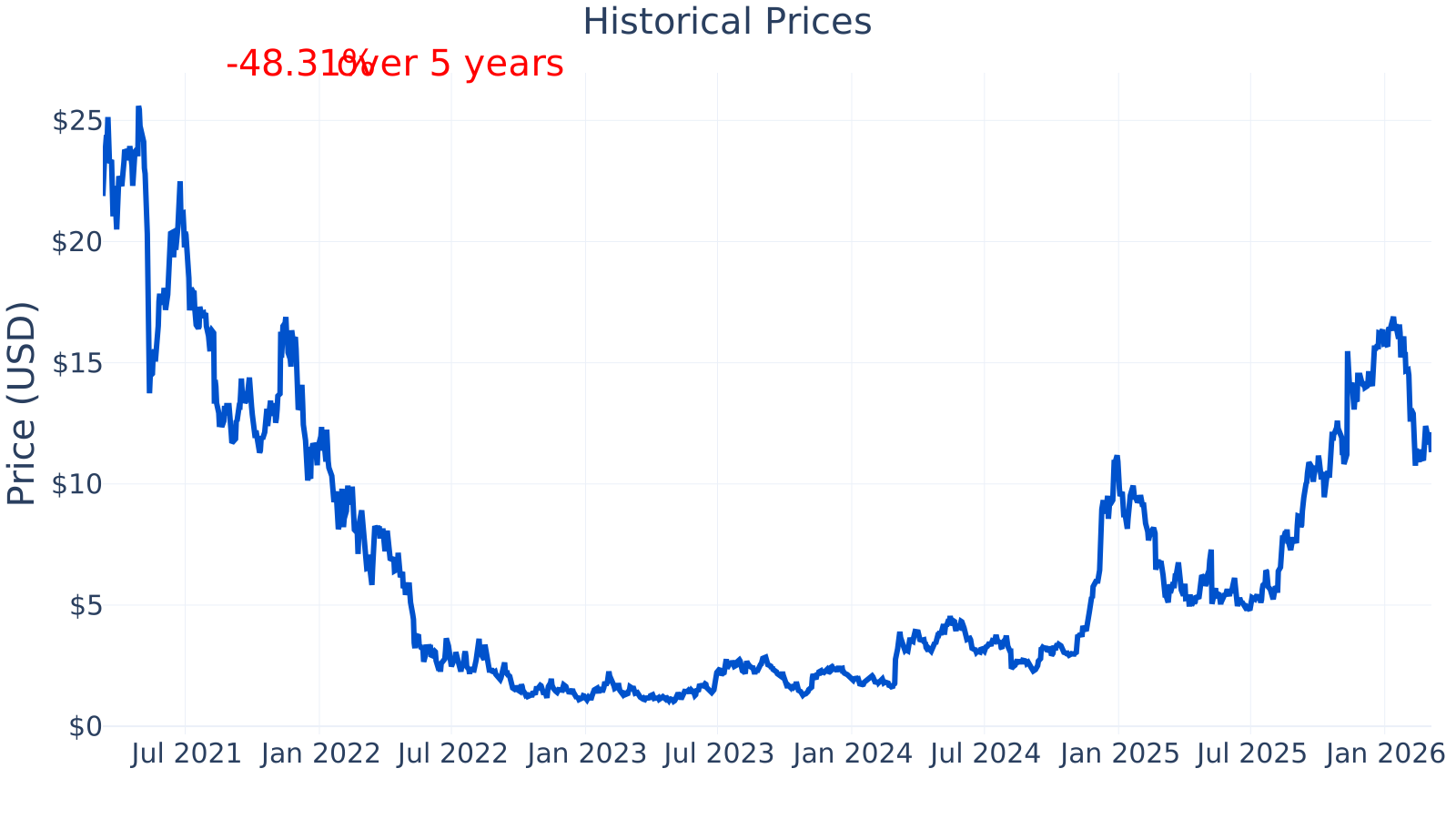
The latest snapshot shows a company with a market capitalization of about $1.35B and a high beta (~2.75), meaning the stock has tended to move much more than the broader market. Profitability remains negative (profit margin about -6.03% versus an industry median near -4.19%), while recent revenue growth is meaningfully higher (about 18.33% year-over-year versus an industry median near 3.8%). Free cash flow is close to break-even on a trailing basis (about $0.8M), which is a notable change from materially negative levels in prior years.
Growth (Medium)
TheRealReal sits within two long-term themes: luxury demand and re-commerce (buying and selling pre-owned goods). The second theme is supported by consumer interest in value, uniqueness, and waste reduction. For a resale platform, growth is not only about attracting more buyers—it's also about ensuring a steady flow of desirable inventory from consignors, since selection drives repeat purchasing.
Revenue growth has been uneven over the last several years, including periods of contraction, but the more recent pattern shown trends back to consistent positive growth, reaching about 18.33% in the most recent period displayed. That matters because marketplaces can benefit from scale: as volume grows, fulfillment and processing can become more efficient—if operations are executed well.
Cash generation has improved substantially over time. The trailing free cash flow trend moves from deeply negative levels (about -$155M in 2021 and -$189M in 2022) toward near break-even (around -$19.6M by 2025-03-31 in the series shown, and about +$0.8M in the latest metrics snapshot). For long-term company durability, a sustained shift toward neutral or positive free cash flow can reduce reliance on external financing.
Potential catalysts for future growth generally relate to: (1) expanding active buyers and repeat purchasing, (2) improving consignor acquisition and retention, (3) raising efficiency in authentication and fulfillment, and (4) increasing monetization per order (for example through better pricing, take rates, or services). Whether these translate into durable results depends on execution and the competitive landscape.
Risks (High)
TheRealReal’s main risks start with the reality that it has not yet produced consistent profitability in the periods shown, even though losses have narrowed. Operational complexity is high: each item must be received, inspected, authenticated, stored, priced, and shipped—this is not a simple “digital-only” marketplace. Any breakdowns in authentication standards, service levels, or shipping/returns can harm brand trust, which is central to luxury resale.
Margins have improved dramatically from very large losses earlier in the timeline (roughly -60% in 2021) to around -6% more recently, but they remain negative. This indicates the business is closer to break-even than in prior years, yet still needs further operating leverage (or other improvements) to generate durable profits through a full cycle.
The debt-to-equity ratio is shown as negative in the most recent periods (about -111% in the latest metrics snapshot). A negative debt-to-equity ratio commonly occurs when book equity is negative, which can happen after accumulated losses over time. This does not automatically mean the company is out of liquidity, but it can be a warning sign that the balance sheet has been pressured historically and may limit flexibility if business conditions weaken. It also makes comparisons versus peers (industry median shown as positive) less straightforward.
Competition is another major risk. Luxury resale includes multiple models:
- Managed marketplaces with authentication and fulfillment (closest to TheRealReal’s approach)
- Peer-to-peer marketplaces where buyers and sellers transact more directly
- Brand-led resale and third-party partnerships that can redirect supply toward alternative channels
In addition, the broader luxury ecosystem has powerful incumbents (luxury brands and large retailers) that influence supply and consumer attention. TheRealReal’s potential competitive advantages typically center on brand recognition in luxury resale, its authentication capabilities, and operational infrastructure. However, maintaining differentiation requires continuous investment, and scale alone does not guarantee defensibility if customer acquisition costs rise or if alternatives offer better pricing, convenience, or trust.
Finally, the stock’s high volatility (as suggested by beta) adds an additional risk for long-horizon holders: outcomes can be strongly affected by sentiment changes, liquidity conditions, and any quarter-to-quarter surprises in growth or profitability.
Valuation
A traditional price-to-earnings (P/E) approach is not very informative here because P/E is typically meaningful when a company has positive net income over a sustained period. The P/E series shown is effectively not applicable (displayed as 0 across the timeline), consistent with the company operating at a net loss during those periods.
In practice, discussions of valuation for a company in this stage often lean more on items like revenue scale, the path toward sustained free cash flow, and operating margin trajectory. The provided fundamentals point to a business with improving economics (narrowing losses and much better cash flow trend) but with remaining uncertainty around achieving stable profitability and the balance-sheet implications of past losses. Whether the current stock price is “expensive” or “cheap” cannot be concluded from P/E, and it depends heavily on how much additional margin improvement and durable growth the company can produce relative to the risks described.
Conclusion
TheRealReal is a luxury resale marketplace with a service-heavy model built around authentication and managed operations. The business has shown meaningful improvement in its financial trajectory over the periods shown: revenue is higher than in earlier years, profit margins are far less negative than before, and free cash flow has moved close to break-even.
At the same time, the company still shows negative profitability, a high-volatility stock profile, and balance-sheet signals that reflect the impact of prior losses (including negative debt-to-equity). The long-term picture depends on continued execution—especially sustaining growth while turning operational scale into consistently positive margins and cash generation—within a competitive luxury resale environment where trust and service quality are central.
Sources:
- SEC EDGAR — TheRealReal, Inc. filings (Form 10-K, Form 10-Q, Form 8-K)
- TheRealReal, Inc. — Investor Relations materials and press releases
- Wikipedia — “The RealReal” (basic company background)
This article is for informational purposes only and does not constitute financial advice. Some content is AI-generated. See Disclaimer


