Stock Analysis · Trade Desk Inc (TTD)
Overview
The Trade Desk, Inc. (TTD) provides a software platform that helps advertisers and advertising agencies buy digital advertising space across many channels. In simple terms, it is a “control center” used to plan, purchase, and measure ad campaigns on the open internet (for example: websites, apps, streaming TV, audio, and other digital formats). The company positions itself on the “demand side” of the advertising market, meaning it works primarily for ad buyers rather than for publishers selling ad inventory.
Trade Desk’s business model is tied to how much advertising spend flows through its platform. In its SEC filings, the company describes revenue mainly coming from platform fees tied to advertising transactions and related services. The company reports revenue as a single operating segment, so investors should generally expect limited public breakdown by product line.
Main sources of revenue (high-level, based on company reporting):
- Platform and transaction-based fees (majority) tied to programmatic media buying through its platform (often described as a “take rate” on spend).
- Other platform-related services (smaller portion) such as data-related and measurement-related offerings that support campaign performance.
The multi-year income profile shown below reflects a software-style model: growing revenue, high gross profit dollars, and meaningful operating expenses largely driven by sales & marketing and research & development.
From 2021 to 2025, total revenue increased from about $1.20B to about $2.90B. Over the same period, operating income rose from about $125M to about $659M, while research & development spending also increased (about $226M to about $525M), suggesting continued investment in the platform alongside scaling profitability.
Key Figures
| Metric | Value | Industry ⓘ |
|---|---|---|
| Date | Mar 02, 2026 | |
| Context | ||
| Sector | Communication Services | |
| Industry | Advertising Agencies | |
| Market Cap ⓘ | $11.65B | |
| Beta ⓘ | 1.19 | |
| Fundamental | ||
| P/E Ratio ⓘ | 27.07 | 30.56 |
| Profit Margin ⓘ | 15.31% | 1.24% |
| Revenue Growth ⓘ | 14.30% | 7.90% |
| Debt to Equity ⓘ | 17.56% | 35.58% |
| PEG ⓘ | 0.86 | |
| Free Cash Flow ⓘ | $787.31M | |
Trade Desk’s market capitalization is about $11.65B. The stock’s beta of 1.19 indicates it has tended to move somewhat more than the overall market. On profitability, the company shows a 15.31% profit margin, which is far above the listed industry median of 1.24%. Growth is also higher than the industry median in the table, with 14.3% year-over-year revenue growth versus an industry median of 7.9%. Financial leverage appears relatively modest with debt-to-equity of ~17.6% compared with an industry median near 35.6%. The company also generated about $787M of trailing twelve-month free cash flow, which can matter because it represents cash generated after operating needs and capital spending.
Growth (Medium)
Trade Desk operates in digital advertising, where budgets have been shifting over time from offline formats (like traditional print) toward online channels that can be measured and optimized more precisely. Within digital advertising, programmatic buying (automated, data-driven purchasing) has become a central method for many campaigns, which aligns directly with Trade Desk’s role as a platform for ad buyers.
Strategically, Trade Desk focuses on the “open internet” rather than walled-garden ecosystems. This matters because advertisers often want flexibility: reaching audiences across many publishers and channels while still having consistent measurement and campaign controls. The company’s filings also emphasize product development and partnerships intended to improve targeting, measurement, and workflows, which are core needs for large advertisers.
Revenue growth has remained positive in every period shown, though it clearly moderated from very high rates in 2021–2022 to more typical mid-teen to mid-20% rates later on, reaching about 14.3% in the most recent data point. For long-term context, this pattern can be consistent with a business moving from earlier rapid expansion toward a larger scale where growth becomes harder to sustain at extreme levels.
Free cash flow has increased steadily over the time periods shown (from about $352M in 2021 to about $686M in 2025, trailing basis in the chart). This can be an important support for long-term business flexibility because it can be used for reinvestment, acquisitions, or balance-sheet resilience—while also reducing dependence on external financing.
Risks (High)
Digital advertising is competitive and cyclical. When the economy weakens, marketing budgets can be reduced quickly, which may slow ad spend flowing through platforms like Trade Desk. Another structural risk is that the digital ad ecosystem depends on technology standards, consumer privacy rules, and platform policies; changes to identifiers, measurement tools, or data-sharing practices can reshape how effectively advertisers can target and measure campaigns. Trade Desk discusses a range of such risks in its SEC filings, including competition, customer concentration dynamics, and dependence on partners and integrations across the ad supply chain.
Competitive advantage is often discussed in terms of scale, performance, and integration. Trade Desk’s platform is widely used by agencies and brands for cross-channel programmatic buying, and its operating results suggest it has been able to grow while maintaining profitability. Still, the company is not alone: large ecosystem players and other ad-tech firms compete aggressively on features, data access, and pricing.
Key competitors and competitive context (high-level):
- Large “walled garden” platforms with their own ad buying systems (these can be competitors for ad budgets even if they are not direct like-for-like software platforms).
- Other independent ad-tech and demand-side platforms competing for the same agency and brand relationships.
- In-house solutions built by large advertisers and agencies that may reduce reliance on third-party platforms.
Leverage looks relatively conservative versus the industry median over most of the timeline shown. Debt-to-equity moved from the mid-20% range in 2021 down near ~11% in 2023–2024, then increased to about 17.6% most recently—still below the industry median (about 30.2% most recently in the chart). Lower leverage can reduce financial risk, but it does not remove business-cycle or competitive risks.
Profitability has been volatile over the multi-year window, dropping materially in 2022 (including a brief negative point) before recovering steadily. More recently, the profit margin improved to around the 15–16% range, ending at about 15.3%. The industry median shown is much lower in many periods, which highlights Trade Desk’s stronger profitability profile relative to the peer group in this dataset—while also reminding readers that margins can swing in ad-tech depending on spend levels and operating cost growth.
Valuation
Trade Desk’s valuation is often discussed using earnings multiples because the company is profitable. In the latest metrics table, the stock trades at a P/E ratio of about 27.1, below the listed industry median of about 30.6. The company also shows a PEG ratio of ~0.86 (a ratio that relates P/E to growth expectations; it can vary widely depending on how growth is measured and what period is used).
Historically, the P/E ratio shown was much higher earlier in the period (well above 100 in several points, and near/above 200 in parts of 2022–2024) before compressing meaningfully to lower levels by late 2025 (around the mid-40s on the chart). Interpreting that pattern in plain terms: the market previously priced the company as an extremely high-growth story, and later moved toward a more moderate earnings multiple. Whether a given multiple is “high” or “low” depends on future growth and profitability durability, which are uncertain—especially in a competitive and rapidly changing ad landscape.
Given the fundamentals shown in this article, a neutral way to frame today’s valuation is that it reflects a company with (1) ongoing revenue growth, (2) improving profitability versus its own recent history, (3) strong free cash flow generation, and (4) meaningful industry and execution risks that can influence results year to year.
Conclusion
Trade Desk is a software-driven advertising platform company tied to the continued shift of marketing budgets toward measurable, automated digital channels. Over several years, it expanded revenue from roughly $1.2B to roughly $2.9B and increased operating income, while continuing to invest heavily in research and development. Recent profitability and free cash flow trends look stronger than the company’s 2022 period and appear favorable relative to the industry medians shown.
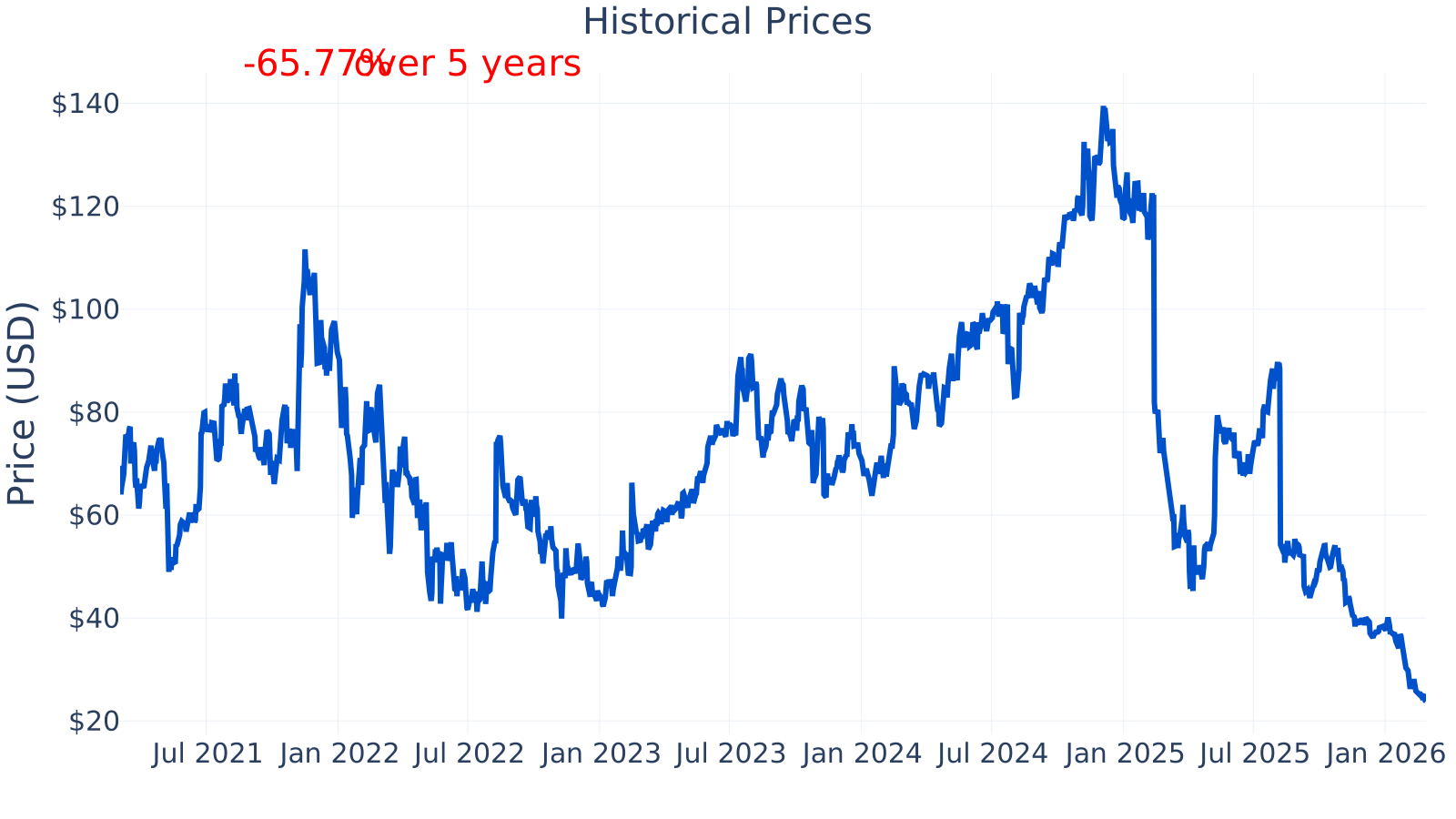
At the same time, the business operates in an environment with high competitive pressure and meaningful exposure to changes in privacy rules, platform policies, and advertising demand cycles. The stock’s valuation has also proven sensitive to market expectations, as seen in the large historical swings in P/E levels and the stock price history shown.
Overall, the long-term picture is best understood as a balance between scalable platform economics and strong cash generation on one side, and a fast-evolving, policy- and competition-driven ad ecosystem on the other.
Sources:
- The Trade Desk, Inc. — SEC Filings (Form 10-K, Form 10-Q) — “Annual Report” and “Quarterly Report” (Business overview, revenue description, and risk factors)
- SEC EDGAR — The Trade Desk, Inc. filings repository (10-K, 10-Q)
- The Trade Desk, Inc. Investor Relations — Company materials and releases (business description and updates)
- Wikipedia — “The Trade Desk” (basic company background and history)
This article is for informational purposes only and does not constitute financial advice. Some content is AI-generated. See Disclaimer


