Stock Analysis · Texas Instruments Incorporated (TXN)
Overview
Texas Instruments Incorporated (TXN) is a semiconductor company best known for designing and manufacturing “analog” chips and “embedded processing” chips. These components are used inside many everyday and industrial products to sense, control, convert power, and process signals—often in ways that are not visible to consumers but are essential for devices to work reliably.
In practice, TXN sells chips that go into end markets such as industrial equipment (factory automation, robotics, power infrastructure), automotive systems (advanced driver assistance, infotainment, powertrain, battery management), and a wide range of electronics. A defining feature of its business model is the breadth of its catalog: many of its parts stay in production for long periods and can be sold across thousands of customers and applications.
In its financial reporting, TXN organizes revenue primarily by product categories (rather than by brand-name product lines):
- Analog (largest share)
- Embedded Processing
- Other (smallest share, includes items such as calculators and certain licensing/other revenue)
Across cycles, the company’s results are closely tied to demand for semiconductors used in industrial and automotive markets, which can be cyclical but often have longer product life cycles than consumer gadgets.
Over the past several years, total revenue and profit have moved with the semiconductor cycle: revenue peaked around 2022, declined into 2024, and then improved in 2025. The same pattern shows up in operating income and net income, which fell during the downturn and then stabilized as revenue recovered.
Key Figures
| Metric | Value | Industry ⓘ |
|---|---|---|
| Date | Apr 27, 2026 | |
| Context | ||
| Sector | Technology | |
| Industry | Semiconductors | |
| Market Cap ⓘ | $252.22B | |
| Beta ⓘ | 0.99 | |
| Fundamental | ||
| P/E Ratio ⓘ | 47.38 | 63.60 |
| Profit Margin ⓘ | 29.11% | 7.71% |
| Revenue Growth ⓘ | 18.60% | 19.70% |
| Debt to Equity ⓘ | 83.74% | 20.71% |
| PEG ⓘ | 1.57 | |
| Free Cash Flow ⓘ | $3.72B | |
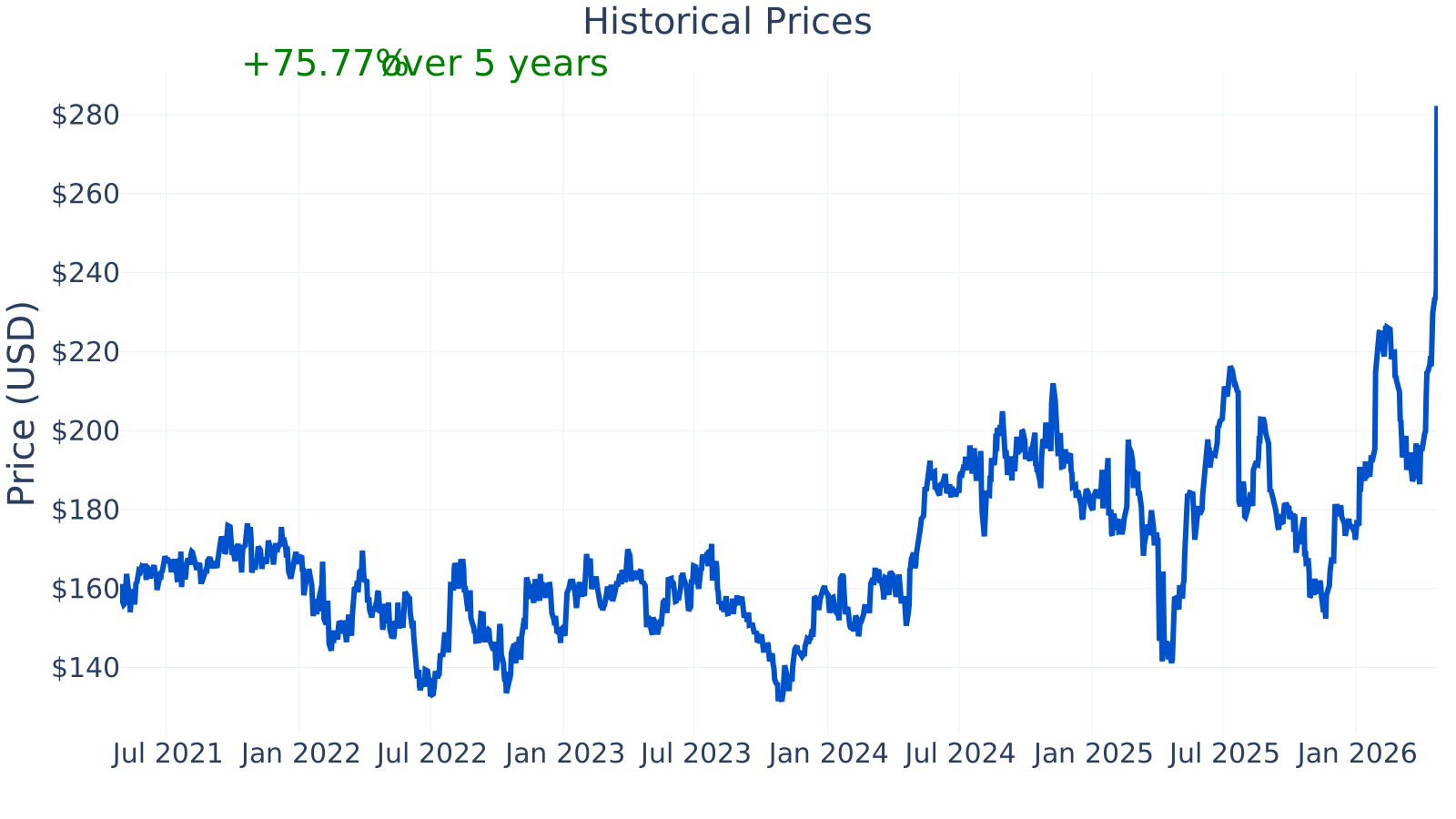
TXN’s market capitalization is about $252B, and its beta is ~0.99, which indicates the stock has historically moved roughly in line with the overall market. The company’s profit margin is ~29.1%, which is well above the semiconductor industry median (~7.7%) shown here—an important signal that TXN has historically converted a larger share of sales into bottom-line profit than many peers.
On growth, the most recent year-over-year revenue growth is ~18.6%, close to the listed industry median (~19.7%). Free cash flow over the trailing twelve months is about $3.72B, reflecting a rebound from the low point seen in 2024. Leverage is more noticeable: debt-to-equity is ~83.7% versus an industry median near 20.7%, meaning TXN uses more debt relative to shareholder equity than many semiconductor peers.
Growth (Medium)
TXN operates in semiconductors, an industry supported over the long run by trends like electrification, automation, and increased electronic content in vehicles and factories. Within semiconductors, analog and embedded chips are often tied to “real economy” demand—equipment, cars, and infrastructure—where product lifetimes can be long and design wins can last years. This can support durability, but it does not eliminate cycles: customers still reduce orders during inventory corrections or slowdowns.
A central part of TXN’s long-term strategy is manufacturing: the company has emphasized expanding internal chipmaking capacity (including 300mm wafer manufacturing) to support scale, cost structure, and supply assurance over time. If executed well, this can improve unit costs and resiliency across cycles, although it typically requires heavy upfront investment.
The revenue growth pattern shown here is consistent with a cyclical business. After strong growth in 2021 and 2022, TXN experienced multiple quarters of negative year-over-year revenue growth through 2023 and much of 2024, followed by a return to positive growth in 2025 and into early 2026 (about 18.6% most recently). For long-term readers, this highlights that periods of contraction can last more than a few quarters even for established chip companies.
Free cash flow also shows meaningful cyclicality: it declined from about $6.45B (2022) to under $1B (2024), then recovered to about $3.72B most recently. This matters because free cash flow is a key resource for funding capital spending, dividends, and share repurchases—especially important for a manufacturer expanding capacity.
Risks (Medium)
The biggest business risk is cyclicality. Industrial and automotive chip demand can weaken when customers work down inventories or when macroeconomic conditions soften. Even though analog and embedded products can be long-lived, revenue and profits can still decline meaningfully during downturns, as seen in the 2023–2024 period.
TXN’s debt-to-equity is ~83.7%, which is higher than the industry median shown (~20.7%). Higher leverage can be manageable for stable businesses, but it can reduce flexibility during weaker parts of the cycle—particularly when a company is also spending heavily on manufacturing capacity. Interest expense has also risen over time in the company’s income statement, which is consistent with a higher debt load and/or higher borrowing costs.
Profitability remains a key competitive advantage. Even though TXN’s profit margin has declined from the low-to-mid 40% range earlier in the period shown to about 29% most recently, it is still far above the industry median displayed (around 7%). This gap suggests strong operating efficiency, product mix, and pricing power relative to many peers, but the downward trend also shows that margins can compress in a downturn or during periods of heavier investment.
Competition is another structural risk. TXN competes with a large set of semiconductor companies, especially in analog and embedded markets. Major competitors commonly cited in company and industry discussions include Analog Devices (analog), Infineon Technologies (power/automotive and industrial), NXP Semiconductors (automotive and embedded), STMicroelectronics (broad industrial/automotive), onsemi (power and automotive), and Microchip Technology (microcontrollers/embedded). TXN is widely recognized as one of the largest analog semiconductor providers, but leadership can vary by sub-segment (for example, power devices, specific automotive platforms, or microcontroller families). The competitive position depends on cost, product breadth, manufacturing execution, and customer relationships.
Manufacturing execution is also a material risk. Building and ramping semiconductor fabrication capacity takes years and significant capital. If industry demand develops differently than expected, the company could face underutilized factories (hurting profitability) or the need to adjust spending plans.
Valuation
TXN’s current price-to-earnings (P/E) ratio is ~47.4, below the semiconductor industry median shown here (~63.6) but still elevated in absolute terms. The historical P/E pattern also shows how the multiple expanded significantly during the earnings downturn: when earnings fall, the P/E can rise even if the stock price does not increase proportionally.
In simple terms, a higher P/E means the market is paying more per dollar of current earnings. For a cyclical company, interpreting that number requires context: if earnings are temporarily depressed and expected to recover, the P/E can look high during the trough. At the same time, if recovery is slower than expected or if margins structurally settle lower due to competition or sustained higher costs, a high multiple can prove harder to justify.
The PEG ratio (~1.57) is another summary measure that relates valuation to expected growth (as typically calculated by data providers). It indicates the valuation is not solely explained by very high growth expectations, reinforcing that the market may be pricing in factors such as business quality, profitability, and durability across long product life cycles.
Conclusion
Texas Instruments is a large, established semiconductor manufacturer focused on analog and embedded chips used across industrial and automotive markets. The company has demonstrated strong profitability relative to many peers, although margins have eased from prior highs during a recent cyclical downturn. Recent results show improving revenue growth and rebounding free cash flow, consistent with a recovery phase.
The main long-term questions center on cycle timing, the pace of end-market demand, and manufacturing execution—especially given higher leverage than the industry median shown. Valuation, as reflected in a P/E around the high-40s, embeds meaningful expectations and is sensitive to how quickly earnings normalize and how sustainably margins hold up.
Sources:
- Texas Instruments Incorporated — Annual Report (Form 10-K) (SEC EDGAR)
- Texas Instruments Incorporated — Quarterly Reports (Form 10-Q) (SEC EDGAR)
- Texas Instruments Incorporated — Investor Relations materials (company website)
- Wikipedia — “Texas Instruments” (basic company background)
This article is for informational purposes only and does not constitute financial advice. Some content is AI-generated. See Disclaimer


