Stock Analysis · Tesla Inc (TSLA)
Overview
Tesla, Inc. designs and manufactures electric vehicles (EVs) and sells them directly to customers. The company also builds and sells energy products such as battery storage systems and solar solutions, and it offers software-enabled features and services tied to its vehicles. In practice, Tesla is best known for its EV lineup (such as Model 3 and Model Y), its global manufacturing footprint, and its approach of combining hardware (cars and batteries) with software (vehicle updates, driver-assistance features) and a charging ecosystem.
Based on Tesla’s segment reporting in its SEC filings, revenue is primarily generated from two operating segments, plus smaller “other” categories within those segments:
- Automotive (the largest): vehicle sales and leasing, plus automotive regulatory credits and other automotive-related revenue.
- Energy generation and storage: sales and leasing of energy storage products and solar offerings.
Across recent years, the company’s results have been dominated by the automotive segment, while the energy segment has been smaller but strategically important as EV adoption increases and grids add more storage capacity.
Looking at the multi-year income flow, Tesla’s total revenue expanded strongly from 2021 to 2024 (about $53.8B in 2021 to about $97.7B in 2024), then declined in 2025 (about $94.8B). Over the same period, operating expenses (including R&D) increased meaningfully, and net income fell from 2024 to 2025. This combination suggests the company has been investing more while facing a more challenging profitability environment than in its earlier peak-margin period.
Key Figures
| Metric | Value | Industry ⓘ |
|---|---|---|
| Date | May 04, 2026 | |
| Context | ||
| Sector | Consumer Cyclical | |
| Industry | Auto Manufacturers | |
| Market Cap ⓘ | $1.47T | |
| Beta ⓘ | 1.92 | |
| Fundamental | ||
| P/E Ratio ⓘ | 358.55 | 23.35 |
| Profit Margin ⓘ | 3.95% | -1.49% |
| Revenue Growth ⓘ | 15.80% | 11.40% |
| Debt to Equity ⓘ | 10.97% | 108.09% |
| PEG ⓘ | 5.38 | |
| Free Cash Flow ⓘ | $7.00B | |
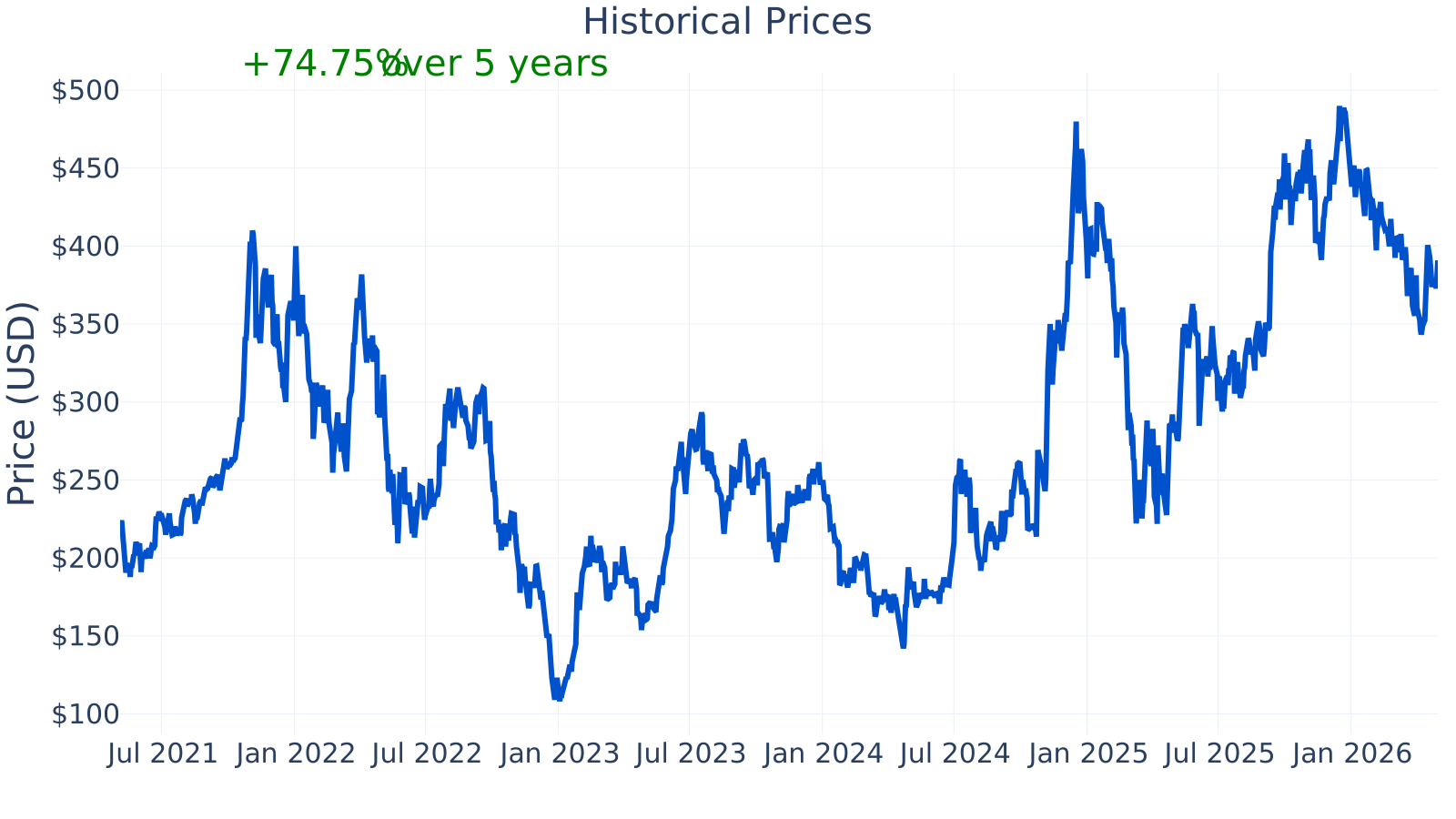
Tesla’s market capitalization is about $1.47T, and the stock’s beta (~1.92) indicates higher-than-market volatility historically. The company’s P/E ratio (~358.6) is far above the industry median (~23.4), meaning the stock price implies expectations for much higher future earnings than the typical auto manufacturer. Profitability is currently positive (~4.0% net profit margin) and above the industry median (which is negative in the provided peer set), while the balance sheet shows comparatively low leverage (debt-to-equity ~11% vs an industry median above 100%). Revenue growth in the most recent period shown is ~15.8% year-over-year, above the industry median (~11.4%). Trailing twelve-month free cash flow is about $7.0B.
Growth (Medium)
Tesla operates in the global EV and energy storage markets, which are generally associated with long-term electrification trends: consumers and fleets shifting toward EVs, charging infrastructure expanding, and electricity systems requiring more battery storage to balance supply and demand. These are large markets, but they are also increasingly competitive and sensitive to pricing, interest rates, and policy support.
Tesla’s growth strategy has typically combined scale manufacturing (to reduce unit costs), software and services (to add higher-margin revenue over time), and expansion beyond vehicles into energy storage. Potential catalysts commonly discussed in Tesla’s own communications include ramping production capacity, launching or scaling new vehicle programs and manufacturing processes, expanding energy storage deployments, and monetizing software features. The key question for long-term growth is whether Tesla can expand volumes and/or add higher-margin software and services while maintaining healthy margins in a market where EV pricing has shown pressure.
Revenue growth has been volatile: it was extremely high in 2021–2022, then slowed sharply in 2023, turned negative in parts of 2024–2025, and most recently returned to positive territory (about +15.8% YoY in the latest point shown). This pattern is consistent with an industry moving from early hyper-growth toward a more competitive, price-sensitive phase.
Free cash flow over the trailing twelve months is about $7.0B, after a notable dip around 2024 (roughly $1.4B at the 2024 point shown) and a recovery afterward. For long-term business resilience, consistent free cash flow matters because it can support factory investment, research spending, and balance-sheet flexibility without relying as heavily on external financing.
Risks (High)
Tesla faces a mix of business, industry, and execution risks. A central risk is pricing pressure in EVs: as more automakers offer competitive models, price cuts or incentives can compress margins. Another risk is cyclicality: vehicle demand can weaken when consumer financing costs rise or when economic conditions tighten. Tesla also carries execution risk tied to manufacturing scale, supply chain stability, product launches, and the challenge of growing the energy business profitably.
Competition is intense. Tesla competes with established global automakers that have large manufacturing scale and dealer/service networks, as well as EV-focused players in multiple regions. Competitors include companies such as BYD, Volkswagen Group, General Motors, Ford, Hyundai/Kia, Mercedes-Benz, BMW, and others, depending on geography and vehicle segment. In energy storage, competition includes large industrial and electronics firms and specialized storage providers. Tesla’s competitive advantages often described in its filings and public communications include brand strength in EVs, vertically integrated engineering, manufacturing scale in key models, a software-centric vehicle architecture, and its charging ecosystem. At the same time, the gap versus competitors can narrow as EV technology and supply chains mature.
Tesla’s leverage appears comparatively conservative in this peer context. The latest debt-to-equity is about 11% versus an industry median above 100%. Even though this ratio has moved around over time, it remains far below the peer median in the period shown, which can reduce financial risk during downturns or heavy investment cycles.
Profitability has weakened versus Tesla’s earlier peak levels. Net profit margin declined from mid-teens percentages in 2022–2024 to about 4.0% at the latest point shown. While this is still better than the negative industry median shown for the peer set, it indicates Tesla’s earnings are currently more sensitive to pricing, costs, and volume changes than they were during its strongest margin period.
Valuation
Valuation is often summarized using the price-to-earnings (P/E) ratio, which compares the stock price to the company’s earnings. A higher P/E typically means the market is assigning a higher value to future growth or future profitability (or both), while a lower P/E can imply more modest expectations or higher perceived risk.
Tesla’s latest P/E is about 358.6, far above the industry median (~23.4). The historical series also shows substantial swings: it fell to lower levels in 2023–2024 (roughly in the ~40–70 range at points shown) and then rose sharply into 2025–2026. In practical terms, this level of P/E means the current valuation is highly dependent on expectations that Tesla’s earnings will grow substantially over time and/or that the company will achieve stronger long-term margins than typical auto manufacturers. If growth or margin expansion does not materialize as expected, the valuation can be more sensitive to changes in sentiment and results.
Conclusion
Tesla is a large EV and energy company whose revenue has been driven primarily by automotive sales, with energy generation and storage as a smaller but potentially important growth area. The business has shown the ability to scale revenue over multiple years, maintain comparatively low balance-sheet leverage versus peers, and generate meaningful free cash flow, even with variability.
At the same time, recent years show more uneven growth and a clear decline in profit margins from earlier highs, consistent with intensifying EV competition and pricing pressure. The stock’s valuation metrics (especially the very high P/E relative to the industry median) indicate that the market price reflects substantial expectations for future earnings growth and/or future margin improvement. As a result, long-term outcomes are likely to be influenced by Tesla’s ability to expand volumes, sustain cost advantages, grow energy and software-related revenue, and defend profitability in a crowded global market.
Sources:
- U.S. SEC EDGAR — Tesla, Inc. Form 10-K (Annual Report)
- U.S. SEC EDGAR — Tesla, Inc. Form 10-Q (Quarterly Report)
- Tesla Investor Relations — Quarterly Update / Shareholder Deck (company-hosted materials)
- Wikipedia — “Tesla, Inc.” (basic company background)
This article is for informational purposes only and does not constitute financial advice. Some content is AI-generated. See Disclaimer


