Stock Analysis · Teradyne Inc (TER)
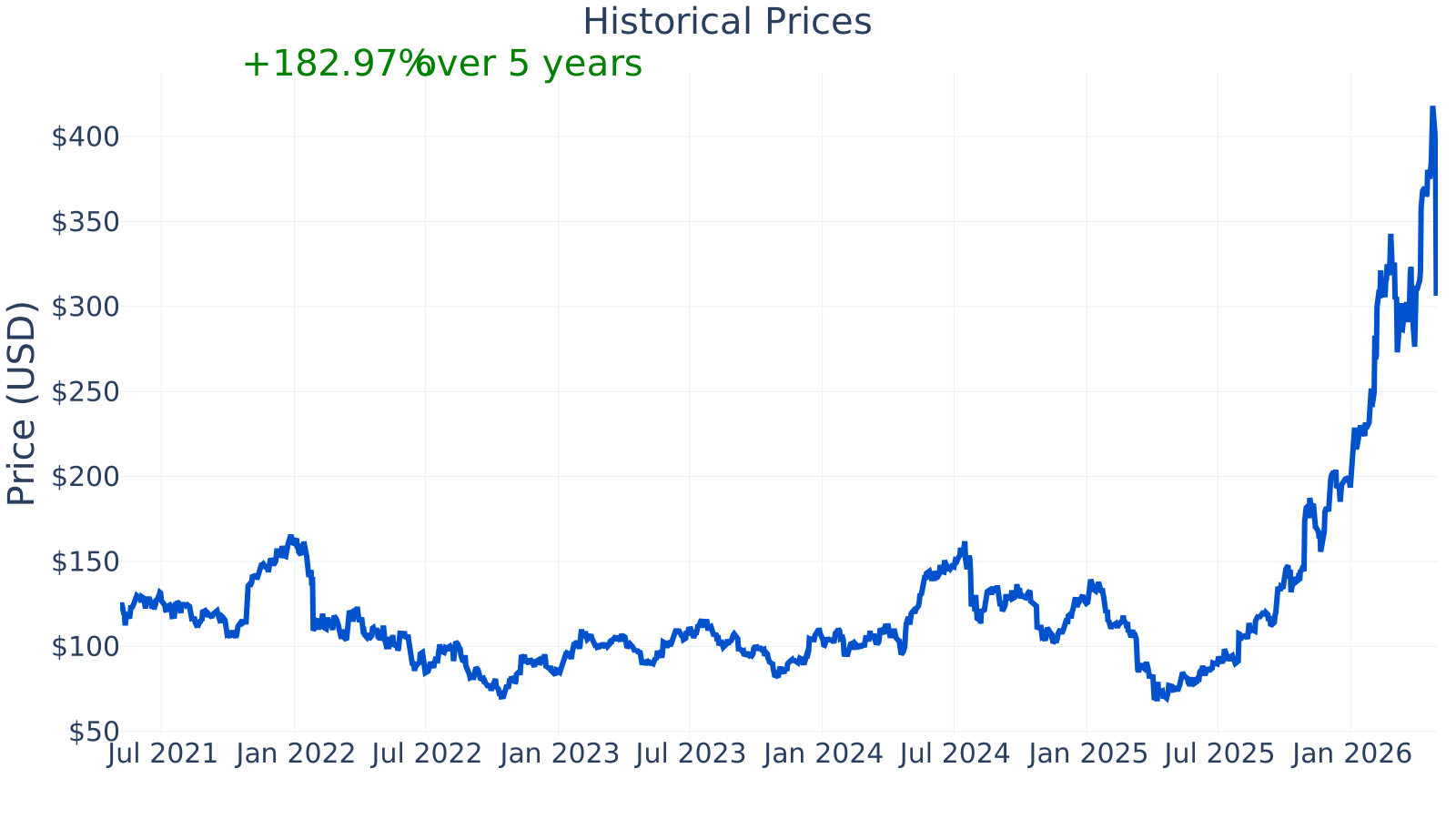
Overview
Teradyne, Inc. designs and sells equipment used to test semiconductors and electronic devices during manufacturing. In simple terms, many chips and electronic components must be checked for speed, power use, and reliability before they can be shipped in products like smartphones, computers, data-center servers, and vehicles. Teradyne’s systems help manufacturers run those checks at high volume, aiming to reduce defects and improve production efficiency.
The company also has an industrial automation business focused on collaborative robots (robots designed to work alongside people) and related automation solutions. This creates exposure not only to chip-making cycles but also to longer-term trends such as factory automation and productivity improvements.
Teradyne reports revenue by operating segments. In its annual reporting, the largest segment is typically Semiconductor Test, followed by Industrial Automation, with System Test generally smaller. Segment shares can shift meaningfully from year to year as the semiconductor industry moves through up-cycles and down-cycles; for exact current percentages, the company’s latest Form 10‑K/10‑Q segment note is the reference point.
The main sources of revenue are typically:
- Semiconductor Test (chip testing equipment and related offerings)
- Industrial Automation (collaborative robots and factory automation solutions)
- System Test (test systems for specific electronic systems and applications)
Over the last several years shown below, total revenue declined from 2021 to 2023 and then began to recover into 2024 and 2025. Profitability also moved with the cycle, which is common for companies tied to semiconductor manufacturing activity.
Across the years shown, revenue dipped from about $3.7B (2021) to about $2.7B (2023), then improved to about $3.2B (2025). Operating income and net income followed a similar pattern, reflecting how demand cycles and cost structure can affect results.
Key Figures
| Metric | Value | Industry ⓘ |
|---|---|---|
| Date | May 04, 2026 | |
| Context | ||
| Sector | Technology | |
| Industry | Semiconductor Equipment & Materials | |
| Market Cap ⓘ | $54.08B | |
| Beta ⓘ | 1.79 | |
| Fundamental | ||
| P/E Ratio ⓘ | 64.09 | 48.78 |
| Profit Margin ⓘ | 22.55% | 8.18% |
| Revenue Growth ⓘ | 87.00% | 11.50% |
| Debt to Equity ⓘ | 2.62% | 26.74% |
| PEG ⓘ | 1.37 | |
| Free Cash Flow ⓘ | $553.18M | |
Teradyne’s market capitalization is about $54.1B. The stock’s beta (~1.79) suggests it has historically moved more than the broader market (higher ups and downs). The latest P/E ratio (~64.1) is above the industry median shown (~48.8). Profitability stands out: the latest profit margin is ~22.6% versus an industry median of ~8.2%. The company’s latest year-over-year revenue growth is ~87.0%, well above the industry median shown (~11.5%), while debt-to-equity is ~2.6%, materially lower than the industry median (~26.7%). Trailing twelve-month free cash flow is about $553M.
Growth (Medium)
Teradyne operates in markets connected to long-term demand for more computing power and more electronics content in everyday products. As chips become more complex (and are used in more places), testing becomes more important—because small defects can cause expensive failures, and because manufacturers want high output with consistent quality. This creates a structural need for advanced testing equipment over time.
At the same time, Teradyne’s results can be strongly influenced by the semiconductor industry’s investment cycle. When chipmakers and outsourced manufacturing firms expand capacity, test-equipment demand can rise quickly; when they pause spending, demand can fall. This is why growth often appears “lumpy” even if the long-term trend is upward.
The year-over-year revenue growth series illustrates this cyclicality: several quarters show negative growth through parts of 2022–2024, followed by a sharp rebound most recently (the latest point shows roughly 87% year-over-year growth). Large swings like these are common in semiconductor-related equipment businesses and can reflect customers timing major projects and capacity expansions.
Free cash flow over the trailing twelve months has remained positive in the periods shown, ranging from roughly $411M to $930M, with the most recent value around $553M. Positive free cash flow can support research and development, acquisitions, and shareholder returns, but the variability also highlights that cash generation can move with industry conditions.
Potential catalysts that can matter for Teradyne over time (without assuming any specific outcome) include: major shifts in chip demand (for example, data-center build-outs), new testing requirements from advanced packaging and complex devices, and continued adoption of factory automation where collaborative robots can be deployed. Whether those translate into sustained growth depends on customer capital spending, competitive dynamics, and Teradyne’s product execution.
Risks (High)
The biggest risk is cyclicality. Customers for test equipment often make large, project-based purchases, and spending can rise or fall quickly depending on semiconductor demand, inventory levels, and capital expenditure plans. That can lead to volatile quarterly and annual results, even if the business remains profitable over a full cycle.
Another important risk is customer concentration and bargaining power (common in semiconductor equipment). Large chip manufacturers and outsourced test/assembly providers can be significant customers, and purchasing decisions may be influenced by pricing, performance, and long qualification cycles. Losing share at a major account—or delays in product adoption—can impact revenue.
Competition is also material. Teradyne competes with other automated test equipment providers and with firms that offer adjacent test solutions. In parts of the market, competitors include Advantest and Keysight Technologies (in certain test categories), among others. Competitive positioning depends on test accuracy, throughput (how fast testing can be completed), total cost of ownership, software ecosystem, and customer support. Teradyne is widely recognized as a major player in automated test equipment, but leadership can vary by test type and end market, and customers can qualify multiple suppliers.
Execution and technology risk matters because testing needs evolve with new chip architectures. The company must keep investing in new platforms and software while managing costs. Industrial automation adds another layer: robotics markets can be competitive and sensitive to industrial demand, and adoption rates can vary by region and manufacturing segment.
Balance-sheet leverage appears low relative to the industry median in the period shown. The latest debt-to-equity is about 2.6% versus an industry median near 26.7%. Lower leverage can reduce financial risk during downturns, though it does not remove earnings volatility driven by demand cycles.
Profit margin has fluctuated over time but remains above the industry median in the periods shown. The latest margin is about 22.6% versus an industry median around 8.1%. The margin trend shows declines from earlier highs (mid-to-high 20% range in 2021) down to the mid-teens in parts of 2024–2025, followed by a rebound most recently—consistent with cycle-driven operating leverage.
Valuation
One simple valuation lens is the price-to-earnings (P/E) ratio, which compares the stock price to the company’s earnings. Higher P/E ratios usually indicate the market is pricing in higher future earnings, higher quality, or both—but they can also mean expectations are demanding, especially for cyclical businesses where earnings can swing.
The P/E ratio shown has risen substantially over the period, moving from levels in the high teens to mid-40s at points and reaching much higher recently (the latest is roughly 87.6 on the series shown). The industry median also increased but remains lower (latest around 55.4). This means Teradyne has been valued at a premium to the industry median in many of the periods shown, and the premium widened recently.
How to interpret that premium depends on context. A higher P/E can be consistent with stronger profitability (Teradyne’s profit margin is above the industry median in the latest period) and with expectations of a rebound after a downturn. At the same time, because semiconductor equipment demand is cyclical, earnings and P/E ratios can change quickly as conditions shift. The company’s PEG ratio (~1.37) indicates that, on this metric, the valuation is not only about today’s earnings but also about expected growth; however, growth estimates can be uncertain in cyclical industries.
Conclusion
Teradyne is a major provider of semiconductor test equipment, with an additional footprint in industrial automation. The business is tied to long-term trends—more chips, more complexity, and more automation—but it is also exposed to pronounced semiconductor capital-spending cycles that can create sharp swings in revenue and profitability.
Financially, the company shows a combination of strong profitability versus the industry median and low leverage, alongside variable growth and cash flow that reflect cycle sensitivity. The recent rebound in revenue growth indicates improving conditions, but the valuation metrics shown (including a higher P/E versus the industry median) imply that market expectations may already incorporate meaningful future improvement. Overall, the facts point to a company with solid competitive positioning and financial strength, operating in a cyclical environment where outcomes can differ significantly depending on industry conditions and execution.
Sources:
- Teradyne, Inc. — Form 10-K (Annual Report) — “Business” and “Management’s Discussion and Analysis of Financial Condition and Results of Operations”
- Teradyne, Inc. — Form 10-Q (Quarterly Report) — “Management’s Discussion and Analysis” and “Financial Statements”
- SEC EDGAR — Teradyne, Inc. filings (10-K, 10-Q, 8-K)
- Teradyne Investor Relations — Press Releases and SEC Filings section
- Wikipedia — “Teradyne” (basic company background only)
This article is for informational purposes only and does not constitute financial advice. Some content is AI-generated. See Disclaimer


