Stock Analysis · Teradyne Inc (TER)
Overview
Teradyne, Inc. is a technology company that makes industrial equipment used to test semiconductors (chips) and other electronics. In simple terms, many chipmakers and electronics manufacturers rely on Teradyne’s systems to check that products work correctly and meet quality standards before they are shipped. Teradyne also has a large business in industrial automation, including collaborative robots (“cobots”) and mobile industrial robots used in factories and warehouses.
Teradyne’s revenue is mainly driven by demand for electronics and chips, which tends to move in cycles: when chip production ramps up, testing demand usually increases; when the industry slows down, customers often reduce equipment purchases. The company’s filings typically describe revenue through these main segments (exact mix can shift materially from year to year):
- Semiconductor Test (testing equipment for chips)
- System Test (testing for electronics such as storage, automotive, wireless, and other complex systems)
- Robotics (industrial automation products)
Business snapshot from recent full-year results: total revenue was about $3.19B in 2025 (vs. about $2.82B in 2024), and net income was about $554M in 2025 (vs. about $542M in 2024). Over this 2024–2025 period, gross profit and operating income also increased, suggesting improved overall business activity alongside continued operating spending.
From 2024 to 2025, revenue rose (about $2.82B to $3.19B) and operating income increased (about $613M to $653M). Operating expenses also moved higher (about $1.06B to $1.17B), reflecting continued investment while the top line expanded.
Key Figures
| Metric | Value | Industry ⓘ |
|---|---|---|
| Date | Feb 07, 2026 | |
| Context | ||
| Sector | Technology | |
| Industry | Semiconductor Equipment & Materials | |
| Market Cap ⓘ | $47.74B | |
| Beta ⓘ | 1.82 | |
| Fundamental | ||
| P/E Ratio ⓘ | 86.24 | 47.44 |
| Profit Margin ⓘ | 17.37% | 9.40% |
| Revenue Growth ⓘ | 43.90% | 9.90% |
| Debt to Equity ⓘ | 12.42% | 20.73% |
| PEG ⓘ | 2.27 | |
| Free Cash Flow ⓘ | $450.40M | |
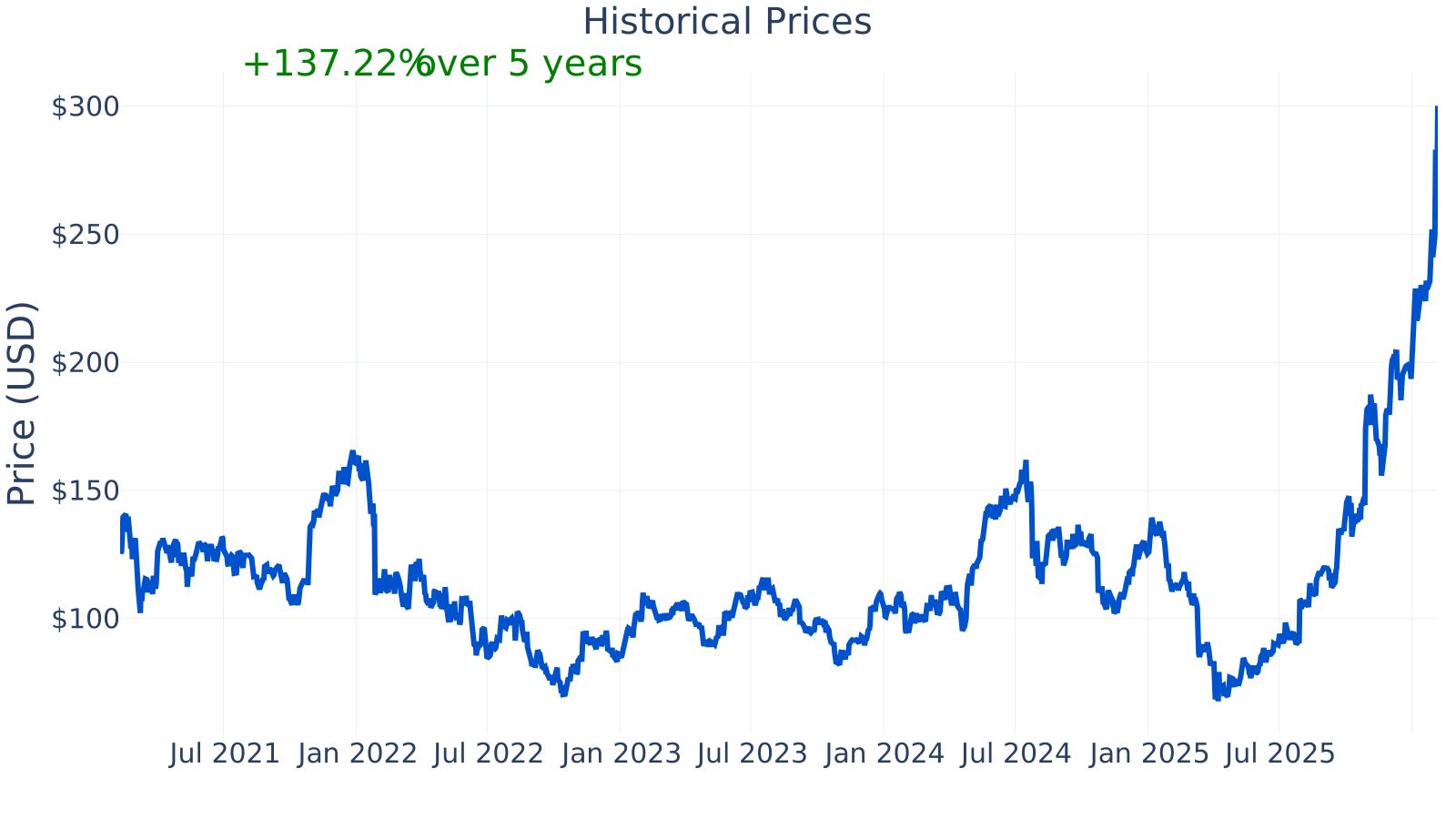
Teradyne’s market capitalization is about $47.7B. The stock has historically shown meaningful price swings, which aligns with a beta of ~1.82 (a measure indicating the shares have tended to move more than the overall market).
On profitability, the company’s profit margin is ~17.4%, which is higher than the industry median shown here (~9.4%). Growth has been volatile, but the latest year-over-year revenue growth shown is ~43.9%, well above the industry median (~9.9%), reflecting a strong rebound after weaker periods.
Financial leverage appears relatively modest: debt-to-equity is ~12.4%, below the industry median (~20.7%). Free cash flow over the trailing twelve months is about $450M, indicating the business is generating cash after operating needs and capital spending (though this metric can fluctuate with industry cycles).
Growth (Medium)
Teradyne operates in markets tied to long-term technology trends. Semiconductors are foundational to computing, networking, industrial equipment, and vehicles, and the complexity of chips generally increases testing requirements. That backdrop can support demand for advanced test equipment over time, even though yearly spending can rise and fall based on customer investment cycles.
Another growth pathway is industrial automation. Robotics and factory automation are often adopted to increase productivity and address labor constraints. In principle, this can broaden Teradyne’s end markets beyond semiconductors, although robotics demand can also be sensitive to industrial capital spending and competition.
The revenue growth pattern is notably cyclical: strong growth in parts of 2021, a prolonged contraction through 2022 and much of 2023, then improvement across 2024 and a sharp acceleration by late 2025 (about +43.9% year-over-year in the most recent point shown). For long-term business analysis, this highlights that Teradyne’s growth can be strong when the industry cycle turns upward, but downturns can last multiple quarters.
Free cash flow has also fluctuated over time: it was higher around 2022 (~$930M TTM), dropped to the low $400M range in 2023–2024, and then improved again in 2025 (~$608M at one point shown, with the latest table indicating ~$450M TTM). This variation is consistent with a business where customer orders and shipment timing can materially impact cash generation.
Potential catalysts discussed in company materials commonly relate to the semiconductor capital spending cycle, rising test intensity for advanced chips, and expansion of automation solutions. The timing of these catalysts is uncertain, but they can meaningfully influence results when customer investment accelerates.
Risks (High)
This article is for informational purposes only and does not constitute financial advice. Some content is AI-generated. See Disclaimer