Stock Analysis · Teradata Corp (TDC)
Overview
Teradata Corp (TDC) is a software company focused on data analytics and data management for large organizations. In simple terms, it helps enterprises store, organize, and analyze large amounts of information so they can run reports, understand customers, manage risk, and make decisions faster. Teradata’s products are commonly used in large-scale environments where performance, reliability, and governance are important.
The company’s business has been shifting over time from older, on-premises deployments (software running in a customer’s own data center) toward subscription software and cloud-related offerings. This shift is typical in enterprise software: instead of one-time licenses and hardware-tied setups, customers increasingly prefer ongoing subscriptions and flexible deployments that can run in public cloud environments.
In its financial reporting, Teradata generally discusses revenue in broad categories rather than a long list of consumer-facing products. The main revenue streams are typically organized as:
- Subscription (software and cloud-related) – recurring revenue tied to ongoing access and usage
- Consulting / services – implementation help, optimization, and advisory work
- Other legacy-related revenue components – depending on the period and reporting structure (often smaller than subscription)
Exact percentages can vary by year and are best read directly from the latest annual report’s revenue footnotes and segment/product disclosures.
Over recent years, total revenue trends downward (from about $1.92B in 2021 to about $1.66B in 2025), while operating expenses decline meaningfully (from about $955M in 2021 to about $782M in 2025). Net income also improves from 2022 levels (about $33M in 2022 to about $130M in 2025), indicating that cost discipline has been an important driver of profitability even as revenue has been under pressure.
Key Figures
| Metric | Value | Industry ⓘ |
|---|---|---|
| Date | Feb 16, 2026 | |
| Context | ||
| Sector | Technology | |
| Industry | Software - Infrastructure | |
| Market Cap ⓘ | $3.17B | |
| Beta ⓘ | 0.54 | |
| Fundamental | ||
| P/E Ratio ⓘ | 24.86 | 25.13 |
| Profit Margin ⓘ | 7.82% | 6.91% |
| Revenue Growth ⓘ | 2.90% | 15.25% |
| Debt to Equity ⓘ | 242.17% | 19.82% |
| PEG ⓘ | 3.35 | |
| Free Cash Flow ⓘ | $305.00M | |
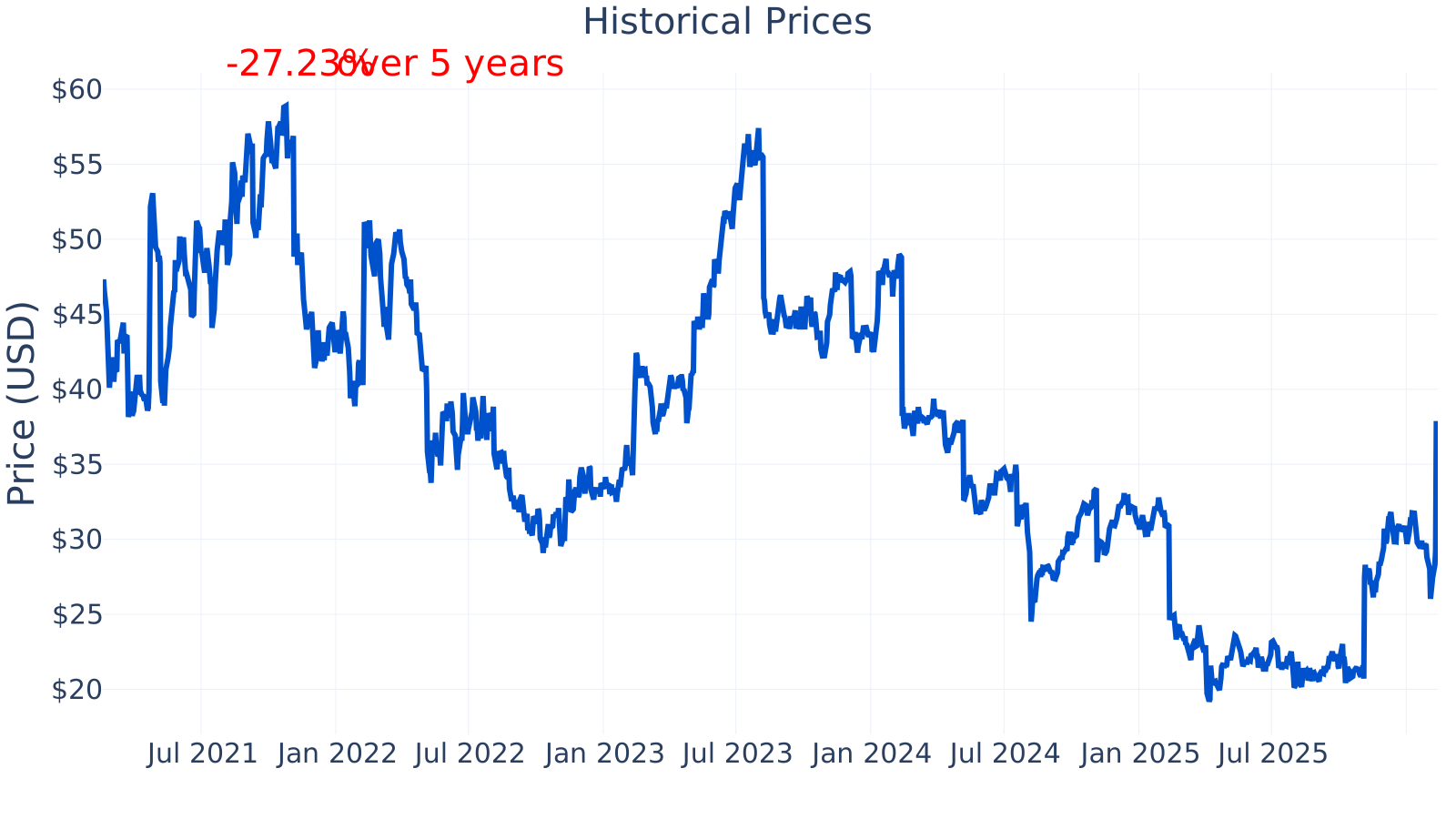
Teradata’s market capitalization is about $3.17B, and its beta of ~0.54 suggests the stock has historically moved less than the broader market. Profit margin is about 7.82%, modestly above the industry median (~6.91%), while year-over-year revenue growth is about 2.9%, far below the industry median (~15.25%). Debt-to-equity is about 242% versus an industry median near 20%, indicating substantially higher leverage than many peers. The P/E ratio is ~24.9, close to the industry median (~25.1). Free cash flow over the trailing twelve months is about $305M.
Growth (Low)
Teradata operates in the broader analytics and data platform area, which is an important part of modern IT. Demand drivers include cloud migration, the need to manage and govern growing data volumes, and wider adoption of advanced analytics. In that sense, the overall problem Teradata addresses remains relevant for many organizations.
However, the company’s recent top-line performance suggests it is not currently capturing the same growth pace as the median company in its industry group. The revenue growth pattern shown below is uneven, including multiple periods of contraction before returning to modest growth in the most recent period.
The chart shows several years where year-over-year revenue growth was negative, followed by a return to positive growth at about 2.9% most recently. That profile can be consistent with a business in transition (for example, product mix changes and contract timing), but it also means that long-term expansion has not yet become consistent.
Cash generation can matter for long-term durability, especially for mature software companies. Teradata has continued to generate positive free cash flow across the periods shown, although it has declined from earlier highs.
Free cash flow remains positive (about $305M TTM), with prior periods ranging roughly from $271M to $477M. Sustained cash generation can support reinvestment in product development and ongoing balance-sheet obligations, but the direction of travel is still important to monitor over time.
Potential catalysts, based on typical items discussed in company filings, include continued migration toward recurring subscription revenue, new product capabilities for analytics in cloud environments, and stabilization of renewals and expansions within large enterprise accounts. Whether these translate into durable growth depends on execution and competitive positioning.
Risks (High)
A key risk is competitive intensity. The market for enterprise analytics and data platforms includes large, well-capitalized technology vendors and cloud providers. Teradata competes for enterprise budgets where customers may standardize on fewer platforms over time, potentially favoring vendors with broad ecosystems and integrated cloud services.
Another major risk is financial leverage. Teradata’s debt-to-equity ratio is much higher than the median for its industry group, which can reduce flexibility if operating conditions weaken or if refinancing becomes more expensive.
The debt-to-equity ratio peaks dramatically in 2024 and remains elevated at about 242% in the most recent period, compared with an industry median near 15%–35% across the chart. This gap suggests Teradata is operating with a balance sheet structure that is materially more leveraged than many peers.
Profitability is also an area to watch closely. While Teradata’s profit margin is currently modestly above the industry median, margins have varied over time. A company can show improving profitability due to cost reductions, but long-term resilience is generally stronger when margin improvement is paired with steady revenue growth.
Profit margin rises to about 7.82% most recently, slightly above the industry median (~7.17%). The longer trend shows improvement from lower levels earlier in the series, which aligns with the observed reduction in operating expenses. The key question for long-horizon analysis is whether margins can remain stable if revenue growth stays low or volatile.
Regarding competitive advantages, Teradata has a long history in large-scale analytics and has been recognized for enterprise-grade performance and handling complex workloads. That said, leadership in this space is fragmented, and many customers can choose alternatives depending on cost, cloud strategy, and existing vendor relationships.
Main competitors typically include:
- Cloud data platforms offered by major cloud providers (integrated with their broader cloud ecosystems)
- Enterprise data and analytics vendors with broad software suites
- Specialized data platform companies focused on cloud-native analytics and data warehousing
Relative positioning often depends on a customer’s workload requirements, migration timelines, and the total cost of ownership across multiple years.
Valuation
Valuation is best interpreted alongside growth, profitability quality, and balance-sheet structure. On a headline basis, Teradata’s P/E ratio is near the industry median, which indicates the market is not pricing it at an extreme premium or discount compared with peers in the same broad classification.
The historical P/E has been volatile, with earlier periods far above the industry median and more recent readings below the industry median. The latest P/E is about 24.9 versus an industry median near 25.1. In practical terms, that places Teradata close to “typical” for its peer group on this single metric, even though its recent revenue growth is well below the group’s median and its leverage is substantially higher.
The PEG ratio (about 3.35) can be read as a signal that the valuation may be demanding relative to the company’s growth rate, since higher PEG values generally reflect lower growth for a given earnings multiple. This is not definitive on its own, but it aligns with the picture of modest recent growth.
Conclusion
Teradata is an established enterprise analytics and data management company operating in a strategically important area of IT. Recent results show improving profitability and continued positive free cash flow, alongside multi-year revenue pressure and only modest recent growth. Compared with industry medians, the company stands out for substantially higher leverage, while its P/E ratio is roughly in line with peers.
From a long-term perspective, the central points to track over time are whether recurring subscription-led revenue can become consistently growing, whether free cash flow remains durable, and whether the balance sheet becomes less leveraged. Competitive pressure remains a core structural risk given the number of strong alternatives available to enterprise customers.
Sources:
- SEC EDGAR — Teradata Corp filings (Form 10-K, Form 10-Q)
- Teradata Investor Relations — Annual Report (Form 10-K) and shareholder materials
- Wikipedia — “Teradata” (basic company background)
This article is for informational purposes only and does not constitute financial advice. Some content is AI-generated. See Disclaimer