Stock Analysis · Somnigroup International Inc (SGI)
Overview
Somnigroup International Inc (SGI) operates in the consumer cyclical sector, within the furnishings, fixtures & appliances industry. In practical terms, this is a business tied to household spending patterns: when consumers feel confident and housing activity is healthy, demand for home-related products tends to be stronger; when conditions tighten, demand often cools.
From its financial profile, SGI appears to generate revenue primarily from selling consumer products in its category (home/furnishings-related offerings) through its commercial channels. The company’s results also show meaningful operating costs (cost of revenue and operating expenses) typical of product-based businesses, where manufacturing/sourcing, distribution, and sales/marketing can represent large portions of the income statement.
Revenue mix by product line or geography (with percentages) is typically disclosed in annual reports and segment notes; it is not included in the information shown here, so this section stays at a high level rather than listing exact shares.
Across 2021–2025, total revenue was roughly flat around $4.9B through 2024, then increased sharply in 2025 to about $7.48B. Over the same span, operating income rose to about $985M in 2025, but net income stayed around $384M, suggesting that below-operating line items (notably interest expense) became more important in the final earnings picture.
Key Figures
| Metric | Value | Industry ⓘ |
|---|---|---|
| Date | Feb 23, 2026 | |
| Context | ||
| Sector | Consumer Cyclical | |
| Industry | Furnishings, Fixtures & Appliances | |
| Market Cap ⓘ | $19.14B | |
| Beta ⓘ | 1.28 | |
| Fundamental | ||
| P/E Ratio ⓘ | 57.72 | 19.28 |
| Profit Margin ⓘ | 5.14% | 3.93% |
| Revenue Growth ⓘ | 54.70% | 1.70% |
| Debt to Equity ⓘ | 265.92% | 100.45% |
| PEG ⓘ | N/A | |
| Free Cash Flow ⓘ | $633.20M | |
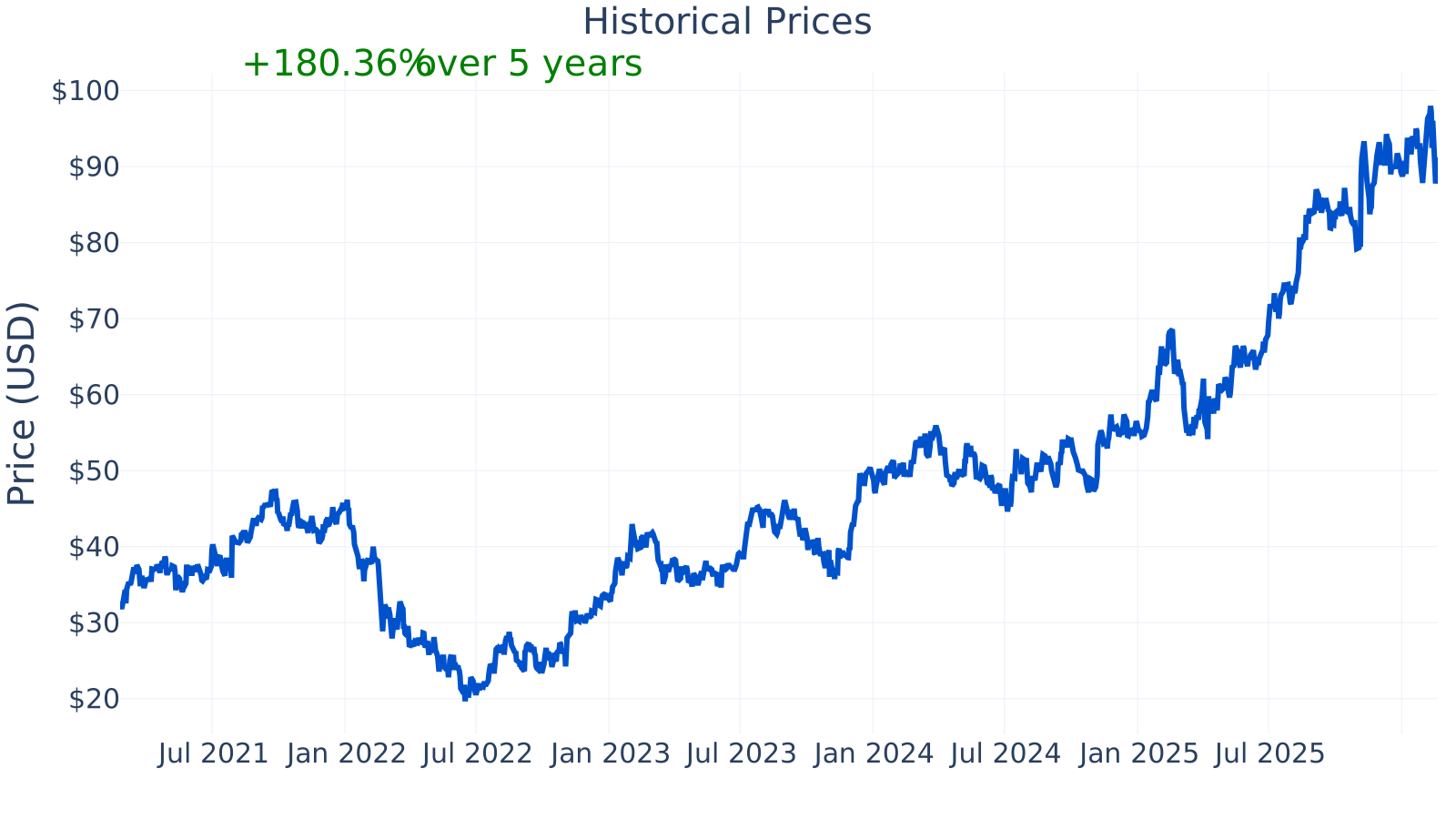
SGI’s market capitalization is about $19.1B. The stock’s beta is about 1.28, which indicates the share price has historically moved more than the broader market on average (higher volatility than a beta near 1).
On valuation, the latest P/E ratio is about 57.7 versus an industry median near 19.3. Profit margin is about 5.14% versus an industry median near 3.93%. Year-over-year revenue growth is shown at about 54.7% versus an industry median near 1.7%, and trailing twelve-month free cash flow is about $633M. Debt-to-equity is about 265.9% versus an industry median near 100.5%, indicating heavier leverage than many peers in the same industry.
Growth (Medium)
SGI operates in a consumer cyclical category, where long-term demand is often linked to household formation, housing turnover, renovation cycles, and consumer purchasing power. That backdrop can support multi-year growth, but it is usually not a straight line: periods of strong demand can be followed by pullbacks when interest rates rise or consumer budgets tighten.
The most recent year-over-year revenue growth figures accelerate materially into 2025 (rising into the ~35% to ~63% range across the year, ending around ~55%). That pattern can reflect a business expansion, acquisitions, distribution gains, pricing changes, or comparisons against weaker prior periods. For long-term analysis, a key question is whether the higher revenue level can be maintained once the comparison becomes “harder” in the following year.
Free cash flow (a rough measure of cash generated after operating needs and capital spending) is positive and has increased in the periods shown (from about $468M to about $553M in the trailing twelve-month snapshots provided, with the latest level shown in the table around $633M). Positive free cash flow can help a company fund reinvestment, reduce debt, or handle downturns without depending as much on external financing—though the strength and consistency over a full cycle matter.
Potential “catalysts” for continued growth typically include expanding distribution, taking market share, product innovation, and (in cyclical industries) a more supportive housing/consumer environment. Whether these drivers are durable depends on SGI’s competitive position and balance sheet flexibility, discussed below.
Risks (High)
The largest structural risk visible in the metrics is leverage. A higher debt load can amplify outcomes: it may boost returns during strong periods but can reduce flexibility when demand slows, interest rates rise, or refinancing becomes more expensive.
SGI’s debt-to-equity ends around ~265.9%, above the industry median (~81.6% at the latest point shown). The chart also shows a large decline from extremely elevated levels earlier (well above 1,000%), which suggests the balance sheet has been changing significantly over time. Even after that improvement, leverage remains meaningfully higher than typical peers, and interest expense is substantial in the income statement (e.g., rising to about $268M in 2025).
Profitability is another key risk area for consumer-product businesses, because margins can be squeezed by input costs, freight, promotions/discounting, and shifts in customer mix.
SGI’s profit margin has fluctuated in recent periods, dipping from the ~7%–8% range in mid/late 2024 to around ~5% in 2025. While the latest margin (~5.14%) is still slightly above the industry median (~3.93%), the downward movement matters because small margin changes can have an outsized impact on earnings in high-volume, competitive categories.
Competitive dynamics are important in furnishings and home-related products. Rivals typically compete on brand, retail presence, product breadth, pricing, supply chain reliability, and customer experience. SGI’s competitive advantages (if any) would usually be evidenced in filings through brand strength, scale efficiencies, differentiated products, and distribution reach. Without using non-permitted sources, this article cannot rank SGI’s market-share position precisely versus named competitors. A practical way to assess relative strength using filings is to compare SGI’s margins, cash generation, and revenue stability to peer ranges over multiple years, and to review risk-factor disclosures about competition and pricing pressure.
Finally, cyclicality is a real risk for long-term holders: demand can soften during housing downturns or when consumers delay discretionary purchases. That can pressure revenue, margins, and cash flow at the same time—especially for more leveraged companies.
Valuation
Valuation is often summarized through the P/E ratio, which compares the stock price to earnings per share. Higher P/E ratios generally imply the market expects higher future growth, higher future profitability, or a combination of both. They also leave less room for disappointment if growth slows or margins compress.
SGI’s latest P/E is about 57.7, well above the industry median near 19.3. The historical series shown begins displaying meaningful company P/E values starting in 2024 and rises into the high-50s by late 2025, while the industry median remains far lower (mid-to-high teens). In plain terms, SGI is being priced at a materially richer earnings multiple than typical peers in the same industry grouping.
That valuation can be consistent with the recent surge in revenue growth, but it also increases sensitivity to execution: if the growth rate normalizes, if profit margins remain under pressure, or if interest expense stays elevated, a high P/E can be harder to sustain. On the other hand, if SGI can keep growing while stabilizing margins and managing leverage, the market may continue to accept a higher multiple than the industry median.
Conclusion
Somnigroup International Inc shows a mix of strong recent top-line momentum and positive free cash flow, alongside notable balance-sheet and cyclicality considerations. Revenue trends in 2025 stand out as unusually strong compared with the broader industry median growth rate, and profitability remains modestly above the peer median despite recent margin compression.
The main trade-offs visible in the fundamentals are (1) higher leverage than typical peers and meaningful interest expense, which can reduce flexibility in a downturn, and (2) a valuation multiple substantially above the industry median, which implies the market is already embedding optimistic expectations.
For a long-term perspective, the most decision-relevant items to track over time are whether elevated revenue growth proves durable beyond a single year, whether profit margins stabilize, and whether leverage continues to move toward peer-like levels without weakening cash generation.
Sources:
- U.S. SEC EDGAR — Company filings for Somnigroup International Inc (Form 10-K, 10-Q, 8-K)
- Somnigroup International Inc — Investor Relations materials and SEC-filed reports (as published by the company)
- Wikipedia — “Somnigroup International” (basic company background; non-financial context)
This article is for informational purposes only and does not constitute financial advice. Some content is AI-generated. See Disclaimer