Stock Analysis · Telephone and Data Systems Inc (TDS)
Overview
Telephone and Data Systems, Inc. (TDS) is a U.S.-based telecommunications company. Through its main businesses, it provides wireless service (primarily through its majority-owned subsidiary UScellular) and broadband and related services (through its TDS Telecom operations). In plain terms, the company earns money by connecting people and businesses to mobile networks and to home/business internet, and by supporting those services with customer care, device sales, and network infrastructure.
In telecom, revenue is typically driven by recurring monthly service fees (wireless plans and internet subscriptions), plus more variable items such as equipment/device sales and certain installation or usage-based fees. TDS also invests heavily in network capacity (wireless spectrum and towers; fiber and other fixed-line infrastructure) to maintain service quality and compete with larger national providers.
Main revenue streams (largest to smaller) are commonly described as:
- Wireless service and equipment (UScellular-related activities; generally the largest portion of the business)
- Broadband / fixed-line services (internet access and related services through TDS Telecom)
- Other/ancillary telecom-related revenue (smaller items depending on reporting period)
Percentages by segment can change by year and should be taken from the most recent annual report segment note; the broad mix above reflects the company’s typical structure as described in its filings.
Across the years shown, total revenue trends downward from the early 2020s to 2024, with a much lower revenue level shown for 2025. Operating income is positive in several years but swings meaningfully, and net income is volatile (including a large loss in 2023). Interest expense is a recurring cost that can matter in periods of higher rates or higher debt balances.
Key Figures
| Metric | Value | Industry ⓘ |
|---|---|---|
| Date | May 04, 2026 | |
| Context | ||
| Sector | Communication Services | |
| Industry | Telecom Services | |
| Market Cap ⓘ | $5.18B | |
| Beta ⓘ | 0.32 | |
| Fundamental | ||
| P/E Ratio ⓘ | 116.62 | 14.31 |
| Profit Margin ⓘ | -0.51% | 7.29% |
| Revenue Growth ⓘ | 12.00% | 4.10% |
| Debt to Equity ⓘ | 37.10% | 105.78% |
| PEG ⓘ | 7.79 | |
| Free Cash Flow ⓘ | $193.19M | |
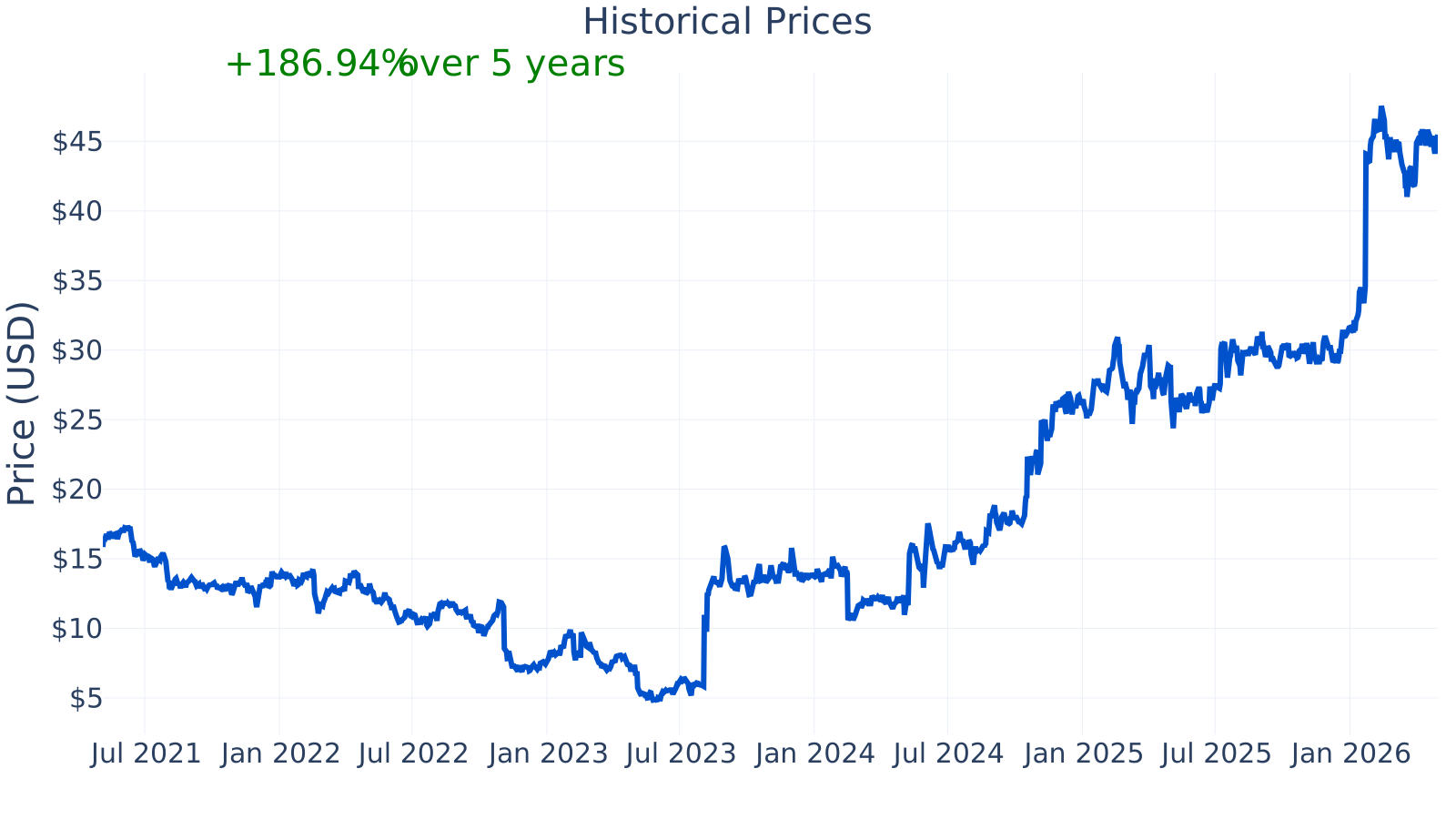
TDS is shown with a market capitalization of about $5.18B and a low historical beta of 0.32, which indicates the stock price has tended to move less than the broader market in the periods measured. The latest profitability snapshot shows a -0.51% net profit margin versus an industry median near 7.29%, meaning the company’s recent earnings have been weaker than the typical telecom peer. Year-over-year revenue growth is listed at 12% versus an industry median near 4.1%, while leverage (debt-to-equity) is about 37%, below the industry median near 106%. The trailing free cash flow shown is about $193M, which suggests the business has recently generated cash after capital spending, even though accounting earnings have been pressured.
Growth (Medium)
Telecom is generally considered a mature, infrastructure-heavy industry: many customers already have service, so growth often comes from taking share, upgrading customers to higher-value plans, expanding broadband footprints, and improving network quality. Demand drivers still exist—data usage keeps rising, homes need faster internet, and businesses rely on connectivity—but competition is intense and pricing power is often limited.
For TDS, a key long-term growth question is whether it can (1) sustain and grow subscribers, (2) monetize network investments efficiently, and (3) improve operating performance in a way that is durable. Strategic efforts in telecom often focus on expanding fiber broadband availability, improving customer experience, and managing capital spending so that the business can produce consistent free cash flow.
The year-over-year revenue growth pattern shown is uneven and turns sharply negative in the most recent periods displayed (including very large declines late in the series). In a telecom business, sharp revenue drops can reflect major structural changes (for example, business mix shifts, asset sales, or reporting changes) or meaningful competitive pressure; understanding the “why” requires reading the company’s most recent 10-K/10-Q discussion and segment notes.
Free cash flow improves substantially over time in the chart, moving from negative levels (2022) to positive and rising levels through 2025. For long-term business resilience, sustained positive free cash flow can matter because it helps fund network investment, debt service, and operational flexibility without relying as heavily on external financing.
Risks (High)
TDS faces several common telecom risks: heavy ongoing capital requirements (networks must be maintained and upgraded), fast-moving competitive dynamics, and sensitivity to customer churn (customers leaving for another provider). In wireless, large national carriers can pressure smaller providers through device promotions, bundling, and broad network coverage. In broadband, competition can come from cable operators, fiber overbuilders, fixed wireless offerings, and local providers depending on geography.
Profitability volatility is a central risk. While telecom can be stable when subscriber bases and pricing are steady, TDS’s net margin has been below typical industry levels in the periods shown, and net income has swung from profit to loss. This can limit flexibility if elevated spending is required for network build-outs or if pricing becomes more promotional.
Debt-to-equity trends lower over the long run displayed, ending around 37% (versus an industry median near 106%). Lower leverage can reduce financial strain, but it does not remove the business risk tied to operating performance, competitive pressure, and required capital expenditures.
Net profit margin deteriorates meaningfully after 2022, reaching deeply negative levels in parts of 2023–2024, and remaining slightly negative most recently (about -0.21%) while the industry median is positive (about 7.81%). For a long-term assessment, a key point to verify in filings is whether these margin pressures are driven by one-time items (such as impairments, restructuring, or transaction-related effects) or reflect ongoing economics (such as subscriber losses or sustained pricing pressure).
Competitive positioning is another risk area. In wireless, the major U.S. national carriers are the primary competitive reference set, with additional pressure from cable companies offering mobile service via wholesale arrangements. In fixed broadband, competition is often regional and technology-dependent (fiber vs. cable vs. fixed wireless). TDS is not the industry leader overall; its competitiveness tends to be more regional and segment-specific, which can work well in certain markets but can be challenged when larger players target the same customers.
Valuation
Valuation measures for telecom companies are often interpreted alongside profitability quality and stability. TDS’s latest P/E ratio is shown around 116.6, much higher than the industry median near 14.3. A very high P/E can occur when earnings are temporarily depressed (making “E” small), when the market expects a rebound in profitability, or when non-recurring items distort net income.
The historical P/E series shows periods where the P/E was in a more typical range earlier in the timeline, followed by stretches where the P/E is not meaningful (not displayed) or spikes (for example around 2023), which is consistent with volatile or very low earnings. In this context, interpreting valuation usually requires looking beyond P/E alone and cross-checking what drove net income changes, whether free cash flow is sustainable, and how much capital spending is required to keep the network competitive.
Because telecom businesses can carry significant depreciation and periodic one-time charges, investors often also focus on cash generation and leverage. Here, the combination of improving free cash flow (as shown) and comparatively lower debt-to-equity can be viewed as offsets to weak recent profit margins, but they do not eliminate the need to understand the underlying earnings power of the operating segments.
Conclusion
TDS operates in a fundamental but highly competitive industry, providing wireless and broadband connectivity services that tend to generate recurring revenue. The company’s recent picture is mixed: free cash flow has improved over time, and leverage appears lower than the industry median, but profitability has been weak compared with peers and revenue growth has been volatile—turning sharply negative in the most recent periods shown.
From a long-term perspective, the key factual items to validate in the latest SEC filings are (1) what is driving the recent revenue declines, (2) whether profit margin pressure is structural or driven by non-recurring charges, (3) the required level of ongoing capital spending to remain competitive, and (4) how management describes the path to more stable operating results. With a high P/E ratio in the latest snapshot and uneven earnings history, the stock’s valuation signals appear tightly linked to whether profitability normalizes and whether cash generation remains durable.
Sources:
- U.S. Securities and Exchange Commission (SEC) EDGAR — Telephone and Data Systems, Inc. filings (Form 10-K, Form 10-Q, Form 8-K)
- Telephone and Data Systems, Inc. — Investor Relations materials (annual reports and press releases, as provided by the company)
- Wikipedia — “Telephone and Data Systems” (basic company background)
This article is for informational purposes only and does not constitute financial advice. Some content is AI-generated. See Disclaimer


