Stock Analysis · Tegna Inc (TGNA)
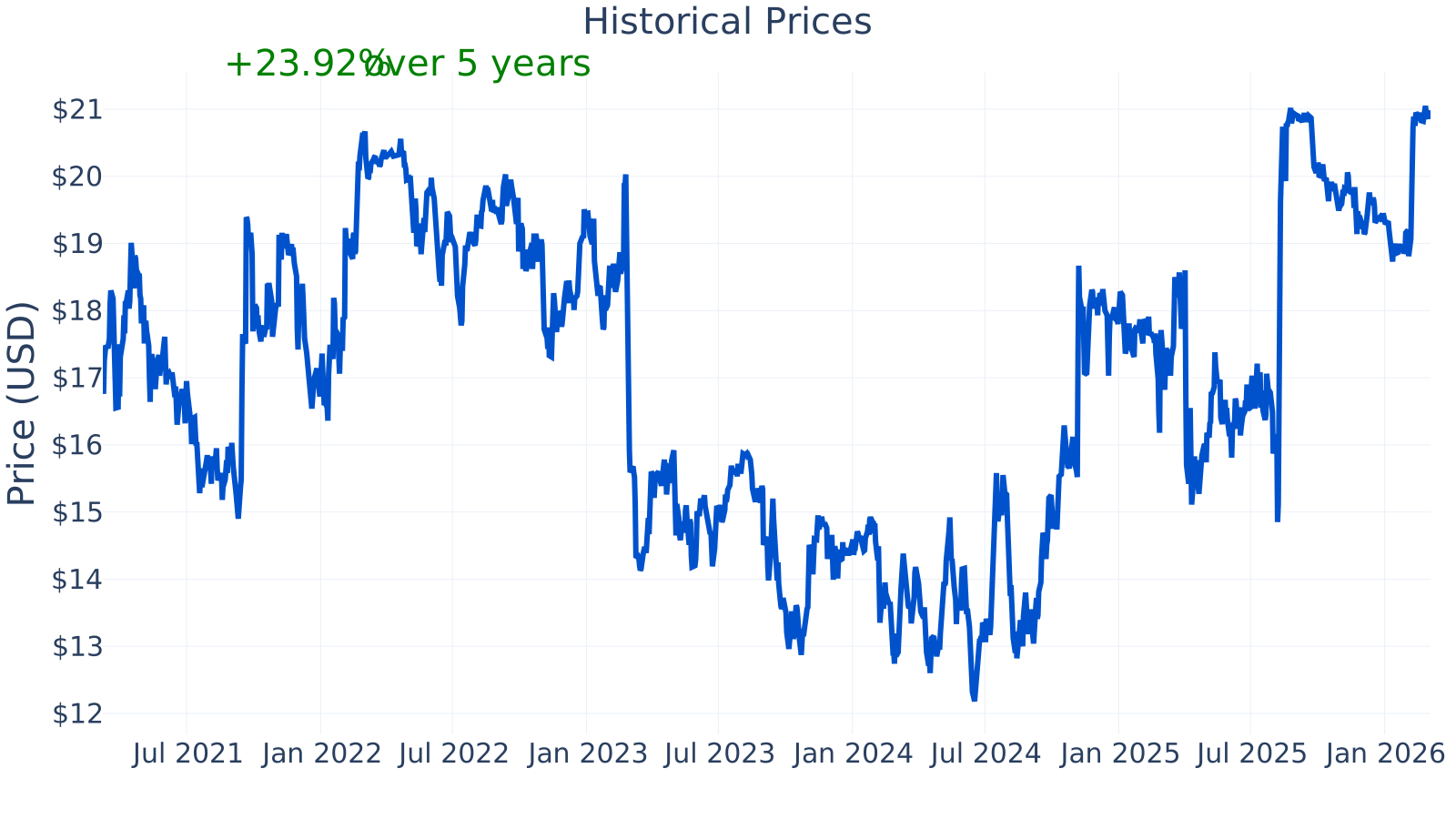
Overview
Tegna Inc. is a U.S. media company best known for owning and operating local television stations. These stations produce local news and community programming and also carry major network content (through affiliations) to viewers in their markets. In practical terms, Tegna’s business sits at the intersection of local advertising, local news audiences, and distribution payments from cable/satellite/streaming TV providers that carry its stations.
Its revenue is largely tied to two main streams that are common in local broadcasting:
- Advertising (including local and national advertising, and political advertising during election cycles)
- Distribution / retransmission revenue (fees paid by cable, satellite, and virtual MVPD providers to carry Tegna’s local stations)
From an operating perspective, Tegna’s results can also be influenced by how much it invests in news gathering and station operations (people, production, and technology), and by the overall health of the advertising market.
Looking at the recent multi-year income “bridge” view below, total revenue rose from about $2.99B (2021) to $3.28B (2022), then declined to $2.91B (2023), improved to $3.10B (2024), and declined again to about $2.71B (2025). Net income followed a similar pattern, with a notably lower level in 2025 (about $220M), reflecting weaker profitability that year compared with 2024 (about $600M).
Key Figures
| Metric | Value | Industry ⓘ |
|---|---|---|
| Date | Mar 06, 2026 | |
| Context | ||
| Sector | Communication Services | |
| Industry | Broadcasting | |
| Market Cap ⓘ | $3.40B | |
| Beta ⓘ | 0.12 | |
| Fundamental | ||
| P/E Ratio ⓘ | 15.66 | |
| Profit Margin ⓘ | 8.11% | |
| Revenue Growth ⓘ | -18.90% | |
| Debt to Equity ⓘ | 82.42% | |
| PEG ⓘ | 0.65 | |
| Free Cash Flow ⓘ | $282.56M | |
Tegna’s market capitalization is about $3.40B. The stock’s beta of ~0.12 indicates that, historically, its price has moved less than the broader market on average (beta can change over time, but it is one way to describe past volatility). The P/E ratio is ~15.66, while the profit margin is ~8.11%. Recent growth has been weak: revenue growth year over year is about -18.9%. Leverage is meaningful with debt-to-equity of ~82%. Over the last twelve months shown, free cash flow is about $282.6M (cash generated after operating needs and capital spending, a common yardstick for financial flexibility).
Growth (Low)
Local broadcasting is a mature industry. Audience behavior has been shifting over time toward streaming and on-demand viewing, which tends to pressure traditional TV advertising. At the same time, local stations can remain relevant because they provide “must-have” content in many markets—especially local news and certain live events—supporting both advertising demand and distribution fees.
For Tegna specifically, growth often depends less on steady, year-by-year expansion and more on a mix of factors that can swing results:
- Political advertising cycles (election years can materially lift advertising revenue, while off-cycle years can be weaker)
- The broader ad market (local and national advertising budgets tend to be sensitive to economic conditions)
- Negotiations with TV distributors (distribution fee renewals can improve revenue, but disputes can also create temporary pressure)
- Digital and local marketing services initiatives (often positioned as a way to reach audiences beyond traditional linear TV)
The year-over-year revenue growth pattern below shows that performance has fluctuated: after periods of positive growth, there were several quarters with negative year-over-year comparisons, and the most recent value shown is roughly -18.9%. This kind of variability is consistent with the mix of cyclical advertising and election-driven spending.
Free cash flow is important for businesses like broadcasting because it can support debt repayment, reinvestment in stations and content, and other corporate needs. The trailing figures shown indicate variability: free cash flow was higher in earlier periods (for example, around $640M in 2021 and $738M in 2023) and is shown at about $283M on a trailing basis in the latest metric set. A sustained lower level of free cash flow can reduce flexibility, especially in a higher-rate financing environment.
Risks (High)
Tegna’s risks are closely tied to the economics of local TV. A key issue is that advertising can be cyclical and can also be structurally pressured as more spending shifts toward digital platforms. Another major risk is the lumpiness of political advertising: strong election-year revenue can make the following periods look weaker by comparison.
Distribution revenue can be steadier than advertising, but it brings its own uncertainty. Fees depend on negotiations with cable/satellite/streaming TV distributors, and disagreements can sometimes lead to temporary signal interruptions, customer churn at distributors, or delayed revenue recognition depending on the situation described in company filings.
Financial leverage matters because it can magnify outcomes when profitability dips. The debt-to-equity trend below shows a meaningful improvement over time—moving from roughly 169% (early 2021) down to about 82% (late 2025). That direction suggests deleveraging, but the remaining leverage level still means earnings and cash flow need to be monitored closely in weaker advertising periods.
Profitability can also swing. The profit margin chart shows margins that were often in the mid-to-high teens earlier in the period, declining to about 8.1% most recently. A margin decline like this can come from a combination of softer revenue, cost pressures, and the operating leverage that’s typical in media businesses (fixed costs don’t fall as quickly as revenue during down cycles).
On competitive positioning, Tegna competes for viewers’ attention and for advertising budgets. In local broadcasting, competitive advantages often come from station scale, local news strength, network affiliations, relationships with local advertisers, and distribution reach. Tegna is a sizable station owner in the U.S., but it is not the only large operator. Major peers in U.S. local broadcasting include companies such as Nexstar Media Group, Sinclair, and Gray Television. Compared with these peers, Tegna’s positioning is largely defined by the quality and reach of its station portfolio and its execution in monetizing both advertising and distribution fees, rather than by a single proprietary technology that creates a strong moat.
Valuation
A simple way many people sanity-check valuation is by looking at the price-to-earnings (P/E) ratio, while keeping in mind that earnings in broadcasting can be cyclical (especially due to political advertising). The latest P/E shown is about 15.66. The historical P/E chart suggests the multiple has varied materially over time (often in the mid-single digits in several periods shown, rising toward higher single digits more recently). This can happen when the stock price moves, when earnings move, or both.
Interpreting whether today’s valuation is “high” or “low” is difficult without a forward-looking earnings path, because recent fundamentals show mixed signals: revenue growth is currently negative (about -18.9% year over year) and profit margin has compressed (to roughly 8.1%), while leverage has improved versus earlier years (debt-to-equity down to about 82%) and free cash flow is still positive (about $283M on a trailing basis). In other words, the valuation needs to be read in the context of a business where both revenue and profitability can change meaningfully from year to year.
Conclusion
Tegna is primarily a local television station operator with revenue tied to advertising (including political cycles) and distribution fees. The company shows characteristics typical of mature media: results can be uneven, with periods of stronger revenue and profitability followed by softer years. Recent figures show negative year-over-year revenue growth and a notable decline in profit margin, while leverage has trended down over time and free cash flow remains positive but lower than some earlier periods.
For long-term analysis, the central points to track over time are the stability of distribution revenue, the company’s ability to manage costs and maintain local audience strength, the size of political advertising in election cycles versus off-cycle years, and whether cash generation remains sufficient relative to debt and ongoing investment needs.
Sources:
- SEC EDGAR — Tegna, Inc. filings (Form 10-K, Form 10-Q)
- Tegna, Inc. Investor Relations — SEC filings and investor materials
- Wikipedia — “Tegna Inc.” (basic company background)
This article is for informational purposes only and does not constitute financial advice. Some content is AI-generated. See Disclaimer


