Stock Analysis · Taylor Morn Home (TMHC)
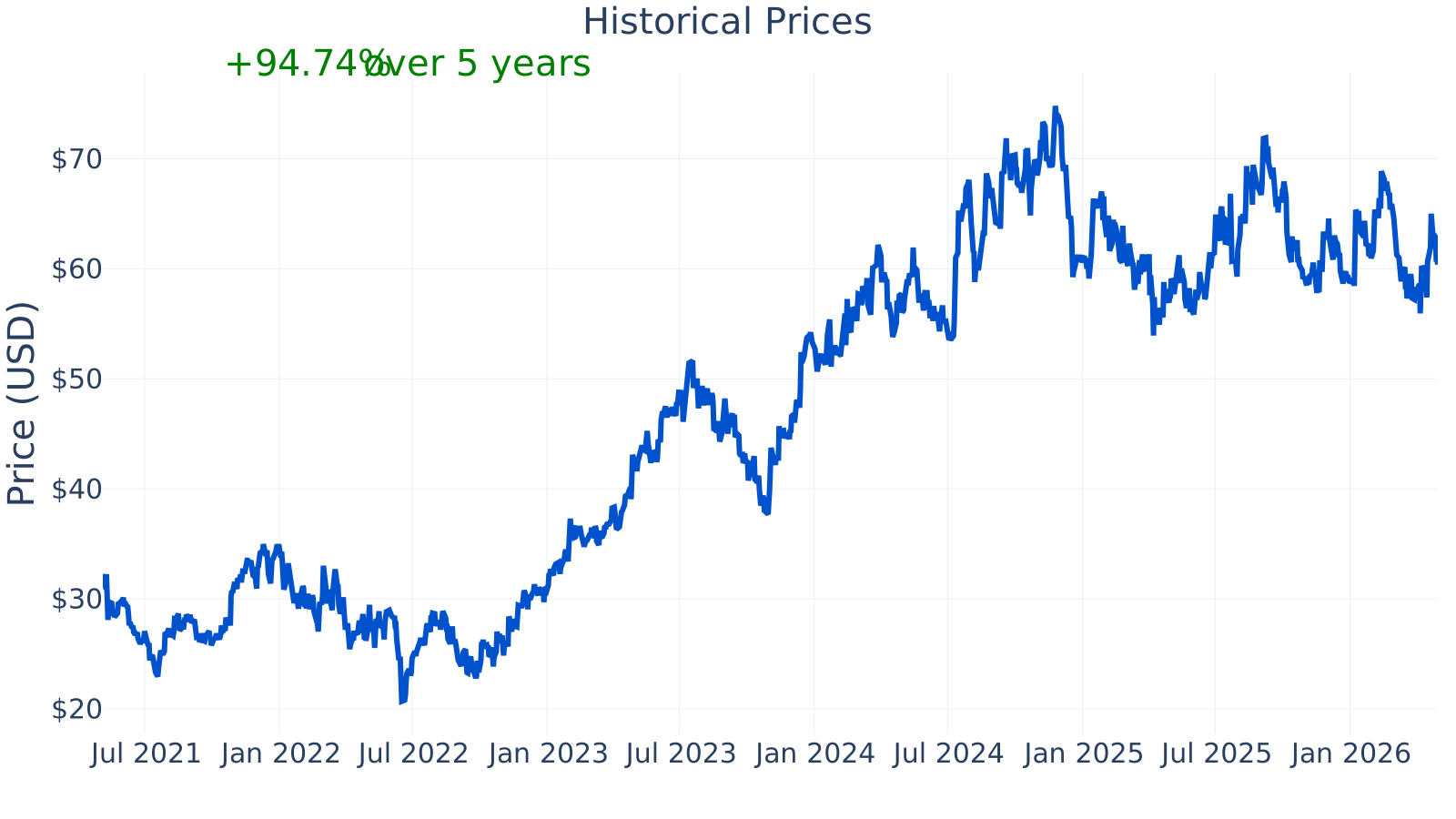
Overview
Taylor Morrison Home Corporation (TMHC) is a U.S. homebuilder. In simple terms, it buys and develops land, builds homes (often within planned communities), and sells those homes to customers. The company also supports buyers through related services such as mortgage origination and title/closing services, which are typically tied to its home sales activity.
TMHC’s business is commonly described in two main parts: (1) building and selling homes (its largest activity), and (2) financial services connected to those home transactions. Because new home construction is cyclical, results can change meaningfully depending on mortgage rates, housing affordability, consumer confidence, and local market conditions.
Main sources of revenue are generally organized as follows (largest to smallest):
- Homebuilding (home sales revenue) — the core business, driven by closings and average selling prices.
- Financial services — mortgage and title-related services associated with home sales.
From 2021 to 2025, revenue stayed in a relatively similar range (roughly $7.4B to $8.2B), while profitability fluctuated with the housing cycle. Over the same period, interest expense increased notably in 2025 versus the prior year, which can matter in a business that uses debt to carry land and construction inventory.
Key Figures
| Metric | Value | Industry ⓘ |
|---|---|---|
| Date | May 04, 2026 | |
| Context | ||
| Sector | Consumer Cyclical | |
| Industry | Residential Construction | |
| Market Cap ⓘ | $5.64B | |
| Beta ⓘ | 1.58 | |
| Fundamental | ||
| P/E Ratio ⓘ | 9.00 | 12.42 |
| Profit Margin ⓘ | 8.77% | 8.30% |
| Revenue Growth ⓘ | -26.80% | -10.70% |
| Debt to Equity ⓘ | 38.65% | 32.82% |
| PEG ⓘ | 1.41 | |
| Free Cash Flow ⓘ | $709.65M | |
TMHC’s market capitalization is about $5.64B, and its beta of 1.58 indicates the stock has historically moved more than the broader market (both up and down). The company shows a P/E ratio of ~9.0, below the residential construction industry median (~12.4), while its latest profit margin is about 8.77% (slightly above the industry median of ~8.31%). Recent year-over-year revenue growth is negative (-26.8%), which is weaker than the industry median (-10.7%). Debt-to-equity is about 38.6%, somewhat higher than the industry median (~32.8%). Trailing twelve-month free cash flow is about $710M.
Growth (Medium)
Homebuilding is tied to long-term housing needs (population growth, household formation, and housing replacement), but the industry is highly sensitive to short- and medium-term changes in interest rates and affordability. This creates a pattern where demand can strengthen quickly when financing becomes easier, and soften when monthly payments rise.
For TMHC, the basic growth logic is straightforward: expand or refresh the community and lot pipeline, convert demand into orders, then deliver completed homes at acceptable margins. The company’s results can improve when it can (a) keep a steady pace of home closings, (b) manage build costs and incentives, and (c) maintain disciplined land spending across the cycle.
The year-over-year revenue trend has been uneven over the last several quarters, including a recent decline (down about 26.8%). In homebuilding, this can reflect changes in the number of homes delivered, shifts in average selling prices, and incentives used to support demand during tougher affordability periods.
Free cash flow is an important lens for homebuilders because working capital (especially land and construction inventory) can absorb or release large amounts of cash. TMHC’s trailing twelve-month free cash flow is about $710M, and it has varied substantially over recent years—showing how cash generation can swing as the company invests in lots and builds homes for future deliveries.
Risks (High)
The largest risk factor is the housing cycle itself. Demand for new homes can drop when mortgage rates rise, affordability worsens, or consumers become more cautious. Because many costs are fixed or semi-fixed in the near term (construction operations, staffing, community overhead), lower volumes can pressure profitability. Another structural risk is cost volatility in labor and materials, which can move faster than selling prices, especially during periods of weaker demand.
TMHC’s debt-to-equity is about 38.6%. The longer-term trend shows a meaningful reduction from much higher levels earlier in the period (near ~88–90% in 2021), but leverage remains somewhat above the industry median more recently. For homebuilders, balance sheet strength matters because land and construction inventory require financing and can become harder to monetize during downturns.
Profit margins improved significantly from 2021 into 2022–2023, then compressed over time, landing around 8.83% most recently. That level is slightly above the industry median (~8.31%), but the downward direction can be a signal that pricing power and/or cost conditions have become less favorable compared with the peak part of the cycle.
Competition is intense in residential construction, often playing out locally rather than nationally. TMHC competes with other large public builders and many private/regional builders. Key publicly traded competitors typically include D.R. Horton, Lennar, PulteGroup, NVR, and Toll Brothers, among others. Compared with the largest builders, TMHC is generally smaller by scale, which can mean less purchasing leverage in some categories, but it can also allow focus in selected markets and product segments.
Competitive advantages in homebuilding usually come from land strategy, local market execution, construction efficiency, brand/community positioning, and access to capital. TMHC’s financial services arm can also support conversion (helping buyers complete financing and closing), though it remains tied to the same underlying housing demand.
Valuation
TMHC’s P/E ratio has frequently traded below the industry median over the displayed period and is currently around 9.0 versus an industry median near 12.4. A lower P/E can reflect market expectations of slower growth, higher cyclicality, or higher risk; it can also occur when earnings are elevated relative to more normalized conditions.
In this industry, valuation ratios need to be read alongside where the company is in the cycle. TMHC’s margins have come down from prior highs and revenue growth is currently negative, which can affect how markets interpret current earnings power. At the same time, profitability remains positive and free cash flow is currently positive, which can be supportive for balance sheet flexibility (for example, funding land investment, reducing debt, or other corporate uses), subject to management decisions and market conditions.
Conclusion
Taylor Morrison is a major U.S. homebuilder whose results are primarily driven by home closings, pricing, and construction/land costs, with additional contribution from mortgage and title-related services tied to its home sales. Recent results show positive profitability and positive free cash flow, while year-over-year revenue growth has weakened and margins have moderated from earlier peaks.
For long-term analysis, the central question is how TMHC performs across full housing cycles: maintaining a disciplined land pipeline, protecting margins through changing affordability conditions, and keeping leverage at levels that remain manageable when demand softens. The company’s valuation multiples appear lower than the industry median, which may align with the sector’s cyclical nature and the market’s expectations about future earnings variability.
Sources:
- SEC EDGAR — Taylor Morrison Home Corporation filings (Form 10-K, Form 10-Q)
- Taylor Morrison Investor Relations — Annual Report materials and investor presentations (company-published)
- Wikipedia — “Taylor Morrison” (basic company background)
This article is for informational purposes only and does not constitute financial advice. Some content is AI-generated. See Disclaimer


