Stock Analysis · Taylor Morn Home (TMHC)
Overview
Taylor Morrison Home Corporation (TMHC) is a U.S. homebuilder. In simple terms, it buys or controls land, develops communities, builds single-family homes, and sells those homes to buyers. The company also offers related services that support the home purchase, such as mortgage lending and title services, which are typically provided around the time a home is closed (finalized).
Its business is closely tied to U.S. housing demand, household formation, local job conditions, consumer confidence, and mortgage rates. Homebuilding is cyclical: in strong periods, buyers purchase more homes and builders can keep pricing firm; in weaker periods, demand can slow and builders may use incentives to support sales.
Main sources of revenue (largest to lowest) are generally structured as:
- Homebuilding (home sales) — selling completed homes to customers (typically the vast majority of revenue).
- Financial services — mortgage origination and related services tied to the home purchase (a smaller portion of revenue, but can support sales through financing availability).
- Other / ancillary — items such as land-related activity or other smaller lines, depending on the period and reporting structure.
The company’s recent income structure (revenue flowing through costs and operating expenses to profit) shows that most dollars go to the direct cost of building homes (materials, labor, land development), while selling and administrative costs represent a smaller slice. Net income has remained substantial in recent years, even with normal ups and downs tied to the housing cycle.
Looking across recent years in the flow above, total revenue has stayed in a similar range (roughly $7.4B–$8.2B), while net income has also remained meaningfully positive. Interest expense, while still small relative to revenue, rises in the latest period shown, which can matter in a higher-rate environment.
Key Figures
| Metric | Value | Industry ⓘ |
|---|---|---|
| Date | Feb 16, 2026 | |
| Context | ||
| Sector | Consumer Cyclical | |
| Industry | Residential Construction | |
| Market Cap ⓘ | $6.73B | |
| Beta ⓘ | 1.59 | |
| Fundamental | ||
| P/E Ratio ⓘ | 8.86 | 13.08 |
| Profit Margin ⓘ | 9.64% | 8.48% |
| Revenue Growth ⓘ | -10.90% | -5.40% |
| Debt to Equity ⓘ | 1.13% | 32.64% |
| PEG ⓘ | 1.51 | |
| Free Cash Flow ⓘ | $580.03M | |
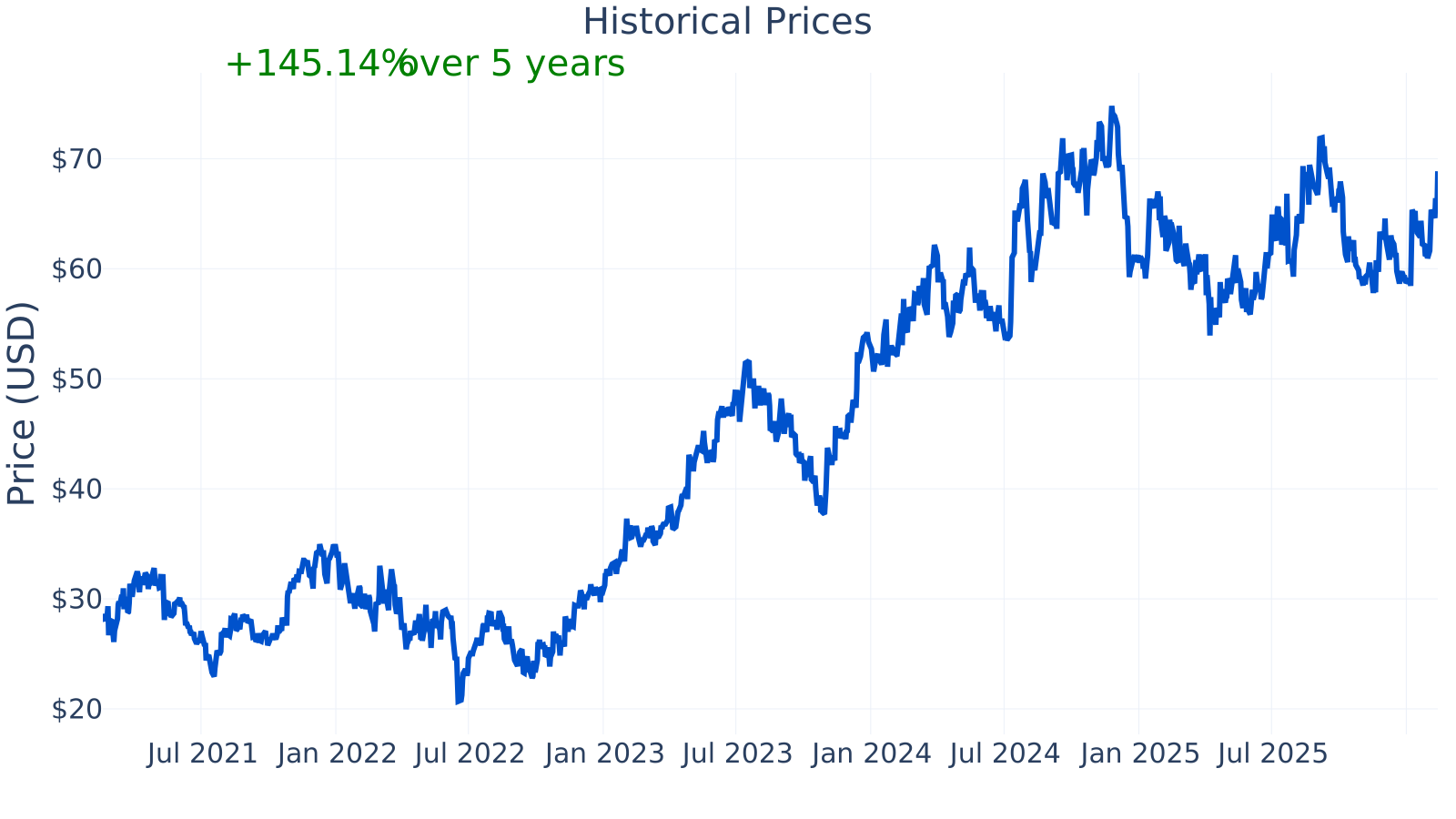
Taylor Morrison’s market capitalization is about $6.7B. The stock’s beta of ~1.59 suggests it has tended to move more than the broader market (both up and down), which is common for economically sensitive companies like homebuilders.
On valuation, the latest P/E ratio is ~8.86, below the industry median shown (~13.08). Profitability (net profit margin) is about 9.64%, modestly above the industry median shown (~8.49%).
Recent growth is mixed: the latest year-over-year revenue growth is about -10.9%, compared with an industry median of about -5.4% (both negative). Balance-sheet leverage appears low on the latest snapshot, with debt-to-equity ~1.13% versus an industry median shown near 32.64%. Free cash flow over the trailing twelve months is about $580M, indicating the business has recently generated meaningful cash after operating needs and capital spending.
Growth (Medium)
Homebuilding participates in an industry that can grow over the long run with population trends and household formation, but it can swing sharply with mortgage rates, affordability, and the overall economy. That means “growth” often looks uneven year to year, even for well-run operators.
A practical long-term growth question for a homebuilder is whether it can (1) keep a strong pipeline of lots and communities, (2) maintain build quality and cycle times, (3) control costs, and (4) protect margins through different parts of the cycle. Taylor Morrison’s ability to generate solid profits in multiple recent years suggests it has been executing effectively, though results still depend heavily on market conditions.
The revenue growth trend shows large positive growth in 2021–2022, followed by periods of contraction and rebound. Most recently, growth is near flat to slightly negative, which is consistent with a market that has been balancing limited housing supply against affordability pressure from higher borrowing costs.
Free cash flow has also been volatile over time (which is common in homebuilding because land spending, development timing, and inventory changes can move cash generation significantly). Still, the latest trailing twelve months remain positive, which can provide flexibility for land investment, debt management, or other capital allocation choices depending on management’s priorities and market conditions.
Potential catalysts in this industry typically include shifts in mortgage rates and affordability, changes in new-home supply versus existing-home supply, and local market strength in the geographies where the builder concentrates its communities. Company-specific catalysts often relate to maintaining a healthy backlog, lot position, and consistent execution on build times and costs.
Risks (High)
This article is for informational purposes only and does not constitute financial advice. Some content is AI-generated. See Disclaimer