Stock Analysis · Taskus Inc (TASK)
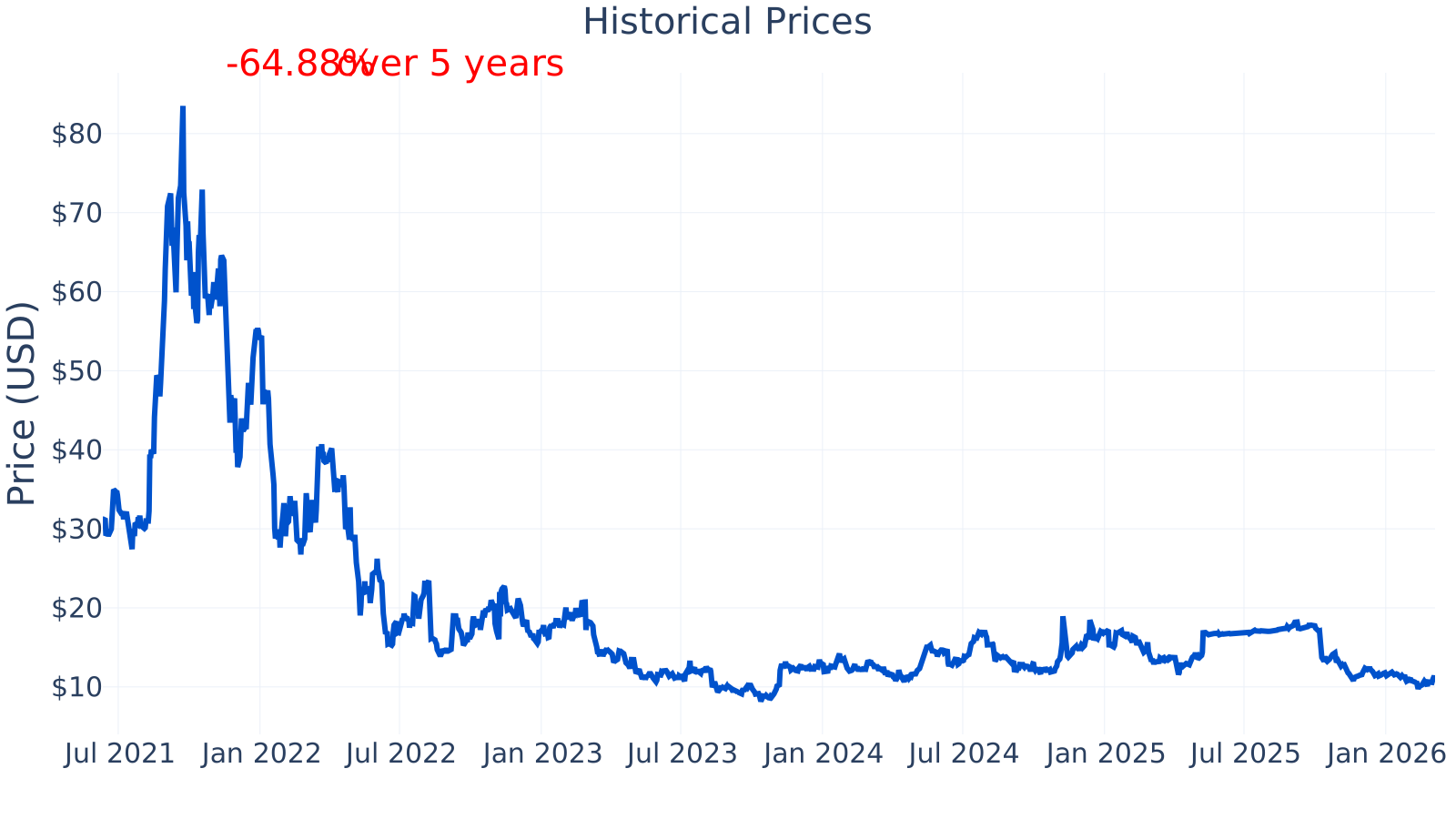
Overview
TaskUs, Inc. is a business services company that helps other organizations run and improve day-to-day customer-facing and operational work. In simple terms, it provides teams, processes, and technology support so its clients can handle things like customer support, content safety work, and other back-office tasks at scale. TaskUs describes this as “digital outsourcing,” meaning the work often supports internet and software-driven businesses and is delivered through a mix of people, standardized workflows, and internal tools.
TaskUs generates revenue primarily by providing outsourced services to clients under contracts (typically priced per hour, per agent, per interaction, or via other service-based pricing, depending on the engagement). The company’s filings describe several major service areas, commonly including customer experience work (support and engagement), “trust and safety” style services (such as content moderation and risk-related operations), and broader back-office or specialized support for fast-growing digital businesses. Public filings generally emphasize that revenue is concentrated in service delivery rather than one-time product sales.
Public filings commonly describe revenue concentration by client and by industry vertical (for example, exposure to technology and high-growth digital-native companies), but the exact mix and percentages can change year to year and are best read directly in the most recent annual report sections on “revenues,” “customers,” and “concentration.”
Across recent years, total revenue moved from about $760.7M (2021) to $1.183B (2025). Over the same period, operating income shifted from a loss in 2021 to a positive level thereafter, with net income rising to about $102.3M in 2025. This pattern suggests that profitability improved as the business scaled and operating expenses were managed relative to revenue.
Key Figures
| Metric | Value | Industry ⓘ |
|---|---|---|
| Date | Mar 09, 2026 | |
| Context | ||
| Sector | Technology | |
| Industry | Information Technology Services | |
| Market Cap ⓘ | $987.36M | |
| Beta ⓘ | 2.12 | |
| Fundamental | ||
| P/E Ratio ⓘ | 9.93 | 19.90 |
| Profit Margin ⓘ | 8.64% | 4.91% |
| Revenue Growth ⓘ | 14.10% | 6.25% |
| Debt to Equity ⓘ | 49.62% | 60.43% |
| PEG ⓘ | N/A | |
| Free Cash Flow ⓘ | $73.72M | |
TaskUs is a mid-to-small cap public company with an approximate market capitalization of $987M. The stock’s beta (~2.12) indicates that its share price has historically moved more than the broader market (higher volatility). On profitability, the company shows a profit margin of ~8.64%, above the listed industry median of ~4.91%. Growth is currently stronger than the industry median as well, with year-over-year revenue growth of ~14.1% versus an industry median of ~6.25%. Balance-sheet leverage appears moderate, with debt-to-equity of ~49.6% compared with an industry median of ~60.4%. Over the trailing twelve months shown, free cash flow is about $73.7M, indicating the business has recently been generating cash after operating needs and capital spending.
Growth (Medium)
TaskUs operates in the broad market for outsourced business services, which tends to expand when companies prioritize efficiency, variable cost structures, and around-the-clock customer coverage. Demand can also rise as digital products scale and require larger support operations and risk-management workflows (for example, areas often associated with online platforms). At the same time, this industry can be cyclical because clients may reduce discretionary spending or renegotiate contracts when economic conditions tighten.
A practical way to judge growth is whether the company can (1) expand with existing clients, (2) win new clients, and (3) protect margins while doing so. The company’s recent pattern suggests it has returned to meaningful top-line expansion after a period of slower or negative growth, while also keeping profitability positive.
Year-over-year revenue growth was very high in 2021–2022, then turned negative through much of 2023 and early 2024, before re-accelerating. Most recently it is about 14.1% (2025-12-31 point shown). This “slowdown then recovery” pattern can matter for long-term analysis because it suggests client demand and contract volumes can fluctuate, but also that growth can return when conditions improve or when new programs ramp.
Free cash flow moved from negative levels in 2021–2022 to solidly positive in 2023–2025, with the latest shown at about $73.98M (2025-03-31 point) and the latest metric table indicating about $73.7M TTM. That shift is important because sustained free cash flow can improve flexibility (for example, funding operations, paying down debt, or supporting repurchases) without relying as heavily on external financing.
Potential catalysts described in company materials for this type of business often include: expansion of service scope within existing accounts, new client wins, ramp-up of newer service lines (including more specialized or higher-value work), and operating efficiency initiatives that allow revenue growth to translate into stronger earnings and cash generation. Whether those catalysts materialize typically shows up in quarterly filings through client concentration commentary, revenue per client trends, and operating margin changes.
Risks (High)
TaskUs’ business model is service-intensive, meaning performance depends heavily on maintaining service quality, controlling labor and delivery costs, and retaining trained teams. A key risk in outsourced services is client concentration: when a small number of large customers represent a meaningful portion of revenue, changes in those relationships (budget cuts, vendor consolidation, insourcing, or contract repricing) can have an outsized impact. This is a common risk factor highlighted in outsourcing companies’ SEC filings and is especially relevant for vendors serving fast-changing digital businesses.
Competition is another central risk. TaskUs competes with large, established outsourcing firms and customer experience providers, as well as specialists focused on trust-and-safety and content-related operations. In addition, some clients may choose to bring work in-house or use technology (including automation) to reduce the amount of outsourced labor required. TaskUs’ differentiation, as described in filings and investor materials, is typically positioned around serving digital-native clients, delivery execution, speed of ramp, and specialized workflows. However, the company is not the only provider pursuing these segments, and scale advantages often favor the largest global providers.
Operating and regulatory risks also matter. For work involving content and platform integrity, requirements can change quickly due to evolving laws, platform policies, and societal expectations. The company must also manage data security and privacy obligations because it handles customer interactions and sensitive operational processes for clients.
Leverage has trended down over time, from levels around the mid-70% range (debt-to-equity) in 2021 to about 49.6% most recently shown. That direction reduces some balance-sheet pressure, although debt still introduces ongoing obligations and sensitivity to interest costs and refinancing conditions.
Profitability improved meaningfully compared with the early period shown: net profit margin moved from negative in 2021 to consistently positive levels, reaching about 8.64% at the latest point. Even with improvement, margins in labor-heavy services can compress if pricing weakens, utilization declines, wage inflation rises, or if the company must invest heavily to support new programs.
Valuation
On an earnings-based view, TaskUs currently shows a P/E ratio of ~9.93, below the provided industry median of ~19.90. Historically, the company’s P/E has varied widely (including periods where it was much higher), and the most recent point shown is near the lower end of the displayed range. Interpreting this in context typically comes down to whether current earnings are viewed as sustainable, and whether growth can remain above the industry’s pace without sacrificing margins.
A lower P/E versus peers can reflect several things without implying a conclusion: higher perceived risk (such as revenue concentration or volatility in demand), uncertainty around future growth, or simply that the market is pricing in slower expansion. Because the company also has a relatively high beta (more share price movement than the market), valuation multiples may change quickly with shifts in sentiment and quarterly results.
Conclusion
TaskUs is a service-based company that supports digital businesses with outsourced customer operations and related workflows. The recent multi-year picture shows (1) revenue reaching about $1.18B in 2025, (2) profitability improving from losses in 2021 to positive net income thereafter, and (3) free cash flow turning positive after earlier negative periods. At the same time, the business carries notable risks typical of outsourcing: reliance on major clients, pricing pressure, execution demands in a labor-driven delivery model, and competitive threats from larger providers and automation.
From a purely descriptive valuation standpoint, the company trades at a lower P/E than the industry median while also showing above-median profit margin and above-median year-over-year revenue growth in the latest snapshot. Whether that combination persists depends on client demand, retention, and the company’s ability to scale programs efficiently while keeping service quality high.
Sources:
- U.S. SEC EDGAR — TaskUs, Inc. Form 10-K (Annual Report)
- U.S. SEC EDGAR — TaskUs, Inc. Form 10-Q (Quarterly Reports)
- TaskUs, Inc. — Investor Relations materials and press releases (company-hosted)
- Wikipedia — “TaskUs” (basic company background)
This article is for informational purposes only and does not constitute financial advice. Some content is AI-generated. See Disclaimer


