Stock Analysis · Tapestry Inc (TPR)
Overview
Tapestry, Inc. is a U.S.-based house of modern luxury accessories and lifestyle brands. It designs, sources, markets, and sells products such as handbags, small leather goods, accessories, footwear, and apparel under its brand portfolio (most notably Coach, Kate Spade, and Stuart Weitzman). Sales are made through a mix of company-operated channels (including brand websites and directly operated stores) and wholesale partners (such as department stores and other retailers), depending on brand and region.
Revenue is primarily generated by selling finished products, with brand strength and pricing power playing an important role. Based on the company’s segment reporting in its annual filings, revenue is largely brand-driven, typically with Coach as the biggest contributor, followed by Kate Spade and then Stuart Weitzman (exact percentages vary by fiscal year and are detailed in the company’s annual report/10‑K).
Main sources of revenue (high-level):
- Coach (largest brand contributor)
- Kate Spade
- Stuart Weitzman (smallest of the three core brands)
- Channel mix (across brands): direct-to-consumer (stores + e-commerce) and wholesale
Tapestry’s income statement profile has shown relatively stable revenue in recent fiscal years, with profitability sensitive to operating costs (notably selling, general and administrative spending) and interest expense.
From fiscal 2021 through fiscal 2024, total revenue stayed in a relatively narrow band (about $5.7B to $6.7B), while gross profit increased alongside revenue. In fiscal 2025 (as shown), revenue rose to about $7.0B, but operating income and net income dropped sharply due to a large increase in operating expenses, which materially reduced the amount of profit left after running the business.
Key Figures
| Metric | Value | Industry ⓘ |
|---|---|---|
| Date | Feb 07, 2026 | |
| Context | ||
| Sector | Consumer Cyclical | |
| Industry | Luxury Goods | |
| Market Cap ⓘ | $31.13B | |
| Beta ⓘ | 1.61 | |
| Fundamental | ||
| P/E Ratio ⓘ | 58.73 | |
| Profit Margin ⓘ | 6.95% | -4.19% |
| Revenue Growth ⓘ | 14.00% | 3.80% |
| Debt to Equity ⓘ | 939.24% | 66.96% |
| PEG ⓘ | 0.47 | |
| Free Cash Flow ⓘ | $1.68B | |
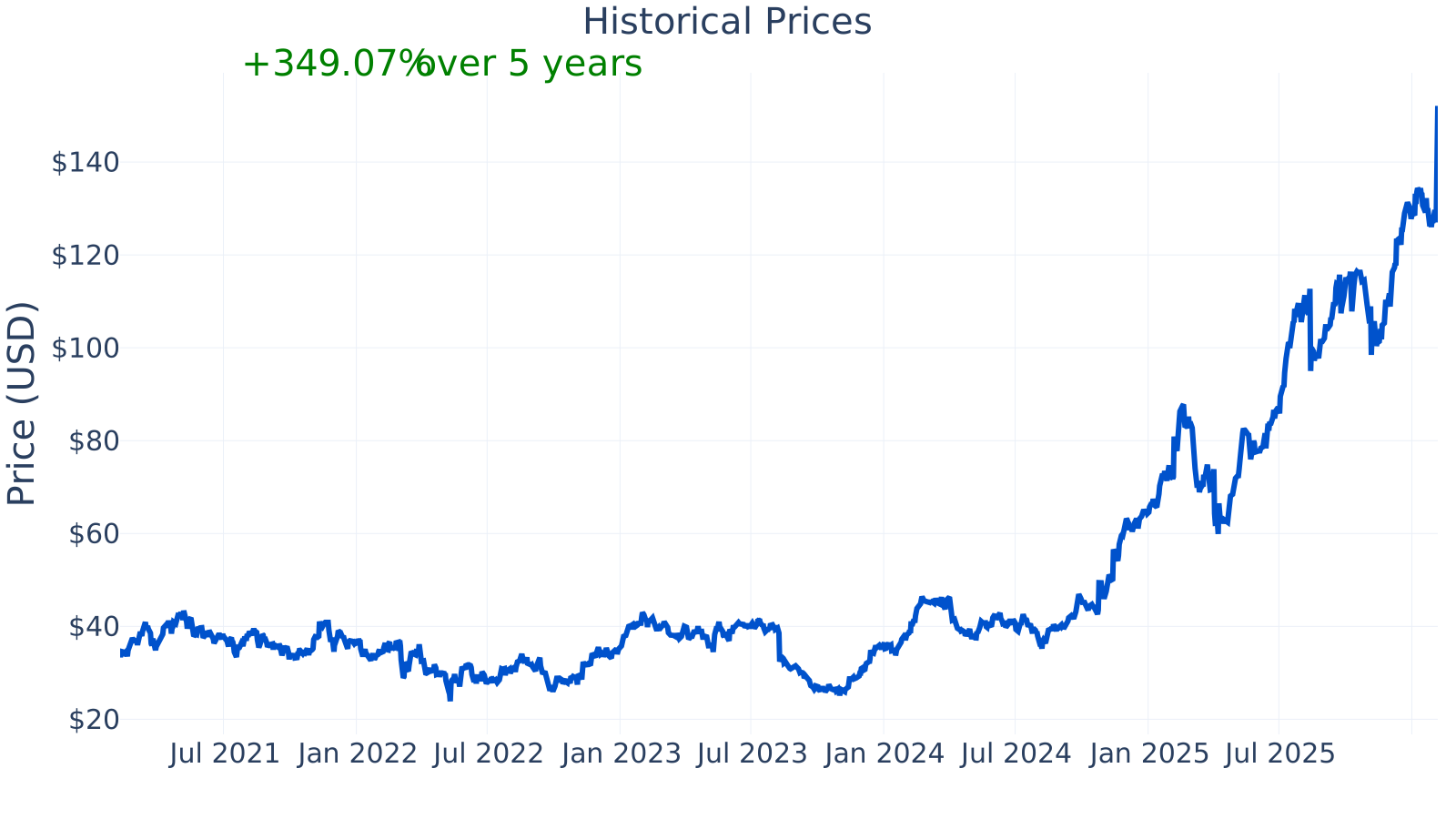
Tapestry’s market capitalization is about $31.1B, and its beta of 1.61 indicates the stock has historically moved more than the broader market. The company’s trailing P/E ratio is about 58.7, which is high compared with what many mature consumer businesses typically trade at, and it suggests the market price is elevated relative to recent earnings.
Profitability is positive with a profit margin around 7.0%, which is above the industry median shown (negative in this peer set). Year-over-year revenue growth is about 14.0%, also above the listed industry median (~3.8%). Free cash flow over the last twelve months is about $1.68B, indicating meaningful cash generation. The debt-to-equity figure is about 939%, far above the industry median shown (~67%), which signals substantially higher balance-sheet leverage than peers (and makes funding costs and refinancing conditions more important to watch).
Growth (medium)
Tapestry operates in the global personal luxury goods space, where long-term demand is often supported by brand preference, product innovation, international tourism flows, and growth in higher-income consumer segments. At the same time, the category can be cyclical: demand tends to soften when consumer confidence falls, promotions rise, or discretionary spending shifts away from accessories.
Strategically, brand-led companies like Tapestry generally focus on a few repeatable growth levers: introducing new designs and “hero” products, expanding customer relationships (including younger cohorts), improving digital and omnichannel experiences, and selectively growing internationally. These initiatives can support growth, but execution quality matters because the category is highly competitive and fashion-driven.
The year-over-year revenue growth line shows a move from roughly flat to modest growth in parts of 2023–2024 to a clearer re-acceleration into 2025, reaching the mid-teens most recently. This pattern suggests improving top-line momentum versus the prior year, though it does not by itself explain whether growth is coming from higher volumes, pricing, or channel mix changes.
Free cash flow has been positive across the periods shown, ranging from roughly $0.64B to $1.30B, and most recently around $0.89B (TTM in the series) and $1.68B in the latest snapshot table. For a consumer brand company, sustained free cash flow can be important because it can be used for reinvestment (stores, digital, marketing), debt service, and shareholder returns, although the amount can fluctuate with inventory and other working-capital needs.
Risks (high)
This article is for informational purposes only and does not constitute financial advice. Some content is AI-generated. See Disclaimer