Stock Analysis · TTM Technologies Inc (TTMI)
Overview
TTM Technologies Inc. (TTMI) is a manufacturer of printed circuit boards (PCBs) and related electronic components. PCBs are the “connective platform” inside most electronic devices, linking chips and other parts so signals and power can move through a product. TTM also provides specialized manufacturing services for complex, high-reliability applications, which typically require tight quality control and long customer qualification cycles.
In simple terms, the company makes critical “hardware backbones” that are used in areas such as data and networking equipment, aerospace and defense electronics, and other advanced industrial and technology products. TTM operates in an industry where customers care about performance, reliability, and supply continuity, not only unit price.
Public filings describe revenue primarily coming from PCB manufacturing and related services, with end-demand tied to electronics production cycles and longer-cycle programs (notably in defense/aerospace). Percentage breakdowns by end market can vary by reporting period; for a precise split, the most recent annual report’s segment and customer/end-market disclosures are the reference point.
Across recent years, total revenue increased from about $2.25B (2021) to about $2.91B (2025). Operating income and net income also improved meaningfully in 2025 compared with 2023–2024, which suggests profitability has been sensitive to volume, mix, and cost structure (common in manufacturing businesses).
Key Figures
| Metric | Value | Industry ⓘ |
|---|---|---|
| Date | May 04, 2026 | |
| Context | ||
| Sector | Technology | |
| Industry | Electronic Components | |
| Market Cap ⓘ | $16.51B | |
| Beta ⓘ | 1.76 | |
| Fundamental | ||
| P/E Ratio ⓘ | 86.41 | 46.65 |
| Profit Margin ⓘ | 6.29% | 6.29% |
| Revenue Growth ⓘ | 30.40% | 17.50% |
| Debt to Equity ⓘ | 49.83% | 37.71% |
| PEG ⓘ | 0.36 | |
| Free Cash Flow ⓘ | $95.03M | |
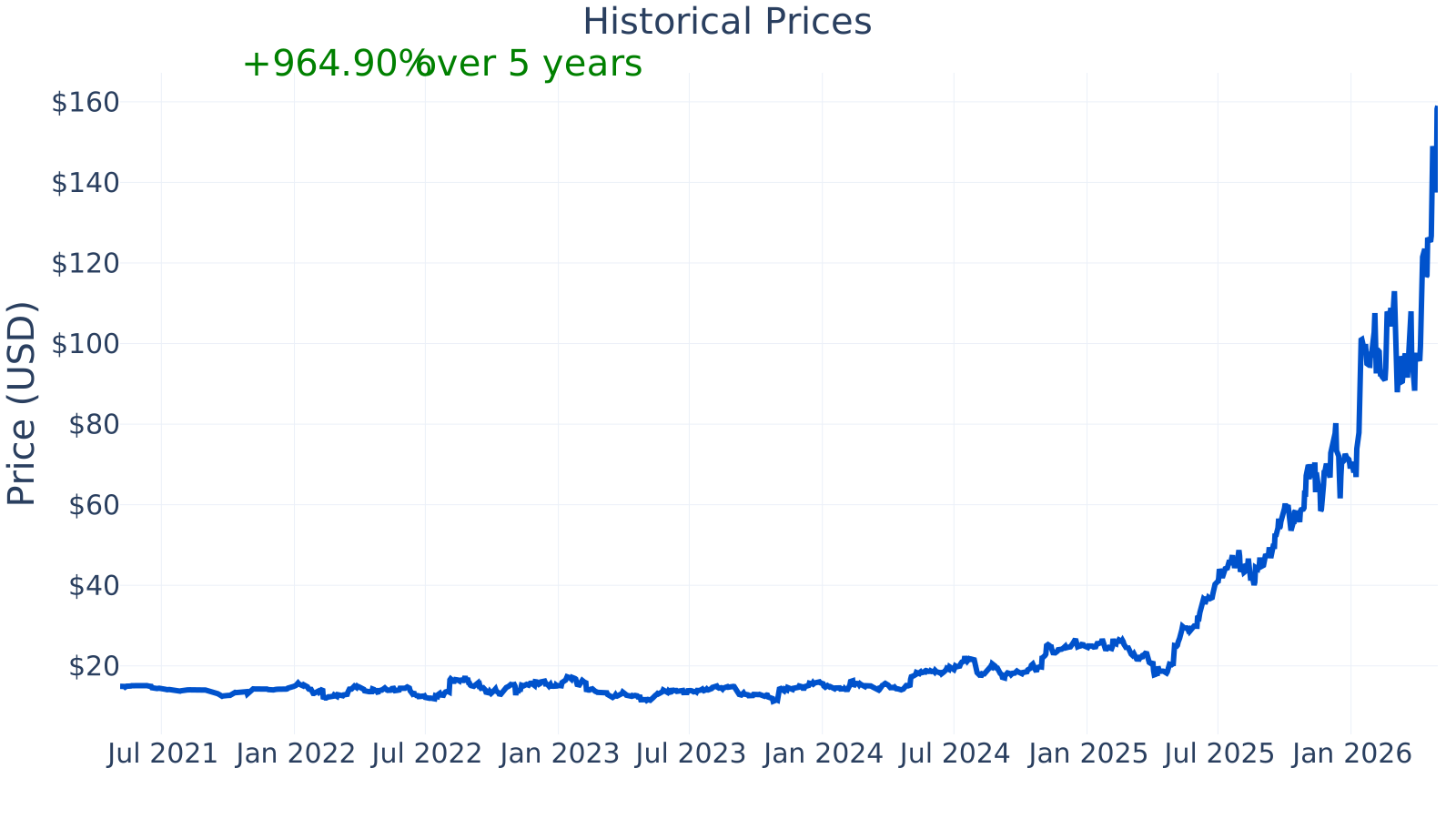
TTM’s market capitalization is about $16.5B, and the stock’s beta of 1.76 indicates it has tended to move more than the broader market (higher price volatility). The latest P/E ratio shown is about 86.4 versus an industry median near 46.6, while profit margin is about 6.29%, in line with the industry median shown (also ~6.29%). Revenue growth year over year is about 30.4% versus an industry median near 17.5%. Debt-to-equity is about 49.8% versus an industry median near 37.7%. Trailing twelve-month free cash flow is about $95.0M.
Growth (Medium)
TTM operates in electronic components, a space supported by long-term drivers like increasing electronic content in equipment, ongoing data infrastructure buildouts, and continued demand for high-reliability electronics in regulated or mission-critical uses. However, the path is not always smooth: PCB demand can be cyclical because many customers’ production volumes rise and fall with the broader electronics cycle.
Strategically, TTM’s focus on complex, higher-reliability manufacturing can fit long-term demand where customers value quality systems, consistency, and engineering support. In these areas, switching suppliers can be slow and expensive because products may require extensive qualification, documentation, and audits.
The revenue growth pattern shows a downturn in 2023 (negative year-over-year comparisons for several quarters) followed by a recovery that strengthened into 2025 and early 2026, culminating in roughly 30% year-over-year growth most recently. That kind of rebound can reflect both cyclical recovery and improved demand in certain end markets, but it can also be hard to extrapolate because electronics demand can normalize after a strong snapback.
Free cash flow has been uneven over the period shown: positive in 2022–2023, turning negative around 2024–2025, and returning to a positive level most recently (about $95M). For a manufacturing company, swings like this can come from changes in working capital (inventory and receivables), timing of customer orders, and capital spending needs. Over long horizons, consistency in converting profits into cash is often an important sign of business quality and financial flexibility.
Risks (High)
TTM’s main risks are tied to manufacturing economics and end-market cycles. PCB production is capital-intensive and competitive, and profitability can compress if demand softens, if pricing pressure increases, or if costs rise faster than expected. Customer concentration can also matter in this industry; if a large customer reduces orders or changes programs, revenue and factory utilization can be affected.
Another key risk is execution: complex electronics manufacturing requires tight process control, quality performance, and on-time delivery. Operational issues (scrap, rework, yield problems, or delays) can reduce margins and potentially harm customer relationships.
Competition is substantial. TTM competes with a wide set of global PCB manufacturers, including large, scaled producers (often with extensive Asian capacity) as well as specialized high-mix/high-reliability suppliers. Relative positioning tends to depend on technology capability, quality certifications, capacity, geography, customer qualification status, and the ability to support demanding designs—not only on size. In many PCB categories the industry is fragmented, so “leadership” is often specific to certain product types or end markets rather than a single clear overall leader.
Debt-to-equity has generally been above the industry median for much of the period shown, though it declined notably in the most recent point to about 49.8%. Debt can help fund capacity and acquisitions, but it can also increase financial risk during downcycles, particularly when demand or margins weaken and cash flow becomes more volatile.
Profitability has improved meaningfully from the losses/near-breakeven periods in 2023–early 2024 to a recent profit margin around 6.29%, roughly in line with the industry median shown. This improvement is a positive operational signal, but the history also shows that margins can swing, which is a reminder that results may be sensitive to cycle timing, factory utilization, and cost control.
Valuation
The P/E ratio shown is elevated versus the industry median (about 86x vs ~47x). A higher P/E can be explained by expectations of faster growth, improving profitability, or a belief that current earnings understate normalized earnings power. At the same time, a high P/E can also mean the stock price is more sensitive to earnings disappointments or to a slowdown after a period of strong growth.
TTM’s recent revenue growth is above the industry median, and profit margin is around the industry level, which helps contextualize why valuation could be higher than many peers. However, the company’s history of margin and free-cash-flow variability, along with above-median leverage over much of the period, are also relevant when considering how much valuation “cushion” exists if operating conditions soften.
Conclusion
TTM Technologies is a PCB and advanced electronics manufacturing company tied to long-term trends in electronics complexity and infrastructure, but also exposed to cyclical demand patterns and competitive manufacturing dynamics. Recent results show a notable recovery: revenue growth strengthened into the latest period, profit margins improved to about industry-average levels, and free cash flow returned positive most recently after a weaker stretch.
The main trade-offs visible from the fundamentals are that improved growth and profitability come alongside historically variable cash generation, meaningful competition, and financial leverage that—while improved recently—has often been above the industry median. Valuation metrics shown (notably the P/E versus peers) imply that expectations embedded in the price may be less forgiving if growth or margins normalize.
Sources:
- SEC EDGAR — TTM Technologies Inc. Form 10-K (Annual Report)
- SEC EDGAR — TTM Technologies Inc. Form 10-Q (Quarterly Reports)
- SEC EDGAR — TTM Technologies Inc. Form 8-K (Current Reports)
- TTM Technologies — Investor Relations materials and press releases
- Wikipedia — “TTM Technologies” (basic company background)
This article is for informational purposes only and does not constitute financial advice. Some content is AI-generated. See Disclaimer


