Stock Analysis · TRI Pointe Homes Inc (TPH)
Overview
TRI Pointe Homes Inc is a U.S. homebuilder. In simple terms, it buys and develops land, designs communities, builds homes through a network of trade partners, and then sells those homes to buyers. The company also supports buyers through related services tied to closing a home purchase (for example, services commonly associated with mortgage and title), which are typically smaller than the core homebuilding business.
Because TRI Pointe operates in residential construction, its results are closely connected to U.S. housing demand, mortgage rates, local affordability, land availability, and build costs (labor and materials). Like most homebuilders, the company’s financial performance can shift meaningfully from year to year depending on the housing cycle.
Main revenue sources generally include:
- Home sales (homebuilding revenue) — the large majority of revenue
- Income from financial services tied to closings (typically smaller and more cyclical)
Over the years shown, total revenue and profit levels moved up and down with the housing cycle. For example, total revenue rose from about $4.0B (2021) to $4.5B (2024), then fell to about $3.5B (2025). Net income followed a similar pattern, decreasing from about $458M (2024) to about $241M (2025), illustrating how sensitive results can be to changes in demand, pricing, and costs.
Key Figures
| Metric | Value | Industry ⓘ |
|---|---|---|
| Date | Apr 27, 2026 | |
| Context | ||
| Sector | Consumer Cyclical | |
| Industry | Residential Construction | |
| Market Cap ⓘ | $3.99B | |
| Beta ⓘ | 1.30 | |
| Fundamental | ||
| P/E Ratio ⓘ | 17.24 | 13.07 |
| Profit Margin ⓘ | 6.95% | 8.30% |
| Revenue Growth ⓘ | -22.40% | -12.85% |
| Debt to Equity ⓘ | 38.69% | 31.99% |
| PEG ⓘ | 1.49 | |
| Free Cash Flow ⓘ | $128.54M | |
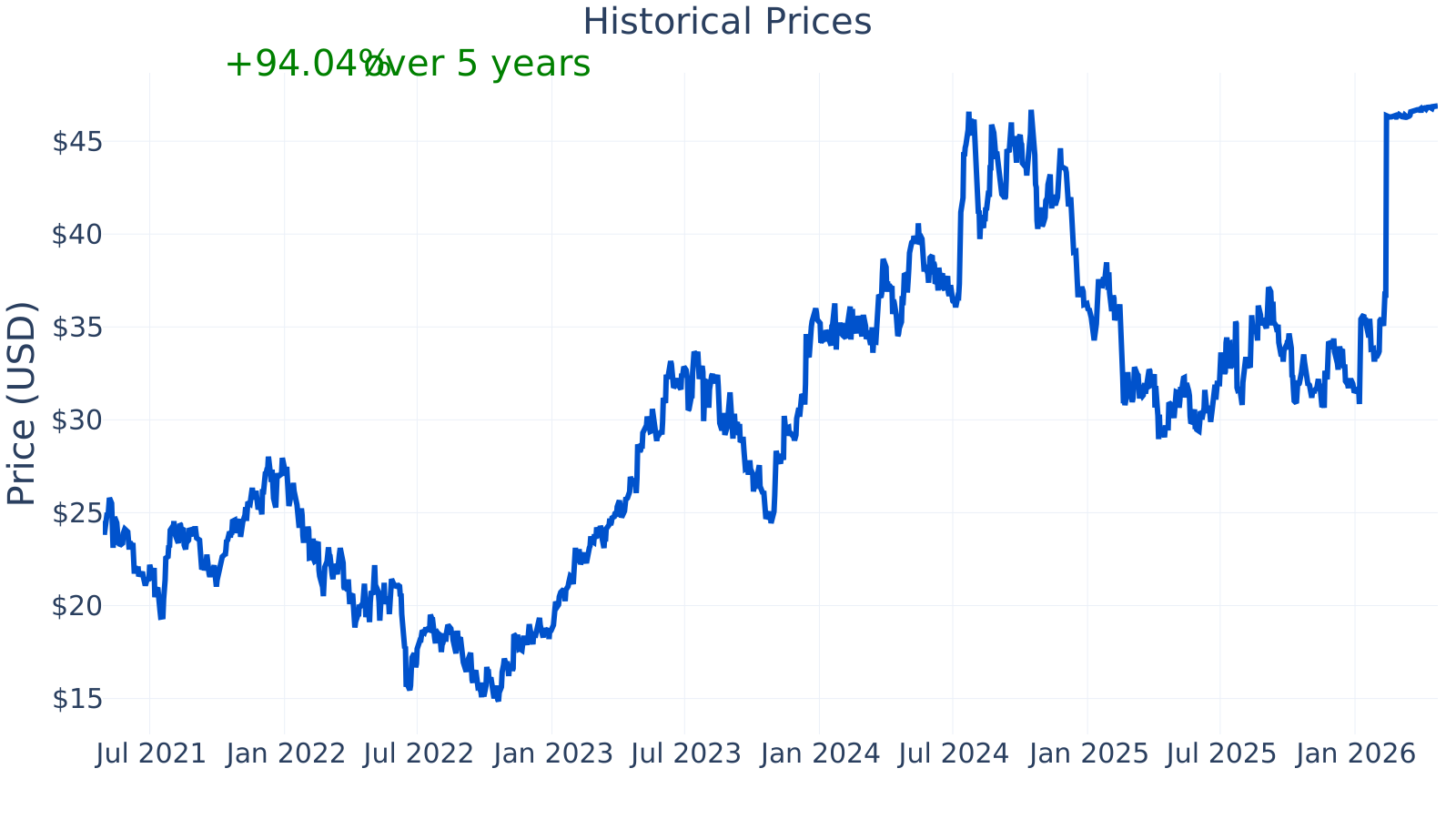
TRI Pointe’s market capitalization is about $4.0B, placing it in the mid-sized range among public homebuilders. The stock’s beta of ~1.30 suggests it has tended to move more than the overall market, which is common in cyclical industries like homebuilding.
On profitability and growth, the latest figures indicate a softer period: profit margin of ~7.0% versus an industry median around 8.3%, and year-over-year revenue change of about -22.4% versus an industry median around -12.9%. Leverage is moderate with debt-to-equity around 38.7% (industry median ~32.0%). Over the trailing twelve months shown, free cash flow is about $129M, which indicates the business generated cash after operating needs and capital spending, though this metric can swing significantly for homebuilders due to land investment and changes in inventory.
Growth (Medium)
Residential construction is a large, long-lived industry, but it is not a steady one. Demand tends to rise and fall with mortgage rates, consumer confidence, employment conditions, and housing affordability. For a company like TRI Pointe, growth is often less about a smooth upward trend and more about managing cycles well—building in markets with lasting demand, controlling costs, and keeping a land pipeline that supports future communities without taking on excessive risk.
A key factor for long-term growth in homebuilding is whether a company can consistently source lots/land in desirable locations and convert that land into closings (delivered homes) at healthy margins. Strategy in this industry typically centers on land acquisition discipline, product positioning (price points and buyer segments), and operational efficiency (build cycle times, trade availability, and materials).
The year-over-year revenue pattern shows pronounced swings. There were periods of positive growth (including strong growth in parts of 2024), followed by a return to negative growth in 2025 (ending the year at roughly -22%). This type of volatility is typical for homebuilders and often reflects changes in buyer demand, incentives, and the pace of deliveries.
Free cash flow has also been uneven over time (for example, moving from higher levels in 2023 to lower levels in 2024, rising again in 2025, and sitting around $129M on the latest trailing basis shown). In homebuilding, this can be driven by how quickly homes close, how much capital is deployed into land and development, and how inventory changes quarter to quarter.
Potential catalysts in this industry are usually macro-driven rather than company-specific: changes in mortgage rates and affordability, local supply conditions (how many homes are available in a market), and the company’s ability to align its community count and product offerings with where demand is strongest.
Risks (High)
Homebuilding is inherently cyclical. A major risk is that higher mortgage rates or weaker consumer conditions reduce demand, forcing builders to use incentives, lower prices, or accept slower sales paces. Another common risk is cost pressure: labor shortages, materials inflation, or delays can reduce profitability even if revenue holds up.
TRI Pointe also faces land and inventory risk. Buying and developing land requires meaningful upfront spending, and the return depends on future selling prices and absorption (how quickly homes sell). If market conditions deteriorate after land is purchased, returns can compress. Regulatory and permitting complexity—often local and time-consuming—can also impact timelines and costs.
Debt matters because it can increase sensitivity to downturns. TRI Pointe’s debt-to-equity has generally improved from higher levels earlier in the period shown (around 65%–70% in 2021–2022) to the low-to-high 30% range more recently, ending near 38.7%. While this is not extreme leverage for the sector, it is slightly above the industry median in the latest snapshot, which can be worth monitoring in a cyclical environment.
Profitability has cooled versus earlier peaks. The profit margin trend shows a decline from roughly 12%–13% in 2022 to about 7% most recently, and it has been below the industry median through much of the later period. This can happen when pricing power fades, incentives rise, costs increase, or the mix of homes delivered shifts to lower-margin communities.
On competitive position, TRI Pointe competes with other publicly traded homebuilders and many private/local builders. The large national builders often benefit from scale (purchasing power, broader market diversification, and operational systems). TRI Pointe is not the dominant leader of the overall U.S. homebuilding market, but it participates in the same competitive arena where execution and land positioning can matter as much as raw size.
Main competitor set typically includes large diversified homebuilders and other regionally strong builders, such as D.R. Horton, Lennar, PulteGroup, NVR, Taylor Morrison, and Toll Brothers (among others). Relative placement tends to be that TRI Pointe is smaller than the biggest national peers, which may mean less scale advantage, but it can still compete effectively through market selection, product design, and disciplined land strategy.
Valuation
One simple way to describe valuation is the price-to-earnings (P/E) ratio, which compares the stock price to the company’s earnings. TRI Pointe’s latest P/E is about 17.2, compared with an industry median near 13.1. That indicates the stock is priced at a higher multiple than the typical company in its peer set at this point in time.
The historical P/E pattern has moved with the cycle. Earlier in the period shown, TRI Pointe traded at lower P/E levels (single digits at times), and more recently the P/E moved higher (into the low double digits). A rising P/E can happen when the stock price increases, when earnings fall, or some combination of both. In a cyclical business, the “E” (earnings) can change quickly, so the P/E ratio can shift even if the underlying business remains similar.
With TRI Pointe showing negative year-over-year revenue and a lower profit margin than the industry median in the latest snapshot, a higher-than-median P/E suggests the market may be assigning value to factors not captured by a single-period margin or growth number (for example, expectations for a future recovery, the company’s land position, or normalization of earnings). At the same time, it means the valuation is more exposed if the down-cycle lasts longer or margins remain pressured.
Conclusion
TRI Pointe Homes is a straightforward business: it primarily earns money by building and selling homes, with results that can change materially across housing cycles. The recent picture shows a softer operating phase, with declining year-over-year revenue and profit margins below the industry median, alongside moderate leverage and positive free cash flow that can fluctuate with land and inventory needs.
For a long-term view, the key facts to weigh are the industry’s cyclicality and rate sensitivity, the company’s ability to sustain margins through different housing environments, and balance sheet discipline as conditions change. On valuation, the latest P/E is above the industry median, which places more importance on how earnings and demand evolve from here compared with peers.
Sources:
- SEC EDGAR — TRI Pointe Homes, Inc. Form 10-K (Annual Report)
- SEC EDGAR — TRI Pointe Homes, Inc. Form 10-Q (Quarterly Reports)
- TRI Pointe Homes Investor Relations — Press Releases and Financial Information
- Wikipedia — “Tri Pointe Homes” (basic company background)
This article is for informational purposes only and does not constitute financial advice. Some content is AI-generated. See Disclaimer


