Stock Analysis · TRI Pointe Homes Inc (TPH)
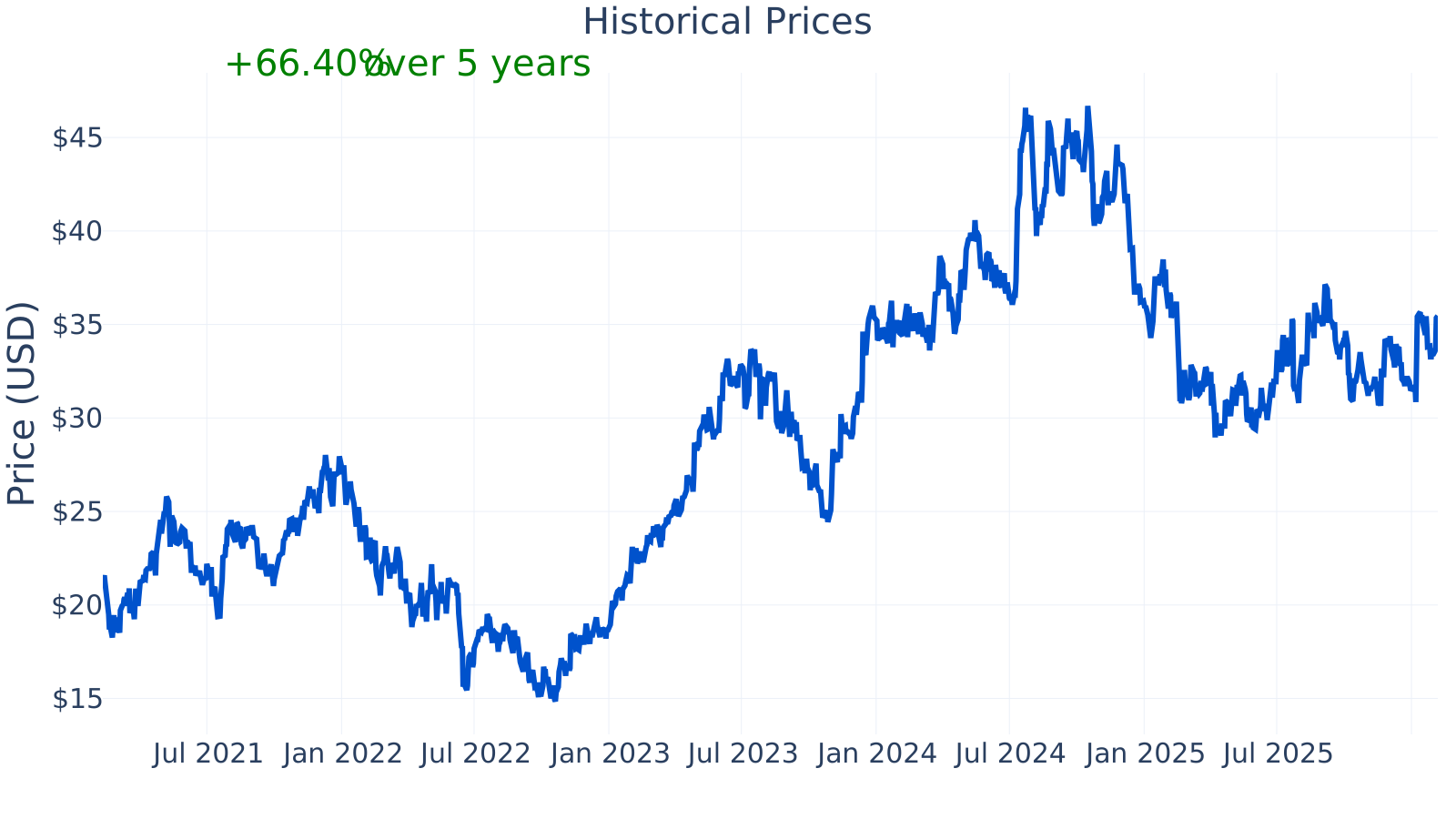
Overview
TRI Pointe Homes Inc is a U.S. homebuilder. In simple terms, it buys land (or controls land through options), develops communities, builds houses, and sells those homes to buyers. The company also typically offers related services tied to the home purchase process, such as arranging mortgage financing and title/escrow services through affiliated operations.
The main business is driven by the number of homes it can deliver and the price it can sell them for, while managing construction costs, land costs, and overhead expenses. Like most homebuilders, results can fluctuate with mortgage rates, housing affordability, and the availability/cost of land and labor.
Main sources of revenue are generally:
- Home sales (homebuilding revenue) — usually the large majority of revenue
- Financial services and other — typically a smaller portion (e.g., mortgage-related and title/closing services connected to home sales)
In recent years, overall revenue has moved with the housing cycle. For example, total revenue was about $4.49B in 2024, compared with $3.72B in 2023 and $4.35B in 2022.
Across 2021–2024, revenue and profits show a cyclical pattern: revenue dipped in 2023 and then rebounded in 2024. Net income followed a similar path (about $469M in 2021, $576M in 2022, $344M in 2023, and $458M in 2024). Interest expense also varied significantly year to year, which can affect bottom-line results in a rate-sensitive industry.
Key Figures
| Metric | Value | Industry ⓘ |
|---|---|---|
| Date | Feb 08, 2026 | |
| Context | ||
| Sector | Consumer Cyclical | |
| Industry | Residential Construction | |
| Market Cap ⓘ | $3.10B | |
| Beta ⓘ | 1.41 | |
| Fundamental | ||
| P/E Ratio ⓘ | 10.46 | 12.00 |
| Profit Margin ⓘ | 8.27% | 8.48% |
| Revenue Growth ⓘ | -25.30% | -4.90% |
| Debt to Equity ⓘ | 38.34% | 34.53% |
| PEG ⓘ | 1.14 | |
| Free Cash Flow ⓘ | $271.31M | |
TRI Pointe Homes’ market capitalization is about $3.10B, and the stock’s beta of ~1.41 suggests it has tended to move more than the overall market (higher volatility). The current P/E ratio is ~10.46, below the industry median of ~12.00. Profit margin is about 8.27% versus an industry median near 8.49%. Recent year-over-year revenue growth is -25.3%, weaker than the industry median of about -4.9%, highlighting how quickly demand and deliveries can shift in homebuilding. Debt-to-equity is about 38% compared with an industry median near 35%. Trailing twelve-month free cash flow is about $271M.
Growth (Medium)
Residential construction is a large, long-term essential industry, but it is also highly cyclical. Demand is influenced by household formation, employment conditions, and especially mortgage rates (which affect monthly payments and affordability). In that context, TRI Pointe’s growth outlook is less about steady expansion every year and more about how well it executes through cycles: controlling land risk, keeping build times efficient, and matching product offerings to local demand.
A practical way to think about TRI Pointe’s growth is to watch whether it can maintain a pipeline of lots/communities while protecting margins. The revenue growth pattern shows this cyclicality clearly, with strong periods followed by contractions.
Year-over-year revenue growth has swung widely over time, including strong positive periods (for example, mid-2024) and more recent declines (2025 readings are negative, reaching about -25% in the latest point). That kind of variability is common in homebuilding because closings can shift with cancellations, incentives, interest rates, and construction timing.
Cash generation can be another “engine” for long-term compounding in homebuilding, because free cash flow can be used to strengthen the balance sheet, invest in land, or return capital to shareholders (when authorized). However, free cash flow also tends to be uneven since land purchases and development require significant up-front cash.
Trailing twelve-month free cash flow has been positive in the periods shown, but it has not been stable (for example, about $687M in 2021, $237M in 2022, $658M in 2023, $179M in 2024, and $495M in 2025). This variability reflects how working capital (especially land and homes under construction) can absorb or release cash depending on the cycle.
Potential catalysts in this industry are typically macro-driven rather than company-specific: easing mortgage rates, improved affordability, and steadier construction input costs can lift demand and profitability across builders. Company execution matters most in how well it manages land exposure, build costs, and pricing discipline when the market shifts.
Risks (High)
This article is for informational purposes only and does not constitute financial advice. Some content is AI-generated. See Disclaimer


