Stock Analysis · T-Mobile US Inc (TMUS)
Overview
T-Mobile US, Inc. (TMUS) is a U.S. wireless and broadband provider. In plain terms, it sells phone plans (for individuals and businesses), finances and sells devices like smartphones, and provides home internet service using its wireless network. The company operates a nationwide mobile network and continues to integrate and optimize assets and customers gained through past acquisitions (including Sprint), with a focus on expanding 5G coverage and capacity.
T-Mobile’s revenue is largely recurring and subscription-like because many customers pay monthly for service. Based on the company’s segment reporting in its annual filings, revenue is mainly generated from these categories:
- Service revenues (monthly wireless and data plans, including home internet) — typically the largest portion
- Equipment revenues (sales of handsets and other devices)
- Other revenues (including certain fees and smaller items reported in financial statements)
The most important takeaway for long-term readers is that the business is built around network scale: large fixed costs to build and maintain the network, and then ongoing customer payments that can support cash generation over time if churn stays low and pricing remains disciplined.
Across 2021–2024, total revenue stayed in a relatively narrow band (roughly high-$70B to low-$80B), while profitability improved materially: operating income rose from about $6.7B (2021) to about $18.1B (2024), and net income increased from about $3.0B to about $11.3B. A notable headwind that remains visible is interest expense (about $3.3B–$3.4B each year), reflecting the industry’s heavy use of debt to fund spectrum and network investment.
Key Figures
| Metric | Value | Industry ⓘ |
|---|---|---|
| Date | Feb 07, 2026 | |
| Context | ||
| Sector | Communication Services | |
| Industry | Telecom Services | |
| Market Cap ⓘ | $222.15B | |
| Beta ⓘ | 0.43 | |
| Fundamental | ||
| P/E Ratio ⓘ | 19.02 | 15.18 |
| Profit Margin ⓘ | 13.83% | 6.18% |
| Revenue Growth ⓘ | 8.90% | 2.10% |
| Debt to Equity ⓘ | 199.15% | 113.97% |
| PEG ⓘ | 0.76 | |
| Free Cash Flow ⓘ | $16.31B | |
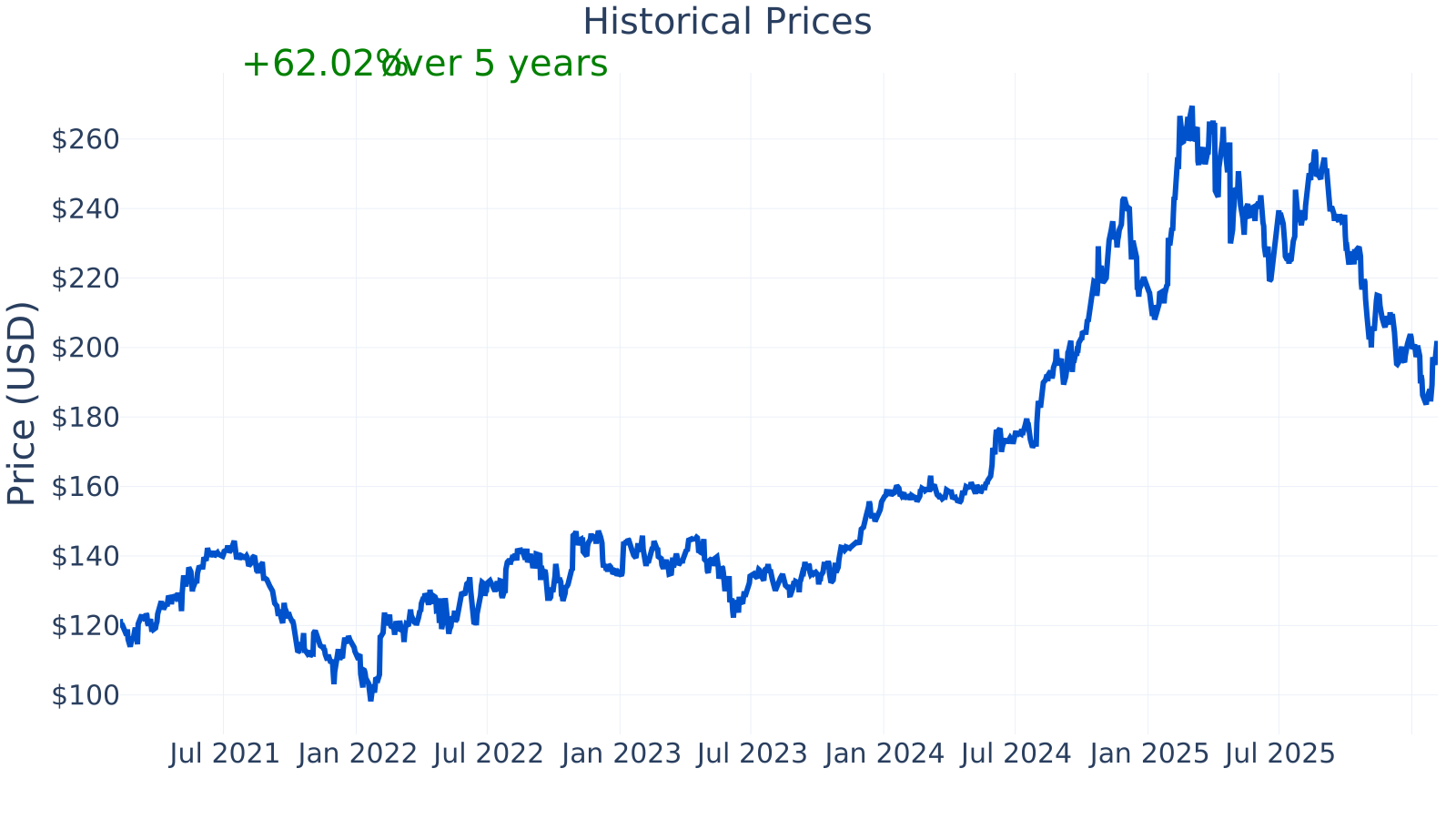
T-Mobile’s market capitalization is about $222B and the stock has shown relatively low volatility versus the broader market (beta about 0.44). Profitability and growth metrics look stronger than the industry median in this dataset: profit margin is about 13.8% (industry median ~6.2%) and year-over-year revenue growth is about 8.9% (industry median ~2.1%). At the same time, leverage is higher: debt-to-equity is about 199% versus an industry median near 114%. The current P/E ratio is about 19.0 (industry median ~15.2), and trailing twelve-month free cash flow is about $16.3B.
Growth (medium)
The U.S. wireless market is mature, meaning the number of total mobile subscribers does not typically grow at startup-like rates. However, there are still meaningful growth vectors inside the industry: customers upgrading to higher-value unlimited plans, continued growth in 5G data usage, fixed wireless home internet offerings, and business/enterprise demand for reliable connectivity. In this environment, market share shifts, pricing, and customer retention matter as much as overall market expansion.
T-Mobile’s strategy is closely tied to network performance and scale economics. In general terms, if the company can maintain strong network quality (coverage, capacity, and consistency) while controlling costs, it can translate subscriber gains and stable churn into higher operating income and cash generation.
Revenue growth was weak or negative for several quarters through 2022–2023, then turned positive and accelerated into 2024–2025, reaching about 8.9% year-over-year in the most recent point shown. This pattern suggests a return to top-line momentum after a period of softer comparisons and integration effects.
Free cash flow improved sharply over time: from deeply negative levels in 2021 (roughly -$12.0B) to positive territory by 2023 (about $2.8B), then rising to about $9.2B in 2024 and about $12.0B by early 2025, with the latest trailing twelve-month figure at about $16.3B. For long-term business quality, this matters because network investment is expensive; sustained positive free cash flow can provide flexibility for debt reduction, spectrum needs, and shareholder return programs (subject to management decisions and constraints described in filings).
Risks (medium)
Telecom comes with structural risks that do not disappear even for large players. Competition is persistent, and the “product” (wireless connectivity) can look similar across carriers, which can lead to promotional intensity, price pressure, and higher customer acquisition costs. When competitors are aggressive, margins can compress even if subscriber numbers rise.
Another core risk is capital intensity. Building and upgrading a nationwide network requires ongoing, large capital expenditures, plus periodic spectrum purchases. Execution risk (network quality issues, slower-than-expected upgrades, or integration challenges) can show up as higher churn or weaker pricing power.
Leverage is meaningfully elevated. Debt-to-equity increased over time and is currently around 199%, above the industry median near 114%. Higher leverage can amplify outcomes in both directions: it can support large-scale investment, but it also increases fixed obligations (interest expense and debt maturities). This can reduce flexibility during downturns, periods of heavier competition, or times when funding costs are higher.
Profit margin improved significantly from low single digits in 2021–2022 to the mid-teens more recently (about 13.8% at the latest point), and it has generally been above the industry median in the period shown. Sustaining this improvement depends on keeping costs controlled while preserving pricing and churn performance.
Competitive positioning is best understood in the context of a concentrated U.S. wireless market dominated by three national carriers. T-Mobile’s main large competitors are Verizon and AT&T, along with regional providers and cable operators offering wireless service through wholesale arrangements. T-Mobile is one of the scale leaders in U.S. wireless, and its competitive advantages commonly discussed in filings and industry context include nationwide network scale, a large subscriber base, and the ability to spread fixed network costs over many customers. The flip side is that large rivals also have scale and significant resources, so advantages tend to be relative and can change with network investment cycles and promotional behavior.
Regulatory and legal risks are also relevant. Wireless carriers operate under federal regulations, must comply with spectrum licensing rules, and face ongoing cybersecurity and customer data protection requirements. Any significant service outage, breach, or compliance failure can create reputational harm and direct costs.
Valuation
At a P/E ratio of about 19.0, T-Mobile trades above the industry median shown here (about 15.2). Over the historical period displayed, the company’s P/E was much higher earlier on and later moved closer to the 20–26 range before declining to around 20 most recently. In practical terms, this indicates the market currently assigns a valuation premium versus the median telecom peer in this dataset, which can be consistent with stronger margins and improving cash flow—but also leaves less room for disappointment if growth slows or competition intensifies.
Because telecom businesses are capital-intensive, readers often look beyond earnings alone and also consider cash generation and leverage. T-Mobile’s rising free cash flow supports the idea that reported earnings are increasingly backed by cash, while the higher debt level remains a counterbalance that can affect how much of that cash is truly flexible over time.
Conclusion
T-Mobile is a large U.S. connectivity provider with a business model centered on recurring service revenue, supported by substantial network investment. Recent years show a notable improvement in profitability and free cash flow, alongside a return to positive and accelerating revenue growth.
The main trade-offs visible in the fundamentals are straightforward: improving margins and cash generation on one side, and above-median leverage and ongoing competitive pressure on the other. The company’s scale and network economics can support durability, but outcomes remain sensitive to pricing discipline, churn, capital spending needs, and the cost of debt.
Sources:
- T-Mobile US, Inc. — Annual Report (Form 10-K)
- SEC EDGAR — T-Mobile US, Inc. filings (10-K, 10-Q, 8-K)
- T-Mobile Investor Relations — SEC Filings & Reports
- Wikipedia — T-Mobile US
This article is for informational purposes only and does not constitute financial advice. Some content is AI-generated. See Disclaimer