Stock Analysis · The TJX Companies Inc (TJX)
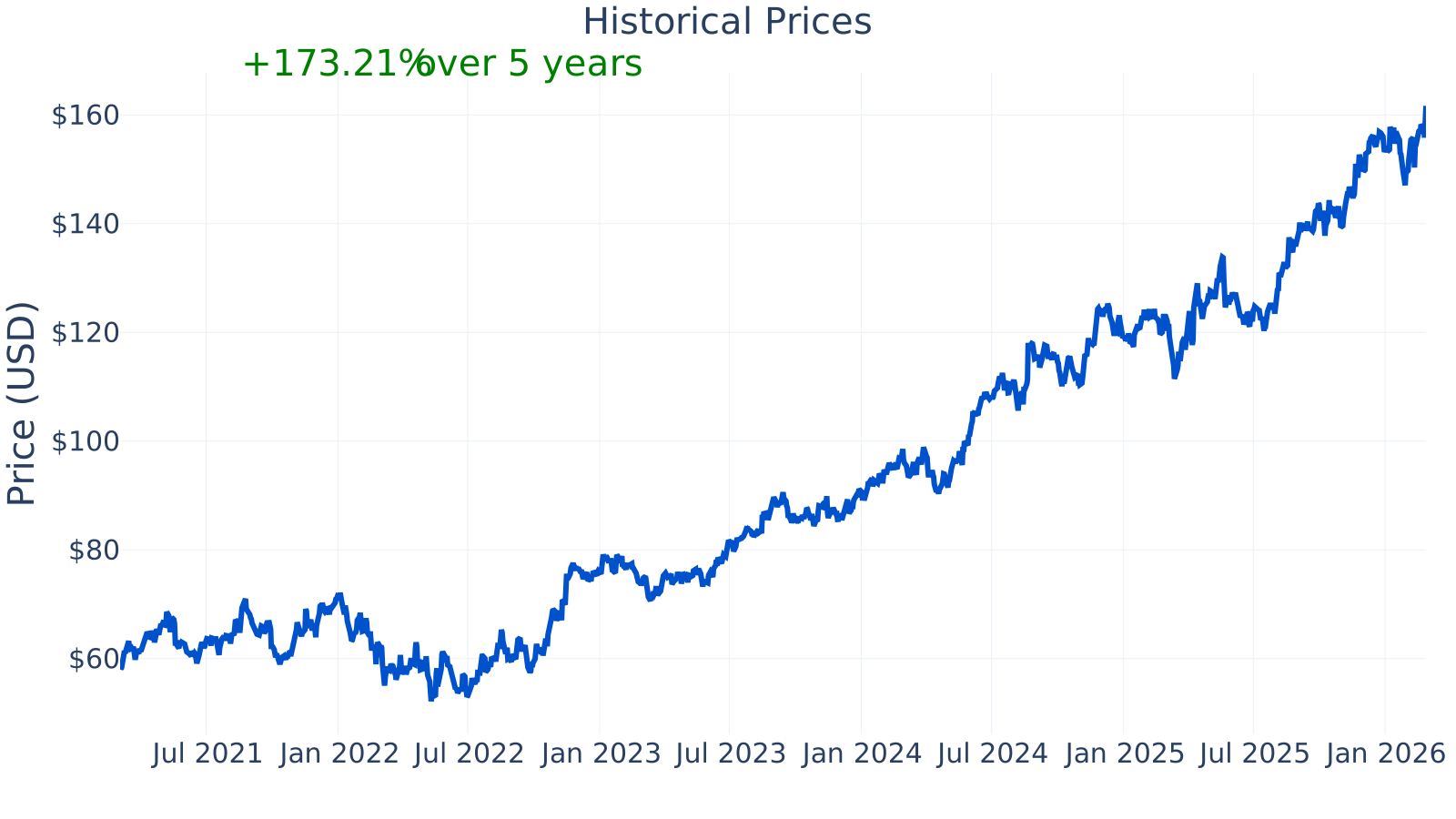
Overview
The TJX Companies, Inc. (TJX) is an off-price retailer. In simple terms, it sells branded apparel and home-related products at discounted prices, mainly through physical stores. The company generally buys merchandise from manufacturers and other vendors (often including excess inventory or special buys) and resells it at lower prices than many traditional retailers, aiming to offer “value” and frequent product turnover that encourages repeat store visits.
TJX operates several well-known retail banners, including T.J. Maxx, Marshalls, HomeGoods, Sierra, and international businesses such as TK Maxx (outside the U.S.) and others. Its revenue is primarily generated from selling merchandise to customers in stores, with e-commerce also present but typically described as complementary to stores in company disclosures.
In TJX’s reporting, revenue is commonly discussed by operating segment rather than by product line. Based on company reporting, the main sources of revenue are:
- Marmaxx (T.J. Maxx & Marshalls, primarily U.S.) – typically the largest segment
- HomeGoods (home fashions, primarily U.S.)
- International (off-price apparel and home fashions outside the U.S.)
Percentages by segment can vary by fiscal year; for precise current-year segment splits, the latest annual report (Form 10‑K) is the most reliable reference.
Over the last several fiscal years shown, total revenue and profit levels increased meaningfully, with operating income and net income rising alongside sales. This pattern suggests that growth has not been driven only by higher costs, but also by improved profitability in absolute dollars.
Key Figures
| Metric | Value | Industry ⓘ |
|---|---|---|
| Date | Mar 02, 2026 | |
| Context | ||
| Sector | Consumer Cyclical | |
| Industry | Apparel Retail | |
| Market Cap ⓘ | $179.92B | |
| Beta ⓘ | 0.74 | |
| Fundamental | ||
| P/E Ratio ⓘ | 35.69 | 17.69 |
| Profit Margin ⓘ | 9.10% | 8.32% |
| Revenue Growth ⓘ | 8.50% | 7.80% |
| Debt to Equity ⓘ | 219.66% | 104.73% |
| PEG ⓘ | 3.35 | |
| Free Cash Flow ⓘ | $4.86B | |
TJX is a very large company by market value (about $180B) and its shares have historically shown lower price swings than the broader market (beta around 0.74). Profitability is solid for apparel retail, with a latest profit margin around 9.1% versus an industry median near 8.3%. Recent year-over-year revenue growth is about 8.5%, slightly above the industry median (~7.8%). The company has also generated substantial cash, with trailing twelve-month free cash flow around $4.86B. On the balance sheet-related side, debt-to-equity is elevated at roughly 220% versus an industry median near 105%, which can matter when conditions tighten or interest rates remain higher.
Growth (Medium)
TJX operates in retail, a mature industry where growth is usually steady rather than explosive. However, “off-price” retail has structural characteristics that can support longer-run resilience: many consumers actively seek value, and brand vendors often have a recurring need to clear inventory. That backdrop can create a fairly durable flow of buying opportunities for off-price retailers, especially when the broader retail sector experiences inventory imbalances.
The company’s store-based model is a central part of the strategy. Off-price retail can be difficult to replicate purely online because the assortment changes frequently and shoppers often value the “treasure hunt” experience—finding unexpected deals in person. Store expansion, new categories, and continued improvement in merchandise sourcing and inventory management are typical levers used in this business model.
Revenue growth has been positive in most recent periods shown, with a dip into slightly negative territory at times and then a return to mid-single-digit to high-single-digit growth. The latest reading is around 8.5% year over year, indicating continued top-line expansion rather than stagnation.
Free cash flow (cash generated after operating needs and capital spending) has trended upward from roughly $2.0B (FY2022) to about $4.86B most recently. For long-term business durability, consistently positive free cash flow can matter because it provides flexibility for reinvestment, debt management, and shareholder returns (such as buybacks and dividends), depending on management’s capital allocation decisions.
Risks (Medium)
A key risk for any retailer is that consumer demand can weaken during economic slowdowns, which can pressure sales volumes. Off-price can sometimes benefit from “trade-down” behavior (shoppers seeking value), but it is not immune to lower discretionary spending, especially in categories like apparel and home goods.
Another important risk is execution: this model depends on consistently sourcing desirable branded goods at the right cost, getting inventory to stores efficiently, and keeping the shopping experience compelling. If supply availability tightens (for example, if brands manage inventory more tightly), or if TJX misjudges trends, the value proposition can be affected.
TJX’s debt-to-equity has generally been above the industry median across the periods shown and is currently around 220%. While the “right” level depends on business stability and accounting specifics, higher leverage can increase sensitivity to changes in financing conditions and can reduce flexibility during downturns.
Profit margin improved over time from mid-single digits earlier in the period to about 9.1% most recently, which is above the industry median (~8.3%). Stronger margins can act as a cushion if costs rise or if demand softens, but retail margins can still be pressured by wage inflation, freight and supply chain costs, and competitive pricing.
In terms of competitive positioning, TJX is widely recognized as a leading off-price retailer with scale advantages. Scale can support bargaining power with vendors, a broader flow of merchandise opportunities, and distribution efficiencies. The competitive set includes other off-price players (notably Ross Stores and Burlington Stores) and, more broadly, mass merchants and department stores that compete for similar consumer spending. Compared with many traditional retailers, off-price players often differentiate through price/value and rapidly changing assortments rather than deep inventory in consistent styles.
Valuation
At the latest point shown, TJX trades at a price-to-earnings (P/E) ratio of about 35.7, which is notably higher than the industry median near 17.7. Historically in the chart, TJX’s P/E has often been above the industry median as well, though the degree of premium varies over time.
A higher P/E can be justified by factors such as steadier earnings, stronger margins, consistent cash generation, and perceived business durability. At the same time, a higher valuation tends to leave less room for disappointment if growth slows, margins compress, or the operating environment becomes tougher. The PEG ratio shown (about 3.35) also suggests that, relative to growth expectations embedded in that metric, the valuation is not low.
Conclusion
TJX is a large, established off-price retailer with a store-driven model that has shown meaningful increases in revenue and profits over the last several years, alongside strong free cash flow generation. Profit margins have improved and sit above the industry median, indicating solid operating performance for its category.
The main trade-offs visible in the fundamentals are (1) retail and consumer cyclicality, (2) reliance on effective merchandise sourcing and execution, and (3) a leverage profile and valuation multiples that are higher than the industry median. Overall, the long-term picture is shaped by TJX’s scale and off-price positioning versus the sensitivity that comes with consumer spending cycles and a market valuation that appears to price in favorable ongoing performance.
Sources:
- The TJX Companies, Inc. — Form 10-K (Annual Report) (Business description, segments, risk factors, financial statements)
- SEC EDGAR — The TJX Companies, Inc. filings (10-K, 10-Q, 8-K)
- The TJX Companies, Inc. Investor Relations — Earnings releases and prepared remarks (company-hosted)
- Wikipedia — “TJX Companies” (basic company background and brand/segment overview)
This article is for informational purposes only and does not constitute financial advice. Some content is AI-generated. See Disclaimer


