Stock Analysis · The TJX Companies Inc (TJX)
Overview
The TJX Companies, Inc. (TJX) is a global off-price retailer. In simple terms, it sells brand-name and designer apparel and home products at discounted prices compared with many traditional retailers. Its model is built around buying merchandise opportunistically from a wide network of vendors and offering shoppers frequently changing assortments (“treasure-hunt” shopping), primarily through physical stores, with online sales playing a supporting role.
TJX generates revenue mainly from selling merchandise through its store banners. In its annual reporting, the company groups revenue by operating segments (rather than breaking it down into detailed product categories). The segments are commonly described as:
- Marmaxx (T.J. Maxx, Marshalls, and related banners) — historically the largest share of company sales
- HomeGoods (home fashions) — the second-largest segment
- TJX International (stores outside the U.S., such as in Canada, Europe, and Australia) — smaller than the two U.S. segments
Across these segments, sales are driven by customer traffic, the value proposition (discounts), and the company’s ability to source compelling inventory at favorable terms.
Over the last several fiscal years shown, total revenue increased (about $48.6B to $56.4B), and net income rose (about $3.3B to $4.9B). Operating income also expanded, indicating that profitability improved as the business scaled and/or managed expenses relative to revenue.
Key Figures
| Metric | Value | Industry ⓘ |
|---|---|---|
| Date | Feb 07, 2026 | |
| Context | ||
| Sector | Consumer Cyclical | |
| Industry | Apparel Retail | |
| Market Cap ⓘ | $173.46B | |
| Beta ⓘ | 0.74 | |
| Fundamental | ||
| P/E Ratio ⓘ | 34.33 | 17.99 |
| Profit Margin ⓘ | 8.68% | 8.42% |
| Revenue Growth ⓘ | 7.50% | 7.30% |
| Debt to Equity ⓘ | 140.98% | 104.73% |
| PEG ⓘ | 3.22 | |
| Free Cash Flow ⓘ | $4.42B | |
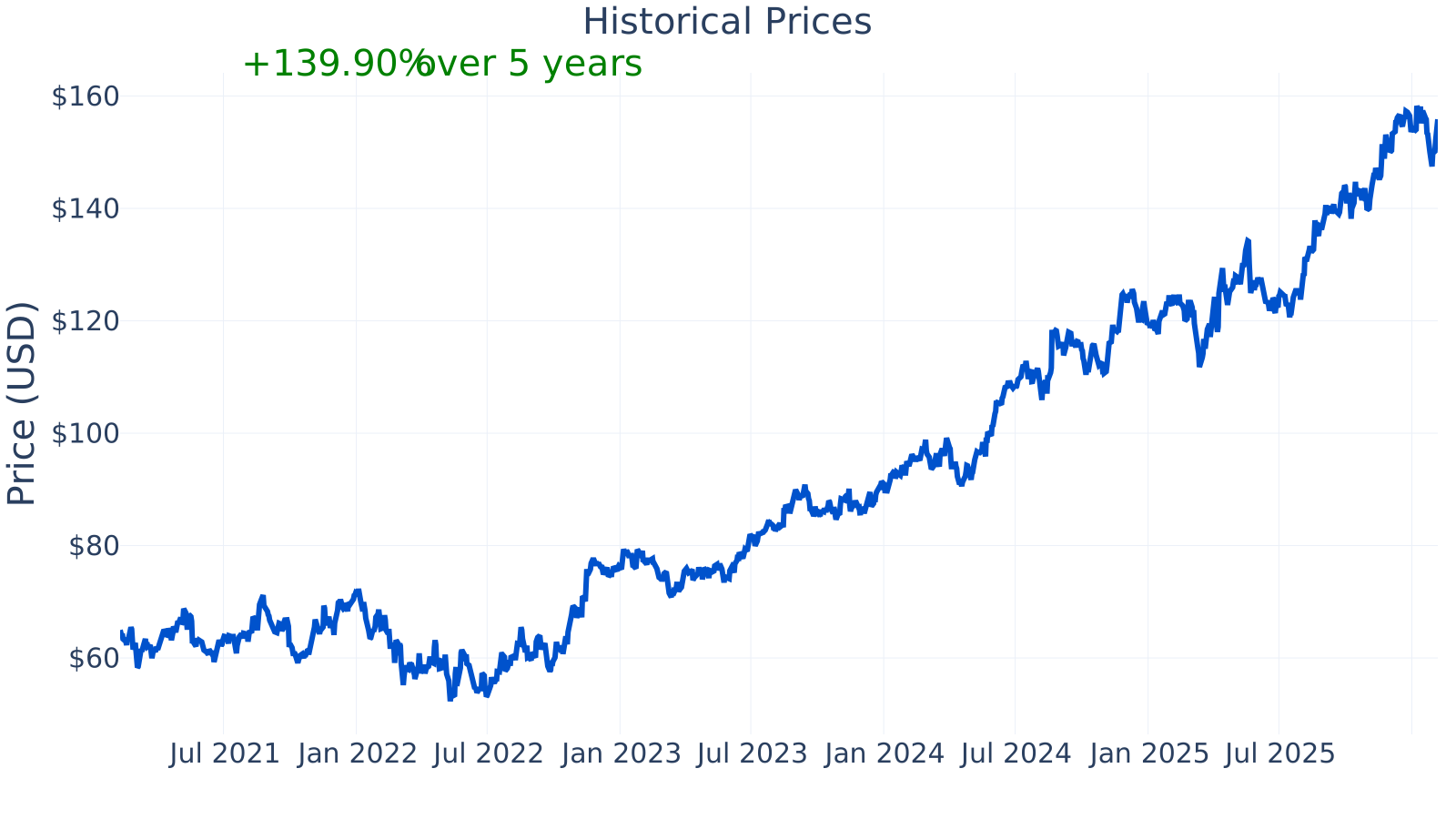
TJX has a market capitalization of about $173B and a beta of ~0.74, which indicates the stock has historically moved less than the broader market on average. The latest P/E ratio is ~34.3 versus an industry median near 18.0, meaning the market is valuing TJX at a higher multiple than many apparel retail peers. Profit margin is about 8.7% (slightly above the industry median near 8.4%). Year-over-year revenue growth is about 7.5%, close to the industry median (~7.3%). Debt-to-equity is around 141%, higher than the industry median (~105%). Trailing twelve-month free cash flow is about $4.4B.
Growth (Medium)
Off-price retail tends to benefit from a broad customer base because it combines recognizable brands with discounts. Demand can hold up in varied economic conditions as shoppers look for value, while brand owners and vendors may use off-price channels to clear excess inventory. That said, apparel and home retail are mature categories overall, so long-run growth often relies on steady store expansion, improving same-store sales, and maintaining strong merchandise availability.
Strategically, TJX’s model is designed around flexible buying and quick inventory turnover. This can support growth when the company consistently finds compelling product at the right cost and keeps shoppers coming back for changing assortments. In addition, its multi-banner footprint (apparel and home, U.S. and international) can diversify growth sources rather than relying on a single retail concept.
The year-over-year revenue growth trend shows that growth can be uneven from quarter to quarter, including periods of low or negative growth, followed by re-acceleration. More recently, the growth rate appears to have stabilized back into positive mid-single-digit territory, ending near ~7.5%.
Free cash flow has increased meaningfully over the period shown, from roughly $2.0B (FY2022) to above $4.3B (FY2024), and remained around $4.2–$4.4B in the most recent years displayed. For a retailer, sustained free cash flow can matter because it helps fund store investment, buybacks/dividends (if management chooses), and resilience during weaker consumer cycles.
Risks (Medium)
This article is for informational purposes only and does not constitute financial advice. Some content is AI-generated. See Disclaimer