Stock Analysis · Synopsys Inc (SNPS)
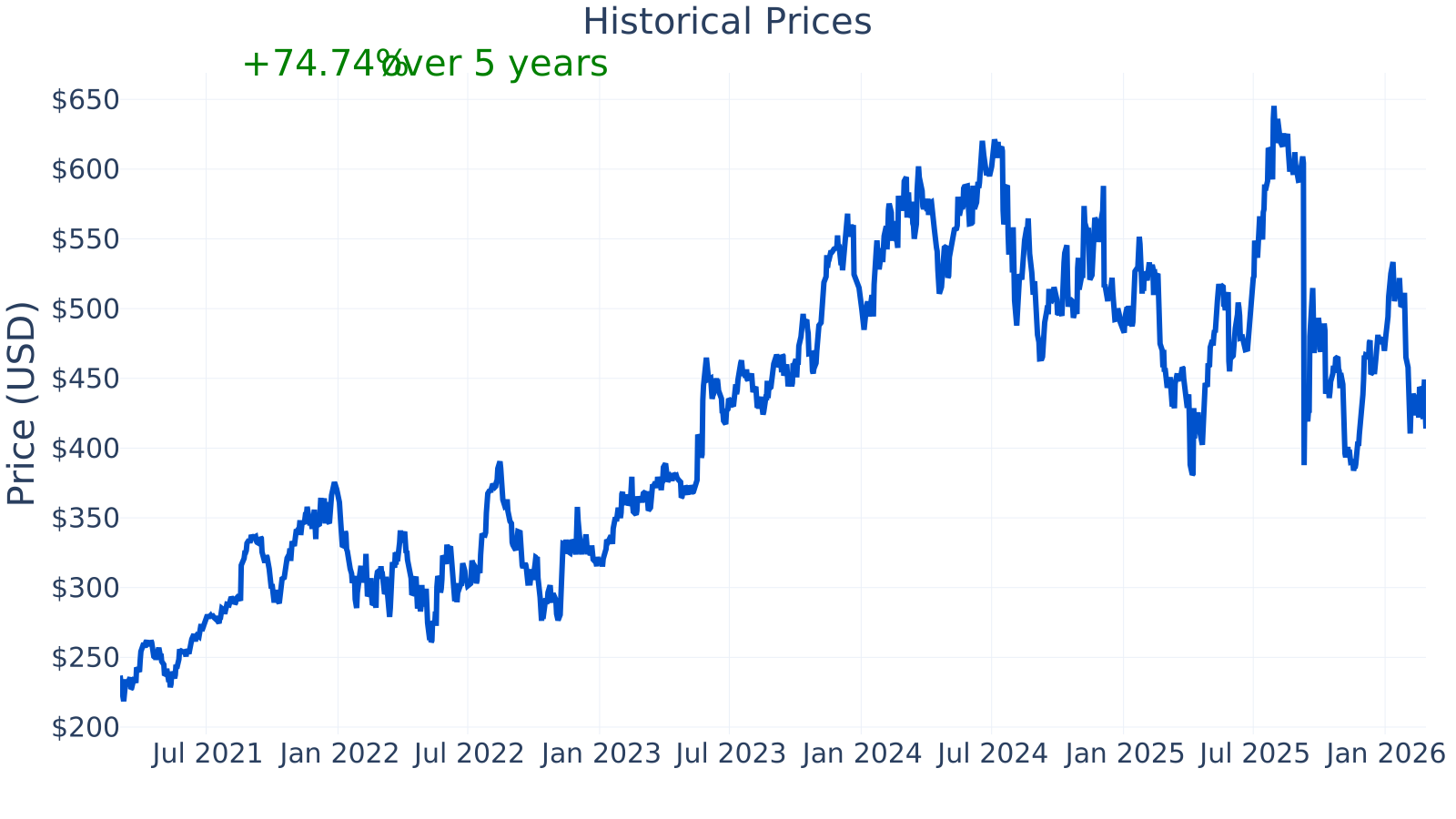
Overview
Synopsys Inc. is a software company focused on helping other companies design and verify computer chips (semiconductors) and complex electronics. In simple terms, it provides tools that engineers use to create chips and to check—before manufacturing—that these chips will work correctly, perform well, and meet power and reliability requirements. Because modern chips are extremely complex and expensive to build, design software and “pre-manufacturing testing” have become essential steps in the process.
Synopsys also sells related products such as reusable design building blocks (often called “IP,” for intellectual property) and software used for hardware security and application security testing. The company’s customer base includes many of the world’s largest semiconductor and electronics companies, and its business model is largely built around software licenses and long-term customer relationships.
Main sources of revenue (typical segment structure used by the company in its filings) include:
- Design Automation (chip design and verification software tools; typically the largest contributor)
- Design IP (licensed chip building blocks integrated into customer designs)
- Software Integrity / Security (application security testing solutions)
Across the period shown, total revenue rises meaningfully (from about $4.2B in FY2021 to about $7.1B in FY2025). A large portion of operating costs is consistently directed to research and development, which is common in advanced software businesses where product leadership depends on sustained engineering investment.
Key Figures
| Metric | Value | Industry ⓘ |
|---|---|---|
| Date | Mar 02, 2026 | |
| Context | ||
| Sector | Technology | |
| Industry | Software - Infrastructure | |
| Market Cap ⓘ | $79.21B | |
| Beta ⓘ | 1.13 | |
| Fundamental | ||
| P/E Ratio ⓘ | 51.30 | 24.58 |
| Profit Margin ⓘ | 13.76% | 6.79% |
| Revenue Growth ⓘ | 65.50% | 16.35% |
| Debt to Equity ⓘ | 32.88% | 26.59% |
| PEG ⓘ | 2.73 | |
| Free Cash Flow ⓘ | $2.28B | |
Synopsys’ latest market capitalization is about $79.2B, and its beta of 1.13 indicates the stock has historically moved somewhat more than the overall market. The company shows a P/E ratio of ~51.3 versus an industry median near 24.6, while its profit margin is ~13.8% versus an industry median near 6.8%. The latest year-over-year revenue growth is ~65.5% (industry median ~16.4%), though growth can be uneven quarter-to-quarter. Debt-to-equity is around 32.9% (industry median ~26.6%). Trailing twelve-month free cash flow is about $2.28B.
Growth (medium)
Synopsys operates in the semiconductor design ecosystem, which is supported by long-term trends: more chips being used in more products (data centers, AI workloads, smartphones, vehicles, industrial equipment), and chips becoming more complex with each new generation. As complexity increases, chipmakers and system companies generally rely more heavily on advanced design tools, verification software, and pre-built design components to reduce risk and shorten development cycles.
The company’s strategy is closely aligned with this direction: maintain broad and deep design tool coverage (from early design to verification), expand reusable IP offerings, and support advanced manufacturing processes and packaging approaches as the industry evolves. This positioning can create “sticky” customer relationships because design tools become embedded in engineering workflows and require training, support, and ongoing compatibility with manufacturing partners.
The year-over-year revenue growth rate varies across time, including some softer periods, followed by a sharp acceleration in the most recent point shown (about 65.5%). For long-term readers, the key takeaway is that growth is not perfectly smooth, but the overall revenue base has expanded substantially over the last several years, consistent with broader semiconductor design demand and the company’s product footprint.
Free cash flow over the trailing twelve months rises to about $2.28B at the latest point shown, after lower levels in the prior few years. In general, sustained free cash flow matters because it can help fund research and development, acquisitions, and other long-term investments without relying as heavily on external financing.
Potential catalysts (in a factual, industry-structure sense) include: continued adoption of AI-related compute infrastructure (which tends to push cutting-edge chip design), ongoing transitions to newer manufacturing nodes, and increasing focus on verification and security as chips and software systems become more interconnected.
Risks (medium)
Synopsys is exposed to the overall semiconductor cycle and to the capital spending patterns of chipmakers and system companies. Even though design work occurs earlier than manufacturing, customer budgets can tighten during downturns, which may affect license growth, renewals, or the pace of new tool adoption.
Competition is a central risk. Synopsys competes in electronic design automation primarily with Cadence Design Systems, and in certain areas with Siemens EDA. In design IP, competition can include large IP providers and internal IP efforts by major chip companies. In application security testing, the competitive set is broad and can include specialized security vendors as well as platform providers. The company’s competitive advantages typically come from the breadth of its tool suite, deep integration into customer workflows, long-standing customer relationships, and high switching costs (changing tools can be disruptive for engineering teams and design schedules). However, leadership can shift if a competitor builds superior capabilities in critical parts of the workflow or if technology transitions create openings for new approaches.
Debt-to-equity trends lower for several years and then shows a sharp jump in 2025 before declining again to about 32.9% at the most recent point (still somewhat above the industry median near 24.5% in the same period). Sudden moves like this can occur due to changes in debt levels, equity levels, or balance-sheet events; it is a reminder that leverage can change over time and should be monitored in the company’s filings.
Profit margin is higher than the industry median throughout most of the period shown, but it also declines materially in the latest point to about 13.8% (still above the industry median near 6.7%). This kind of drop can reflect business mix changes, costs rising faster than revenue, one-time items, or other operating factors. Regardless of the cause, margin variability is a risk because it can influence how much of revenue growth converts into earnings and cash.
Other notable risks include execution risk in integrating acquisitions or expanding product lines, the need to keep pace with rapid technology change (new chip architectures and manufacturing requirements), and customer concentration dynamics common in semiconductor tooling (a relatively small number of very large customers can represent a meaningful portion of revenue).
Valuation
The P/E ratio shown for Synopsys is frequently above the industry median across the period displayed, and the latest value is about 51.3 versus an industry median near 24.6. In descriptive terms, that means the market has often priced Synopsys at a premium compared with many peers in its industry category, which can be consistent with expectations for higher growth, stronger competitive positioning, or more resilient profitability.
At the same time, a higher valuation multiple can increase sensitivity to changes in expectations. If revenue growth slows, margins compress, or industry conditions weaken, the multiple investors are willing to pay can change quickly—even if the company remains fundamentally profitable. The company’s PEG ratio of ~2.73 is another commonly used reference point that reflects the relationship between valuation and growth assumptions; a higher number often implies the valuation is demanding relative to expected growth, though PEG is highly dependent on forecasts and the period used.
Conclusion
Synopsys is a major provider of software and IP used to design and validate semiconductors, a role that tends to become more important as chips grow more complex and expensive to develop. Over the last several years, the company’s revenue has expanded substantially, and the latest trailing free cash flow level is meaningfully higher than in prior periods shown. Profitability, while still above the industry median, has been more variable recently, and leverage has also fluctuated.
From a long-term, fundamentals-based perspective, the central trade-off is clear in the publicly visible metrics: Synopsys has shown strong business scale and industry relevance, while the stock has often carried a higher valuation multiple than the broader industry group. The practical implication is that results and expectations—especially around sustained growth and margins—tend to matter more when valuation is elevated. Monitoring segment performance, customer demand signals described in filings, and longer-term profitability trends can provide the most grounded way to track how the company’s fundamentals evolve over time.
Sources:
- Synopsys, Inc. — Annual Report (Form 10-K): Business description, segment information, risk factors, and financial statements
- SEC EDGAR — Synopsys, Inc. filings (10-K, 10-Q, 8-K)
- Synopsys Investor Relations — Earnings materials and shareholder communications (company-hosted)
- Wikipedia — “Synopsys” (basic company background and history)
This article is for informational purposes only and does not constitute financial advice. Some content is AI-generated. See Disclaimer


