Stock Analysis · Super Micro Computer Inc (SMCI)
Overview
Super Micro Computer, Inc. (Supermicro) designs and builds server and storage systems used in data centers. In simple terms, it supplies the “heavy-duty computers” that companies and cloud providers use to run large workloads, including artificial intelligence (AI), databases, and enterprise applications. The company typically sells complete systems (not just individual components), and it also provides related software/firmware, support, and services.
Supermicro positions itself around fast product development cycles and a building-block approach that allows customers to tailor systems to specific needs (for example, different processors, graphics chips, memory, storage, and networking). This matters in modern data centers because customers often want highly specialized hardware for performance, power efficiency, and deployment speed.
In its financial reporting, Supermicro commonly describes revenue primarily by product sales versus services and software. Product revenue is typically the dominant share, while services/software are smaller and tied to support and related offerings. Detailed percentages by category can vary by period and are reported in the company’s filings.
Typical revenue sources (largest to smallest) are:
- Server and storage systems (product revenue) — the core business, generally the vast majority of sales
- Services and software — support, maintenance, and related offerings, usually a smaller portion
One notable pattern in the company’s recent years is the sharp expansion in revenue alongside higher spending on operating expenses (including R&D). Gross profit has increased in absolute dollars as revenue has scaled, while operating expenses have also risen as the business grew.
Key Figures
| Metric | Value | Industry ⓘ |
|---|---|---|
| Date | Feb 07, 2026 | |
| Context | ||
| Sector | Technology | |
| Industry | Computer Hardware | |
| Market Cap ⓘ | $20.52B | |
| Beta ⓘ | 1.52 | |
| Fundamental | ||
| P/E Ratio ⓘ | 25.09 | 25.91 |
| Profit Margin ⓘ | 3.11% | 3.74% |
| Revenue Growth ⓘ | 123.40% | 21.50% |
| Debt to Equity ⓘ | 69.46% | 4.92% |
| PEG ⓘ | 0.76 | |
| Free Cash Flow ⓘ | $440.09M | |
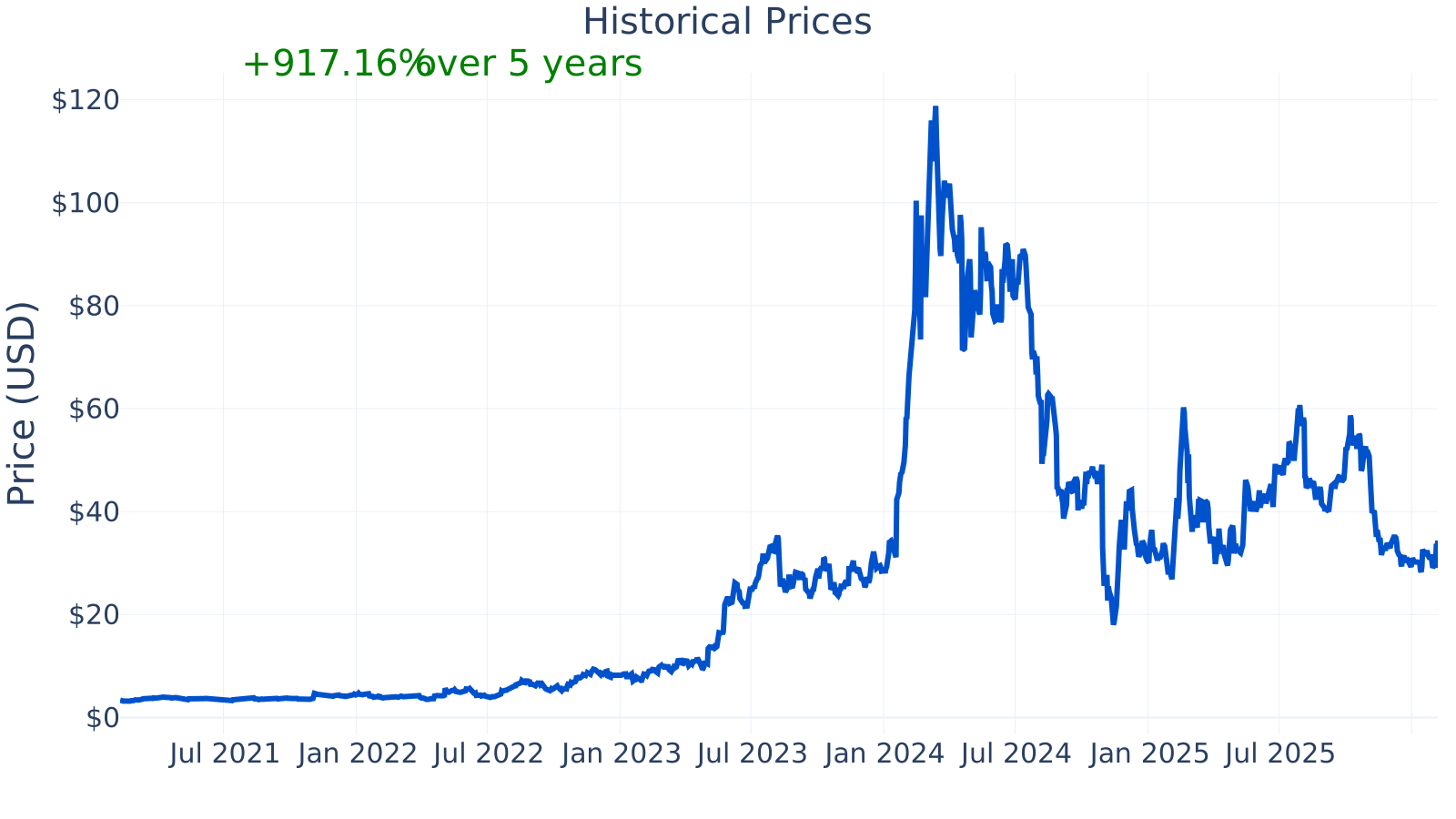
Supermicro’s market capitalization is about $20.5B. The stock’s beta of ~1.52 indicates it has tended to move more than the broader market (higher volatility). The P/E ratio is ~25.1, close to the industry median (~25.9), while the profit margin is ~3.11%, below the industry median (~3.74%). At the same time, its most recent year-over-year revenue growth is ~123%, far above the industry median (~21.5%), reflecting a period of unusually rapid expansion. The company also shows positive free cash flow (TTM) of ~$440M, though cash generation has fluctuated meaningfully in recent years.
Growth (High)
Supermicro operates in the broader market for servers and data-center infrastructure, which is closely linked to cloud computing, enterprise IT refresh cycles, and—more recently—large AI workloads that require specialized, high-performance systems. Demand in this area can be strong when customers expand data-center capacity, but it can also be cyclical when spending slows or supply conditions shift.
A key element of Supermicro’s growth strategy is speed: releasing new system designs quickly as chip platforms change, then delivering configurable systems that can be deployed at scale. In periods when customers are rapidly building capacity (for example, adding compute for AI), the ability to qualify and ship new configurations quickly can be a practical advantage.
The revenue growth trend shows very large swings, including quarters with extremely high expansion and periods of slowdown or contraction. The latest figure (around 123% YoY) is exceptional for hardware and suggests a surge in demand and/or a ramp in shipments versus the prior-year period. For long-term context, it is important to treat such spikes as potentially hard to sustain, because data-center spending can normalize after rapid build-outs.
Free cash flow has been volatile, moving from negative to strongly positive and back again before returning closer to breakeven and then positive. For a hardware manufacturer that scales quickly, this can happen when working capital needs change (for example, building inventory, extending customer credit, or managing payables) and when supply chain conditions affect timing. Over time, consistently positive free cash flow is typically easier to maintain when growth becomes more steady and margins are resilient.
Risks (High)
Supermicro’s business is tied to large, project-based customer spending in data centers. That can create uneven demand, where a few large orders or a short period of strong builds can be followed by digestion periods. Hardware markets can also face pricing pressure, especially when competitors pursue share or when component costs change.
Competition is a central risk. Supermicro participates in markets served by major enterprise server vendors and original design manufacturers (ODMs). Well-known competitors in servers and infrastructure include Dell Technologies, Hewlett Packard Enterprise (HPE), Lenovo, and others depending on the exact product segment and customer type. Relative positioning can vary by customer: large vendors may lead in end-to-end enterprise solutions and long-standing relationships, while Supermicro is often associated with rapid configuration and system-level customization. Whether that translates into durable advantage depends on execution, supply availability, service quality, and the ability to maintain performance and reliability at scale.
Another key risk area is profitability. Even when revenue grows quickly, hardware businesses can have relatively thin margins, and mix shifts (for example, more competitive deals, different system configurations, or higher component costs) can pressure earnings.
The profit margin trend shows that margins were meaningfully higher in parts of 2022–2024, then declined into the most recent level of about 3.11%, which is below the industry median (~3.74%). This pattern can matter for long-term durability: if revenue growth slows, lower margins can reduce the cushion available for R&D investment and operating flexibility.
Balance sheet and financing risk also deserve attention, especially during rapid expansion when companies may rely more on borrowing or other funding to support working capital and capacity needs.
The latest debt-to-equity ratio is about 69%, far above the industry median (~4.9%). The chart indicates this ratio rose sharply during the expansion phase. Higher leverage can amplify both outcomes: it can help fund growth, but it can also increase sensitivity to margin pressure, demand slowdowns, or tighter credit conditions.
Valuation
Supermicro’s current valuation (as reflected by its price-to-earnings ratio) looks broadly in line with the industry median, even though the company’s recent revenue growth has been much higher than typical for the peer group. At the same time, its current profit margin is below the industry median and its leverage is higher, both of which can influence how the market prices risk and sustainability.
The P/E history shows periods where Supermicro traded at lower multiples (for example, near the low teens in parts of 2022–2023), followed by a sharp increase (including a peak above 50 in early 2024) and then a return to levels closer to the mid‑20s to around 30 more recently. This pattern is consistent with a stock that can re-rate quickly when growth expectations and near-term business conditions change.
In practical terms, whether the current price level is “expensive” or “cheap” depends heavily on forward-looking questions the financial statements alone cannot answer: how durable the recent growth proves to be, whether margins stabilize or continue to compress, and how much balance-sheet leverage remains necessary to support operations. The current multiple being near the industry median suggests the market is balancing unusually high recent growth against meaningful execution, margin, and financial-structure risks.
Conclusion
Supermicro is a data-center hardware company that has recently shown exceptionally rapid revenue expansion, indicating strong demand for its server and storage systems during a major build-out phase in the market. Its business model emphasizes fast, configurable system delivery, which can fit well with rapidly changing compute needs such as AI-oriented infrastructure.
At the same time, the picture includes several areas that can matter to long-term outcomes: profit margins have trended down to levels below the industry median, free cash flow has been volatile, and leverage (debt relative to equity) is considerably higher than many peers. Combined with a history of large valuation swings, these factors point to a company where results can change quickly with demand cycles, pricing, and execution.
Sources:
- U.S. Securities and Exchange Commission (SEC EDGAR) — Super Micro Computer, Inc. filings (Form 10-K, 10-Q, 8-K)
- Super Micro Computer, Inc. — Investor Relations materials and press releases
- Wikipedia — “Super Micro Computer” (basic company background)
This article is for informational purposes only and does not constitute financial advice. Some content is AI-generated. See Disclaimer