Stock Analysis · Sunrun Inc (RUN)
Overview
Sunrun Inc. is a U.S. residential solar company that offers homeowners solar energy systems and related services. In simple terms, it helps households produce electricity from rooftop solar panels, and it can also add battery storage so customers can store energy for later use (for example, during the evening or a grid outage). Sunrun generally operates across the full customer journey: marketing and customer acquisition, system design, installation, arranging financing, and long-term service/monitoring.
Sunrun’s revenue is primarily tied to (1) selling solar systems and related equipment/services, and (2) long-term customer agreements where Sunrun provides solar power or system services over time. The exact mix can change over time based on interest rates, consumer demand for loans vs. leases, and company strategy. For an up-to-date breakdown by revenue category, the company’s Form 10-K/10-Q revenue footnotes are the most reliable reference.
The business model is capital-intensive. That means Sunrun often pays significant upfront costs to acquire customers and install systems, while some customer contracts generate cash flows over many years. As a result, reported accounting profits and cash generation can move differently than what people may expect from simpler “sell a product once” businesses.
Across the years shown, total revenue moves from about $1.61B (2021) to about $2.96B (2025). However, profitability is uneven: operating income is deeply negative in 2023–2024 and then turns positive in 2025. Interest expense also rises substantially over the period (from about $328M in 2021 to about $2.41B in 2025), which highlights how important financing conditions are for this type of business.
Key Figures
| Metric | Value | Industry ⓘ |
|---|---|---|
| Date | Mar 02, 2026 | |
| Context | ||
| Sector | Technology | |
| Industry | Solar | |
| Market Cap ⓘ | $3.07B | |
| Beta ⓘ | 2.46 | |
| Fundamental | ||
| P/E Ratio ⓘ | N/A | |
| Profit Margin ⓘ | 15.22% | 7.06% |
| Revenue Growth ⓘ | 123.50% | 11.10% |
| Debt to Equity ⓘ | 470.92% | 104.92% |
| PEG ⓘ | 0.45 | |
| Free Cash Flow ⓘ | -$1.10B | |
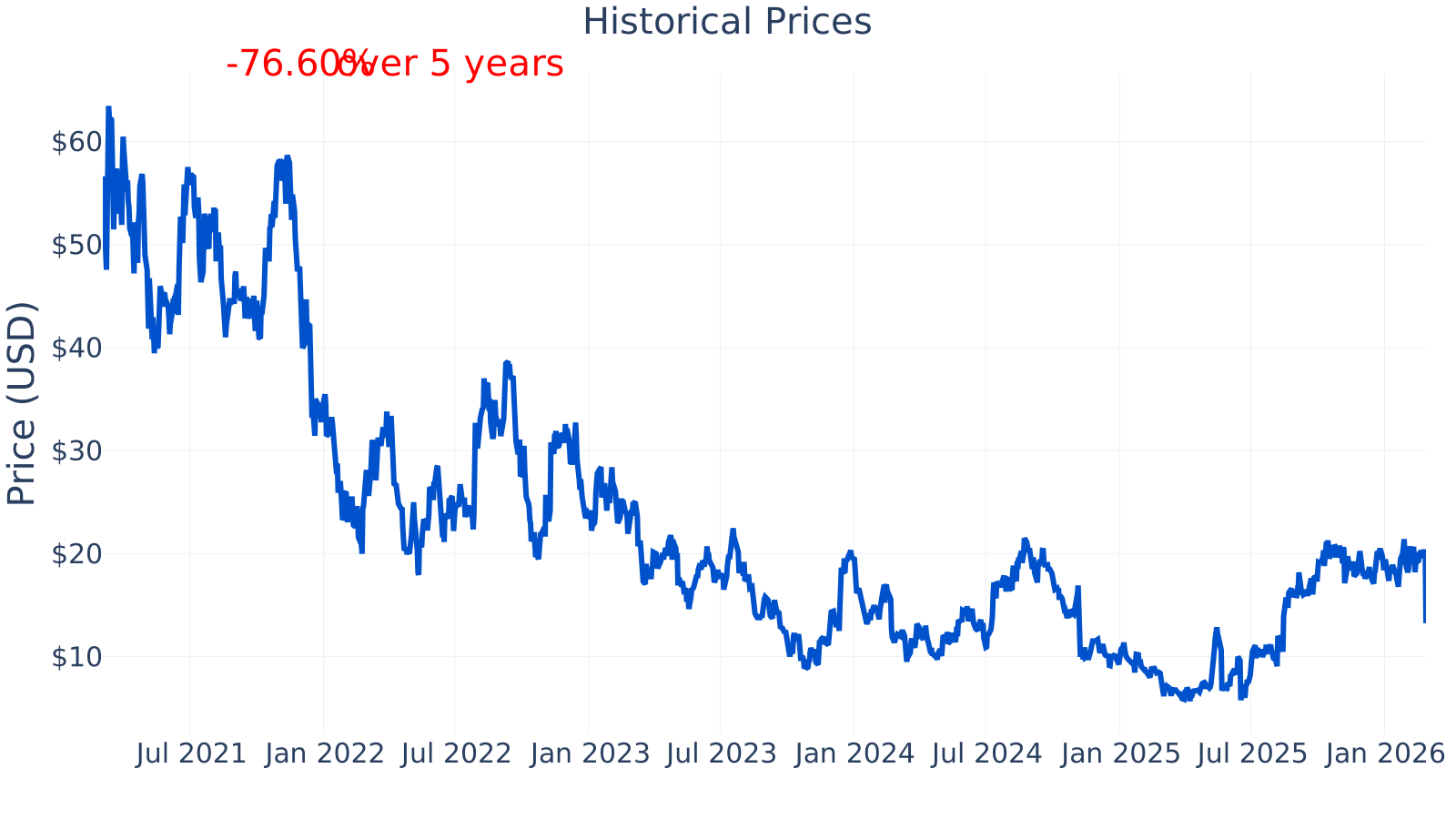
Sunrun’s market capitalization is about $3.1B, placing it in the mid-cap range. The stock’s beta of ~2.46 indicates the share price has historically moved much more than the broader market, which can translate into large swings in both directions.
On operating metrics shown here, profit margin is ~15.22% versus an industry median of ~7.06%, while year-over-year revenue growth is ~123.5% versus an industry median of ~11.1%. At the same time, debt-to-equity is ~471%, well above the industry median of ~105%, and free cash flow (TTM) is about -$1.10B, indicating significant cash outflow over the trailing twelve months.
Growth (Medium)
Residential solar and home energy storage participate in broad, long-term trends: electrification of homes, consumer interest in managing electricity costs, and resilience concerns (backup power). The overall direction of these themes can support long-run demand, but the pace of adoption tends to be cyclical—often sensitive to interest rates, utility rate structures, and local policy rules (such as net metering).
Sunrun’s strategy centers on offering multiple ways for customers to go solar (purchase/loan vs. long-term agreements) and expanding attachment of battery storage. Storage can be meaningful because it can raise the value proposition for homeowners (backup power and self-consumption), potentially improving customer demand in markets where exporting power back to the grid becomes less favorable.
The chart shows revenue growth was strong in 2021–2022, weakened and turned negative through parts of 2023–2024, then improved sharply in the most recent period shown (about +123.5% year over year). That kind of pattern suggests demand and/or revenue recognition has been volatile rather than steadily compounding.
Free cash flow remains materially negative over the period shown (roughly -$1.5B in 2021 worsening to about -$3.5B by 2025 in the series displayed, with the latest TTM shown at about -$1.10B in the table). For a capital-intensive model, negative free cash flow can happen during growth phases, but persistently large outflows keep financing needs high and can limit flexibility during tougher market conditions.
Risks (High)
Sunrun faces elevated financial and operating risk mainly because residential solar depends heavily on financing. When interest rates rise, monthly payments for customers can increase and demand can soften; at the same time, Sunrun’s own funding costs can rise. This dynamic can pressure volumes, margins, and the economics of long-duration customer contracts.
The debt-to-equity trend rises significantly over time, reaching about 471% most recently shown, far above the industry median (about 105%). Higher leverage can amplify results in good periods, but it can also increase vulnerability when installation volumes slow, tax equity becomes harder to source, or refinancing becomes more expensive.
Profitability has been volatile. The profit margin series includes periods of steep losses (notably in 2023–2024) before improving to a positive level most recently (about 5.81% at the end of the series shown), which is slightly below the industry median near 6.44% at that time. This pattern indicates that single-year profitability may not fully represent the underlying stability of the model, especially when policy, financing costs, and installation volumes are shifting.
Competitive risk is also meaningful. Residential solar installers and financiers compete on customer acquisition cost, installation efficiency, access to funding (including tax equity structures), and brand trust. Sunrun has historically been viewed as one of the larger U.S. residential solar providers by scale, but the market includes numerous regional installers and national players, and competition can intensify when overall demand slows.
Beyond competition, policy and regulatory changes can materially affect demand. Changes to net metering rules, interconnection timelines, permitting, and incentives can shift payback periods for homeowners. Supply chain disruptions, labor availability, and warranty/service execution also matter because systems are physical assets installed on homes and supported over many years.
Valuation
For many companies, a commonly cited valuation tool is the price-to-earnings (P/E) ratio. For Sunrun, the P/E ratio is not consistently meaningful across the full period shown because earnings have been volatile and sometimes negative (which can make P/E unusable or misleading).
In the periods where the company P/E is displayed, it varies widely (for example, roughly 113 in late 2022, about 33 in early 2023, and above 300 in mid-2023). The industry median P/E in the same display generally ranges from the mid-teens to over 100 depending on the date. Large swings like these typically reflect unstable earnings rather than a stable, easy-to-compare valuation signal.
Given the combination of (1) high leverage, (2) negative free cash flow in the latest table, and (3) earnings volatility, valuation discussions often rely more on balance-sheet strength, funding access, and the durability of customer cash flows than on a single ratio. In practical terms, whether the current stock price looks “expensive” or “cheap” can depend heavily on assumptions about future installation volumes, financing costs, and policy conditions—inputs that can change quickly.
Conclusion
Sunrun operates in residential solar and storage, areas with long-term demand drivers tied to electrification and consumer interest in managing energy costs and resilience. The company’s results, however, show considerable volatility: revenue growth has swung from strong to negative and back to strong, profitability has been inconsistent across years, and free cash flow has been substantially negative in the latest metrics provided.
The main factors that can shape long-term outcomes include financing conditions (interest rates and funding availability), regulatory policy at the state and utility level, and the company’s ability to manage customer acquisition costs and installation/service execution at scale. The balance sheet also stands out: debt relative to equity is high compared with the industry median, which can increase sensitivity to downturns.
Overall, the factual picture is a company tied to a potentially durable theme (home solar and storage) but with a business model that can produce uneven financial results and requires ongoing access to capital. Any long-term assessment typically hinges on whether operations can generate more consistent cash flow and profitability while maintaining competitive positioning in a policy- and rate-sensitive market.
Sources:
- SEC EDGAR — Sunrun, Inc. filings (Form 10-K, Form 10-Q)
- Sunrun Investor Relations — SEC Filings and shareholder materials (company-hosted)
- Wikipedia — “Sunrun” (basic company background)
This article is for informational purposes only and does not constitute financial advice. Some content is AI-generated. See Disclaimer