Stock Analysis · STMicroelectronics NV (STM)
Overview
STMicroelectronics N.V. (STM) is a global semiconductor company. In simple terms, it designs and manufactures chips and other electronic components that help devices “sense,” “process,” and “control” electricity and data. These products end up inside everyday items such as cars (power systems, safety features, infotainment), industrial equipment (factory automation, robotics, power conversion), and consumer devices (smartphones, smart home, appliances).
STMicroelectronics generally describes its business around a few large end markets, with a strong presence in automotive and industrial applications. Its portfolio includes microcontrollers (the “brains” of many embedded devices), power and analog chips (to manage electricity safely and efficiently), sensors (to detect motion, pressure, etc.), and specialized chips used in connectivity and other functions.
Public company reporting commonly breaks revenue down by business lines and/or end markets. A typical breakdown (largest to smaller) includes:
- Automotive (chips for vehicles, including electrification and advanced driver assistance features)
- Industrial (factory automation, energy infrastructure, power supplies, motors)
- Personal electronics (consumer devices such as phones and other electronics)
- Communications equipment (networking and related infrastructure)
Because semiconductor products are often sold through a mix of direct customer relationships and distribution channels, the exact shares can shift from year to year depending on industry cycles. In broad terms, STM’s financial results show meaningful sensitivity to demand trends in automotive and industrial markets, alongside more cyclical consumer-related demand.
From 2021 to 2023, the company expanded revenue and operating profit, while continuing to spend heavily on research and development. In 2024–2025, revenue and profitability declined materially, which is consistent with a downcycle and/or weaker demand conditions in parts of its end markets. Research and development spending stayed high in absolute terms, which can support future product competitiveness but also raises the cost base when revenue is under pressure.
Key Figures
| Metric | Value | Industry ⓘ |
|---|---|---|
| Date | Apr 27, 2026 | |
| Context | ||
| Sector | Technology | |
| Industry | Semiconductors | |
| Market Cap ⓘ | $44.86B | |
| Beta ⓘ | 1.22 | |
| Fundamental | ||
| P/E Ratio ⓘ | 315.44 | 63.60 |
| Profit Margin ⓘ | 1.19% | 7.71% |
| Revenue Growth ⓘ | 23.00% | 19.70% |
| Debt to Equity ⓘ | 14.46% | 20.71% |
| PEG ⓘ | 0.52 | |
| Free Cash Flow ⓘ | $160.13M | |
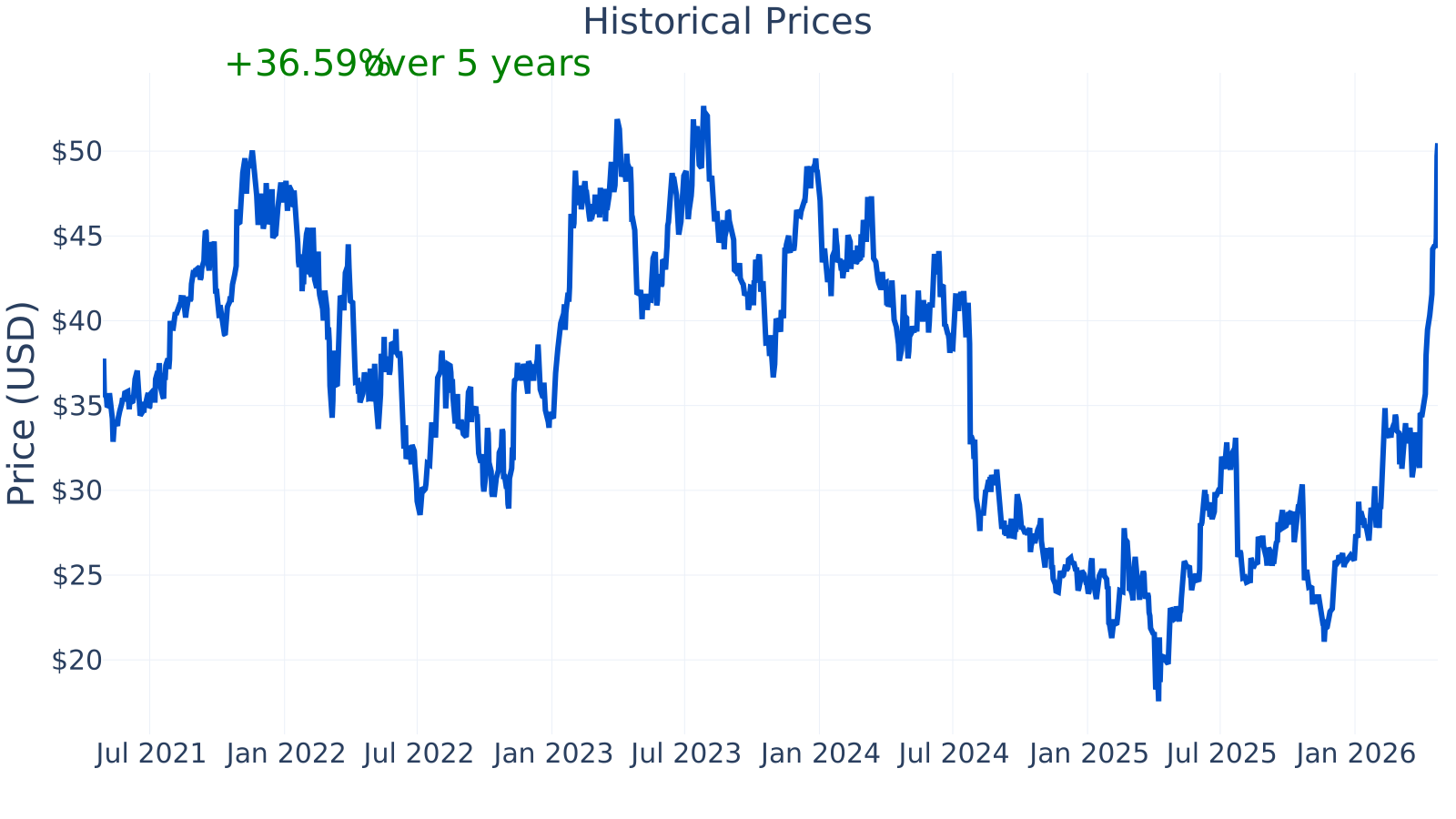
The latest snapshot shows a market capitalization of about $44.9B and a beta of ~1.22, which indicates the stock has historically moved somewhat more than the broad market. The company’s year-over-year revenue growth is ~23% versus an industry median near 19.7%, but profit margin is ~1.2% versus an industry median near 7.7%, reflecting very weak recent profitability. Leverage appears moderate with debt-to-equity ~14% versus an industry median near 20.7%. The reported P/E ratio (~315) is far above the industry median (~63.6), which often happens when earnings have recently fallen sharply (even if revenue is stabilizing), mechanically pushing the ratio up.
Growth (Medium)
Semiconductors are a long-term growth industry because chips are increasingly required in more places: vehicles are becoming more electronics-heavy, factories are automating, and energy systems are being upgraded with power electronics. STM’s focus on automotive and industrial markets aligns with these structural trends, especially as electric vehicles and energy-efficient power conversion typically require more semiconductor content than older designs.
At the same time, this industry is cyclical. Even when long-term demand grows, customers can reduce orders for a period as they work through excess inventory or delay projects. This can create multi-quarter swings in revenue and profit, which STM’s recent financial pattern illustrates.
The year-over-year revenue trend shows a strong period in 2021–2022, followed by a clear downturn through 2024–2025, and then a move back toward positive growth by early 2026 (about +22.8%). That rebound can be a meaningful inflection point if it is sustained, but one quarter alone typically does not define a full cycle.
Free cash flow (cash generated after operating needs and capital spending) rose strongly by 2023 (around $2.18B), then compressed sharply in 2025 and remained low into 2026 (about $160M on a trailing basis). For a manufacturer, free cash flow can be pressured when the company invests heavily in factories and equipment or when profitability drops. A durable recovery often requires not only improving sales, but also a rebound in margins and careful management of capital expenditures.
Risks (High)
The biggest risk for STM is the cyclical nature of semiconductors. When demand slows, fixed costs (factories, equipment, engineering teams) can weigh heavily on profitability. This shows up in the company’s recent margin compression, where profits fell much faster than revenue.
Another important risk is customer and end-market concentration. Automotive and industrial can be resilient over long horizons, but they are not immune to downturns. Automotive programs can also have long qualification cycles, and losing a design slot can affect revenue for years.
Manufacturing and execution risk is also meaningful. Producing chips at high quality and good yields is complex. Delays in ramping production, cost overruns, or technology transitions that do not go as planned can hurt competitiveness and financial performance.
Geopolitical and supply-chain constraints remain a structural risk for the entire sector, including export restrictions, changing trade rules, and the need for specialized equipment and materials.
Leverage looks relatively contained. Debt-to-equity declined from roughly 38% in mid-2021 to about 14% by early 2026, generally below the industry median across most periods shown. Lower leverage can reduce financial stress during downturns, although it does not remove operational cyclicality.
Profitability is the area showing the most pressure. Net profit margin peaked around 25% in 2023, then fell steadily to about 1.2% by early 2026. While the industry median also moved, STM’s drop is significant, and low margins can limit flexibility (for example, how much the company can invest while still generating cash).
Competitive advantages for STM typically include a broad product lineup for embedded systems (microcontrollers), strong positions in power and analog, and long-term relationships with industrial and automotive customers. However, the company competes against very large and highly capable peers, and leadership depends on the specific chip category rather than the overall semiconductor market.
Main competitors vary by product line and end market, but commonly include:
- Texas Instruments (analog and embedded processing)
- NXP Semiconductors (automotive and industrial)
- Infineon Technologies (power semiconductors and automotive)
- onsemi (power and sensing, automotive exposure)
- Renesas Electronics (automotive and embedded)
Relative positioning often comes down to product performance, long-term supply reliability, cost structure, and the ability to support large customers through multi-year production programs.
Valuation
Valuation for cyclical companies can be difficult to interpret using a single metric, because earnings can swing dramatically across the cycle. When profits temporarily fall, the P/E ratio can jump even if the stock price is flat or down.
Historically, STM’s P/E ratio mostly sat in a more typical range (often roughly 9–20 in 2022–2024 in the data shown), frequently below the industry median in those periods. More recently, it rose sharply (about 157 on 2026-02-03 in the chart, and around 315 in the latest snapshot table), far above the industry median. This pattern is consistent with a period of compressed earnings rather than a sudden, sustained re-rating alone. In practice, investors often look at additional measures (such as normalized earnings power through a cycle, operating margin trends, and free cash flow recovery) to interpret valuation during downturns.
Conclusion
STMicroelectronics is a diversified semiconductor manufacturer with significant exposure to automotive and industrial markets, which are supported by long-term trends such as electrification, automation, and energy efficiency. Over 2021–2023, the company expanded revenue and profitability while maintaining substantial research and development investment.
The most important current fundamentals to monitor are the depth and duration of the recent profitability decline, the pace of free cash flow recovery, and whether the return to positive year-over-year revenue growth becomes consistent across multiple quarters. Balance-sheet leverage appears moderate relative to industry norms, but the company’s results remain sensitive to semiconductor cycles and competitive pressure across multiple product categories.
Sources:
- STMicroelectronics — Annual Report (Form 20-F): “Business,” “Operating and Financial Review,” and “Financial Statements”
- SEC EDGAR — STMicroelectronics N.V. filings (Form 20-F and other submitted reports)
- STMicroelectronics — Investor Relations materials (annual results press releases and presentations)
- Wikipedia — “STMicroelectronics” (basic company background and general description)
This article is for informational purposes only and does not constitute financial advice. Some content is AI-generated. See Disclaimer


