Stock Analysis · Starbucks Corporation (SBUX)
Overview
Starbucks Corporation is a global coffee company that operates and licenses coffee shops and sells beverages, food, and other products. Its core business is serving drinks (especially coffee-based beverages) and food through company-operated and licensed stores, complemented by branded products sold through other channels and a large loyalty and digital ordering ecosystem.
In its financial reporting, Starbucks organizes operations mainly into two reportable segments: North America (primarily the U.S. and Canada) and International (including China and other markets). In addition, the company reports Channel Development (branded products sold outside Starbucks stores, such as packaged coffee and ready-to-drink offerings, depending on partnerships and distribution arrangements).
At a practical level, Starbucks’ revenue is typically driven by the following sources (largest to smallest; exact percentages can vary by year and are detailed in company filings):
- Company-operated stores (sales of beverages and food directly to customers)
- Licensed stores (royalties and product sales to licensed partners)
- Channel Development (branded products sold through consumer packaged goods and other channels)
- Other (smaller items such as certain retail and ancillary revenues)
The company’s economics are shaped by store traffic, pricing, product mix (for example, premium beverages), and input costs like coffee, dairy, and labor. The general flow of profitability also depends heavily on operating costs tied to running stores and supporting the brand globally.
Over the periods shown, total revenue rose overall (from about $29.1B in fiscal 2021 to about $37.2B in fiscal 2025). At the same time, costs and operating expenses increased, and fiscal 2025 shows notably lower operating income and net income than prior years in the same view—highlighting how sensitive results can be to cost pressure and operating conditions.
Key Figures
| Metric | Value | Industry ⓘ |
|---|---|---|
| Date | Feb 07, 2026 | |
| Context | ||
| Sector | Consumer Cyclical | |
| Industry | Restaurants | |
| Market Cap ⓘ | $113.30B | |
| Beta ⓘ | 0.94 | |
| Fundamental | ||
| P/E Ratio ⓘ | 82.88 | 29.16 |
| Profit Margin ⓘ | 3.63% | 7.98% |
| Revenue Growth ⓘ | 5.50% | 6.90% |
| Debt to Equity ⓘ | -399.57% | 69.29% |
| PEG ⓘ | 1.61 | |
| Free Cash Flow ⓘ | $2.34B | |
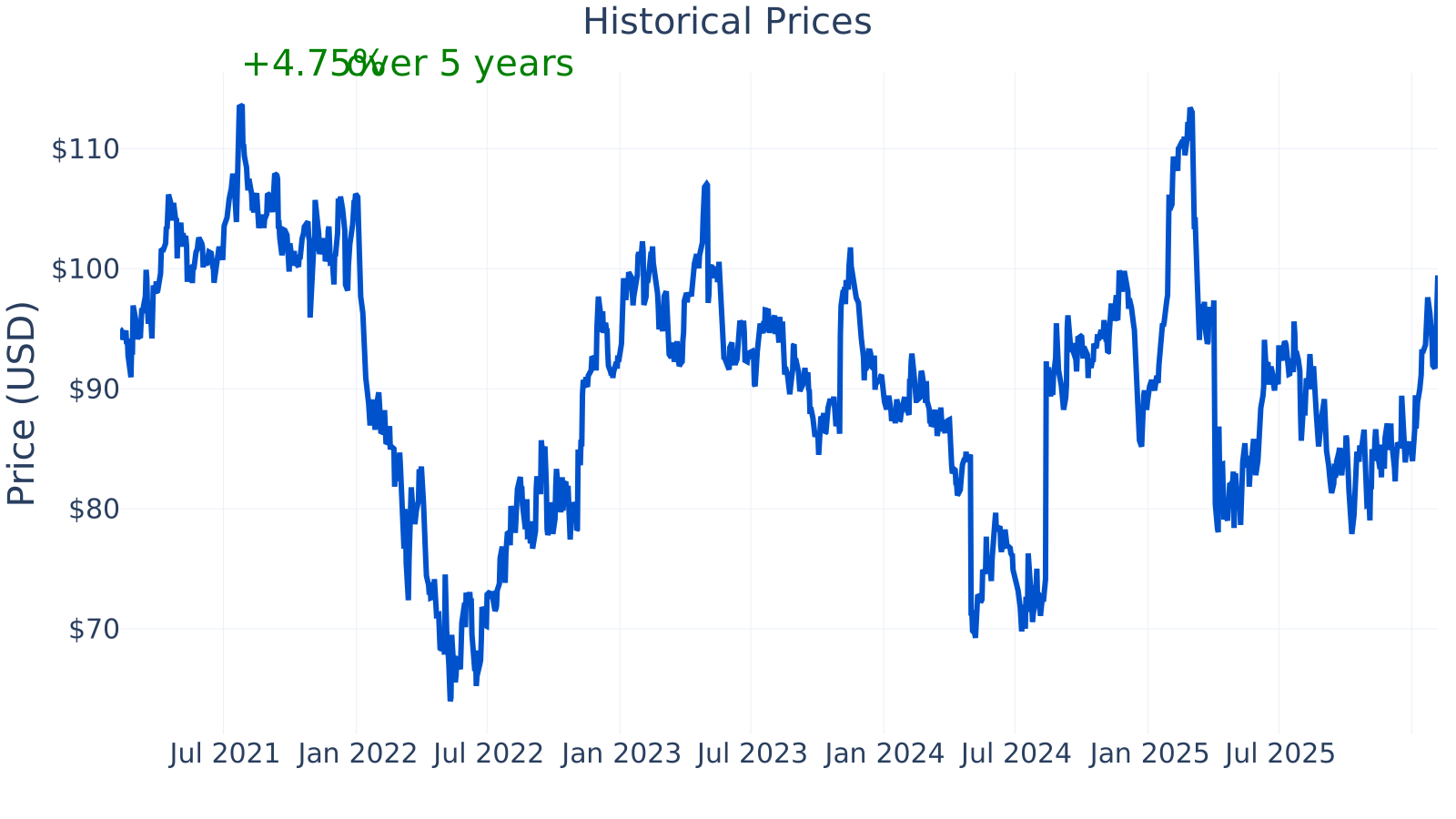
Starbucks’ market capitalization is about $113.3B, and the stock’s beta of ~0.94 suggests price moves that have often been somewhat close to the broader market rather than dramatically more volatile. The latest P/E ratio is ~82.9, which is well above the industry median (~29.2) in the comparison set provided. Recent profitability also looks weaker versus peers on this snapshot: profit margin is ~3.6% versus an industry median ~8.0%. Year-over-year revenue growth is about 5.5% compared with an industry median ~6.9%. Free cash flow over the trailing twelve months is about $2.34B, and the PEG ratio (~1.61) indicates the valuation is high relative to growth assumptions implied by that metric.
Growth (Medium)
Starbucks operates in the restaurant and specialty coffee space, which tends to grow over time with population, income levels, urbanization, and consumer demand for convenient food and beverages. Over long periods, branded quick-service concepts can expand through new store openings, higher sales per store, and growth in licensed formats—especially in international markets where store density is still building.
Starbucks’ strategy has historically emphasized brand strength, product innovation (seasonal and premium beverages), loyalty and digital engagement (mobile ordering and personalized offers), and a mix of company-operated and licensed stores to balance control and capital efficiency. Those themes generally align with how large restaurant brands scale: increasing convenience, broadening dayparts, and using data-driven marketing to improve frequency.
The year-over-year revenue growth pattern shown is uneven: strong growth earlier in the period, a softer patch with slightly negative growth through parts of fiscal 2024, then a return to modest positive growth by fiscal 2025 (around the mid-single digits in the latest point). This kind of re-acceleration can matter for long-term narratives, but it also shows that Starbucks is not immune to macro slowdowns, competitive pressure, or operational constraints.
Free cash flow has remained positive over the period shown, but it has fluctuated meaningfully (roughly $2.47B in 2021, $3.61B in 2022, $2.75B in 2023, $3.95B in 2024, and $2.77B in 2025 based on the displayed trailing periods). For a consumer brand, sustained free cash flow is important because it supports reinvestment in stores and equipment, marketing, and shareholder returns; volatility, however, can signal periods of higher costs or investment needs.
Risks (High)
A major risk for Starbucks is that it is a large, mature brand in a competitive category where small changes in traffic, consumer spending, or costs can have an outsized impact on profit. Labor costs, commodity inputs (coffee, dairy), and occupancy costs can pressure margins, particularly if pricing power weakens. Demand can also be sensitive to economic conditions because many purchases are discretionary “small luxuries,” even if coffee has habitual elements.
The margin trend shown deteriorates substantially over time: from double-digit levels earlier in the series to about 3.6% at the latest point, which is also below the industry median (~7.9%) shown. Regardless of the exact drivers in a given year, a declining margin profile increases sensitivity to execution mistakes and makes future results more dependent on restoring efficiency, improving sales mix, or moderating cost growth.
The debt-to-equity values are negative throughout the period shown, which commonly occurs when a company has negative shareholders’ equity (often influenced by large share repurchases and balance sheet structure). This does not automatically mean the company cannot meet its obligations, but it can make leverage comparisons less intuitive and puts more emphasis on cash flow generation, liquidity, and the ability to service debt through different operating environments. By contrast, the industry median in the comparison set is positive and around the ~69% to ~114% range across the period displayed.
Competition is another key risk. Starbucks competes with:
- Large global quick-service and coffee-focused chains (scale, marketing budgets, and real estate access)
- Regional coffee chains and local independent cafés (often strong on authenticity and local loyalty)
- Convenience stores and fast-food operators (increasingly high-quality coffee at lower price points)
- At-home coffee (machines, pods, and premium beans that can substitute for store visits)
Starbucks’ competitive advantages have traditionally included brand recognition, premium positioning, store network scale, and a well-developed loyalty and digital ordering platform. It is widely recognized as one of the leading global specialty coffee brands by scale. The main question for long-term fundamentals is less about brand awareness and more about whether Starbucks can sustain traffic and pricing while managing labor and operational complexity at its size.
Valuation
The P/E ratio shown for Starbucks has varied widely over time, falling into the ~20–40 range for portions of 2022–2024, and then rising to higher levels more recently, with the latest table showing about 82.9. In the same comparison set, the industry median is ~29.2 for the latest point in the table. A higher P/E can be consistent with expectations of stronger future growth, higher long-run margins, or greater perceived durability of the business model; it can also reflect a period when current earnings are temporarily depressed, which mathematically pushes the P/E higher.
In Starbucks’ case, the valuation picture in this snapshot sits alongside (1) mid-single-digit revenue growth (about 5.5% year over year in the latest metric), and (2) a notably lower current profit margin (about 3.6%) than both its own recent history in the chart and the industry median shown. With that combination, the current multiple implies that future results would need to rely on improvements such as margin recovery, stronger comparable-store sales, and/or durable long-term growth to bring earnings in line with the higher valuation level.
Conclusion
Starbucks is a global consumer brand built around a large store base, premium beverages, and a scaled digital and loyalty ecosystem. Over the period shown, revenue increased overall, but profitability weakened materially in the more recent data, and free cash flow—while consistently positive—has been volatile. The competitive position benefits from brand strength and scale, yet the business remains exposed to cost inflation, shifting consumer demand, and intense competition across coffee, quick service, and at-home alternatives.
On valuation, the latest P/E level shown is substantially above the industry median in the provided comparison set, while current margins appear lower than both the peer median and Starbucks’ earlier levels. In plain terms, that combination places more weight on the company’s ability to restore profitability and sustain growth over time for the valuation to remain consistent with operating fundamentals.
Sources:
- Starbucks Corporation — Form 10-K (Annual Report), “Item 1. Business” and segment information (SEC EDGAR)
- Starbucks Corporation — Form 10-Q (Quarterly Reports), segment information and “Management’s Discussion and Analysis” (SEC EDGAR)
- Starbucks Corporation — Investor Relations materials and SEC filings archive (company website)
- Wikipedia — “Starbucks” (basic company background; non-financial overview)
This article is for informational purposes only and does not constitute financial advice. Some content is AI-generated. See Disclaimer


