Stock Analysis · Stagwell Inc (STGW)
Overview
Stagwell Inc (STGW) is a marketing services company. In simple terms, it helps brands plan, create, and measure advertising and marketing campaigns across channels such as digital, social, and traditional media. Its activities span areas like brand strategy, creative work, performance marketing (campaigns aimed at measurable outcomes), data/analytics, and related services that support client growth.
Stagwell’s revenue mainly comes from providing marketing and advertising services to corporate and institutional clients. Advertising agencies typically earn revenue through service fees (for strategy, creative, and production work) and, depending on the contract, may also record pass-through media and production costs in revenue with a corresponding cost line. In Stagwell’s reported results, a large “cost of revenue” component indicates a meaningful amount of spend that flows through the income statement, alongside the firm’s service-driven gross profit.
The company reports consolidated revenue rather than a simple consumer-style product breakdown. Over 2021–2025, total revenue increased from about $1.47B (2021) to about $2.91B (2025), while gross profit rose from about $0.56B (2021) to about $1.06B (2025), reflecting expansion in overall scale.
Across 2021–2025, total revenue rose meaningfully, but the path from operating income to net income was influenced by sizable operating expenses (including selling, general and administrative costs) and ongoing interest expense. For example, interest expense increased from about $31.9M (2021) to about $96.4M (2025), which can matter when evaluating how much of operating performance ultimately reaches bottom-line earnings.
Key Figures
| Metric | Value | Industry ⓘ |
|---|---|---|
| Date | May 04, 2026 | |
| Context | ||
| Sector | Communication Services | |
| Industry | Advertising Agencies | |
| Market Cap ⓘ | $1.57B | |
| Beta ⓘ | 1.23 | |
| Fundamental | ||
| P/E Ratio ⓘ | 90.57 | 26.21 |
| Profit Margin ⓘ | 0.64% | 3.26% |
| Revenue Growth ⓘ | 8.00% | 7.90% |
| Debt to Equity ⓘ | 236.38% | 30.22% |
| PEG ⓘ | N/A | |
| Free Cash Flow ⓘ | $274.51M | |
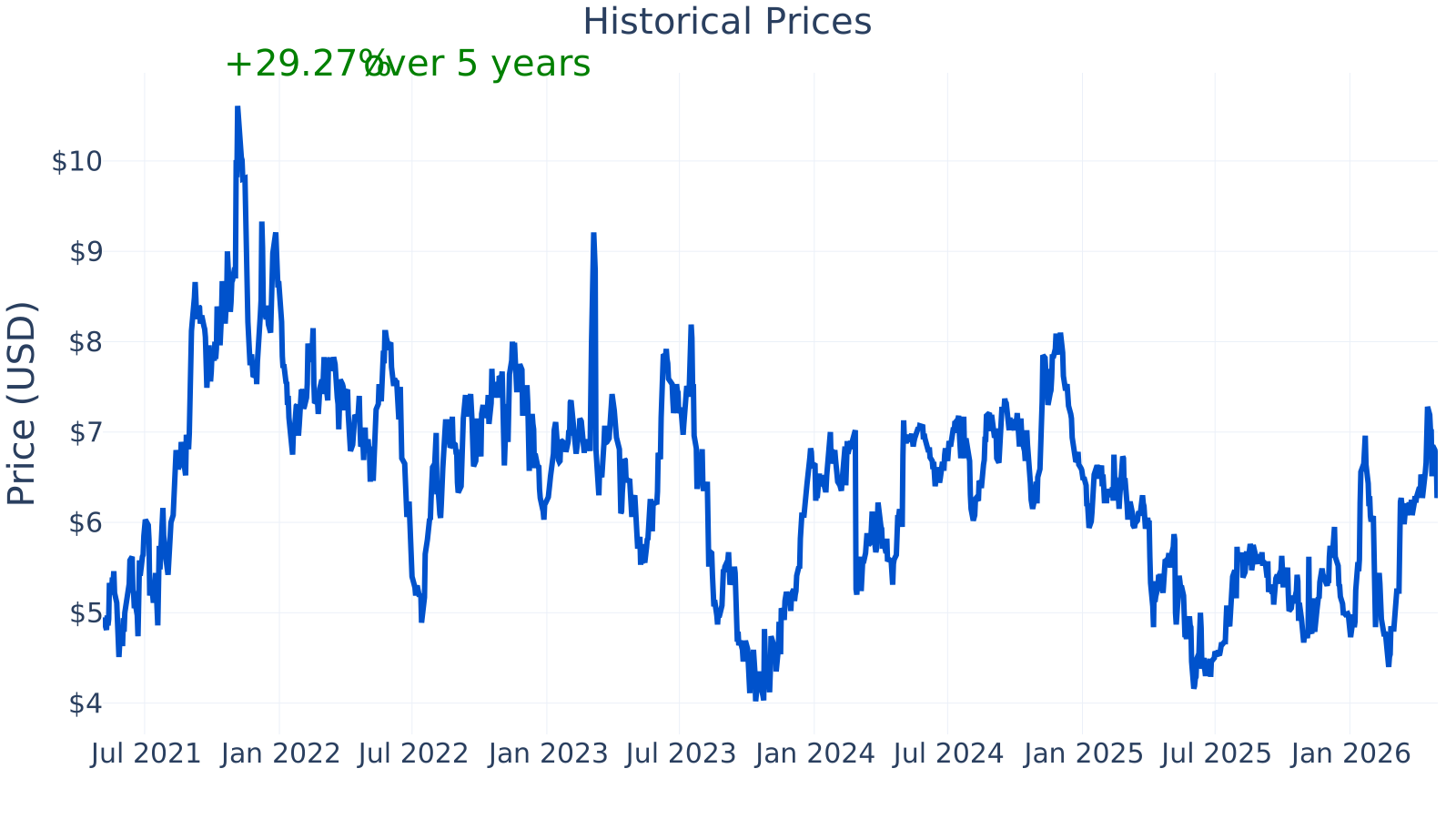
Stagwell’s market capitalization is about $1.57B. The stock’s beta of about 1.23 suggests it has historically moved somewhat more than the overall market (higher volatility than a beta near 1.0).
Profit margin is about 0.64% versus an industry median near 3.26%, indicating relatively thin bottom-line profitability compared with peers in the advertising agencies group. Revenue growth year over year is about 8.0%, roughly in line with the industry median near 7.9%.
Debt-to-equity is about 236% versus an industry median near 30%, which stands out as a higher-leverage balance sheet than many peers. At the same time, trailing twelve-month free cash flow is about $274.5M, which can help support operations, debt service, and reinvestment (though free cash flow can fluctuate year to year).
Growth (Medium)
Advertising and marketing services are closely tied to overall business activity and corporate marketing budgets. Over time, a major structural trend has been the shift toward more measurable, digital-first marketing and the growing importance of data, analytics, and performance-oriented campaigns. Agencies positioned to provide integrated services (creative + digital execution + measurement) are generally aligned with how many clients allocate spend.
Stagwell’s reported year-over-year revenue growth has been uneven over the past several years, including periods of decline and periods of positive growth.
More recently, year-over-year revenue growth is about 8.0% (latest period shown). That is close to the industry median in the same dataset, suggesting Stagwell’s top-line growth rate has been broadly in line with peers at that point in time. The earlier spikes and dips highlight that acquisition activity, client budget cycles, and comparison periods can materially affect reported growth.
Cash generation is often a practical lens for service businesses because it can provide flexibility to invest and manage financial obligations.
Trailing free cash flow shows variability (for example, roughly $265.4M in 2023, down to about $75.7M in 2024, then rising to about $274.5M by 2026). A rebound in free cash flow can be a meaningful operational positive, but the variation also suggests results may be sensitive to working capital timing, integration costs, or shifts in underlying profitability.
Risks (High)
Marketing services is a competitive and cyclical industry. Client spending can tighten during economic uncertainty, and budgets may shift quickly across channels and vendors. In addition, agencies face ongoing pressure around pricing (fees), talent retention, and the need to keep pace with changing platforms and measurement tools.
A key company-specific risk visible in the metrics is leverage. Stagwell’s debt-to-equity level is elevated versus the industry median, which can increase sensitivity to interest costs and refinancing conditions.
The longer trend shown indicates debt-to-equity has often been high in prior periods and remains well above the peer median in the latest point shown (about 236% versus about 24% industry median on the chart’s latest date). This does not automatically imply financial distress, but it does mean capital structure is an important part of understanding the equity risk profile.
Another important risk area is profitability. Stagwell’s net profit margin has been low and at times slightly negative over the period shown, while the industry median has generally been higher.
In the latest period shown, profit margin is about 0.64% versus an industry median near 6.77%. Thin margins can leave less room for error if costs rise, if clients cut spending, or if integration and restructuring expenses recur.
On competitive positioning, Stagwell operates among large global agency holding companies and numerous specialized firms. In broad terms, major competitors in global advertising and marketing services include large diversified holding groups (for example, WPP, Omnicom, Interpublic Group, and Publicis) as well as consulting and digital specialists. Stagwell is not the largest player by scale; its differentiation is typically described in company materials as a focus on modern, digitally oriented marketing services and a portfolio approach. Whether that translates into durable competitive advantage depends on execution, client retention, and the ability to sustain margins while competing for talent and accounts.
Valuation
One common valuation reference is the price-to-earnings (P/E) ratio, which compares the stock price to earnings per share. P/E ratios can become hard to interpret when net income is very small or volatile (because the “E” can swing significantly), which is relevant for businesses with thin profit margins.
The latest P/E shown in the table is about 90.6 versus an industry median near 26.2. Historically in the chart, Stagwell’s P/E has moved widely, including periods where it was much higher than the industry median. A higher P/E can reflect expectations of future improvement, but it can also reflect temporarily depressed earnings (which mechanically inflates the ratio). Given the company’s low profit margin in the most recent period shown, the P/E should be interpreted alongside profitability trends, leverage, and cash flow rather than as a standalone conclusion.
Conclusion
Stagwell is a marketing services company operating in a large, competitive industry that continues to evolve toward digital execution and measurable outcomes. The company has grown its reported revenue meaningfully from 2021 to 2025, and the most recent year-over-year revenue growth shown is roughly in line with the peer median. Free cash flow has recently improved after a weaker period, which is a relevant indicator for a service business.
At the same time, the key trade-offs visible in the fundamentals are thin net profit margins and a notably higher debt-to-equity level than the industry median. Those factors can increase sensitivity to operating setbacks and interest costs. Valuation signals such as the P/E ratio appear elevated versus peers, and because earnings have been relatively small, that valuation measure may be more sensitive to small changes in profitability.
Sources:
- SEC EDGAR — Stagwell Inc (STGW) filings (Form 10-K, Form 10-Q)
- Stagwell Inc — Investor Relations materials and press releases (including earnings-related releases)
- Wikipedia — “Stagwell Inc.” (basic company background)
This article is for informational purposes only and does not constitute financial advice. Some content is AI-generated. See Disclaimer