Stock Analysis · Tron Inc (TRON)
Overview
Tron Inc (TRON) is a small-cap company in the Consumer Cyclical sector, classified in the Leisure industry. In practical terms, that means its results tend to be more sensitive to the economy and consumer spending patterns than “everyday needs” businesses.
Based on its public financial statements, Tron Inc’s reported revenue base is relatively small (in the low single-digit millions of dollars annually in recent years). The income statement also shows a cost structure where operating expenses (especially overhead and operating costs) can quickly outweigh gross profit, which has contributed to periods of losses.
Public filings do not provide enough standardized detail here to present a reliable percentage breakdown of revenue sources (for example, by product line or geography) without risking guesswork. When companies do not disclose this consistently, the safest approach is to focus on what is clearly reported: total revenue, costs, operating expenses, and profitability trends.
Across the years shown, total revenue fluctuates in a relatively narrow band (roughly $4.3M to $6.1M). What stands out more is that operating expenses can vary sharply year to year, which has been a major driver of operating losses when expenses rise faster than gross profit.
Key Figures
| Metric | Value | Industry ⓘ |
|---|---|---|
| Date | Apr 14, 2026 | |
| Context | ||
| Sector | Consumer Cyclical | |
| Industry | Leisure | |
| Market Cap ⓘ | $1.12B | |
| Beta ⓘ | 11.89 | |
| Fundamental | ||
| P/E Ratio ⓘ | N/A | 27.64 |
| Profit Margin ⓘ | N/A | 6.94% |
| Revenue Growth ⓘ | 30.70% | 9.00% |
| Debt to Equity ⓘ | 0.33% | 38.37% |
| PEG ⓘ | N/A | |
| Free Cash Flow ⓘ | -$1.51M | |
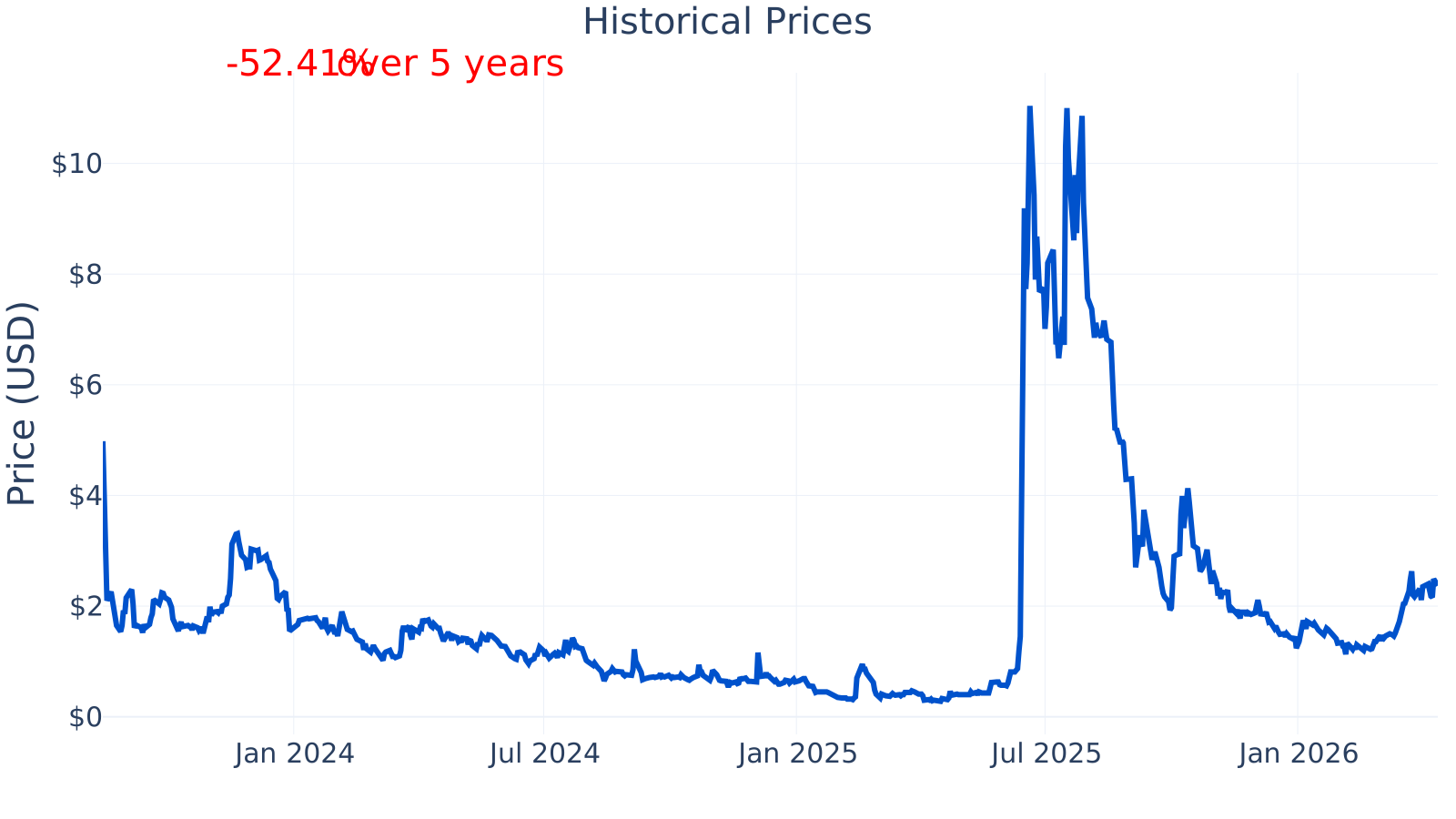
Tron Inc’s market capitalization is about $1.12B, while its share price history shown is highly volatile. The beta of ~11.89 also points to very large price swings versus the broader market. On operating performance, the company shows negative trailing free cash flow (about -$1.51M). The latest year-over-year revenue growth displayed is about 31% versus an industry median around 9%, while the latest profit margin shown is 0% (with the broader industry median near 6.94%). Debt-to-equity is shown as very low (about 0.33%) compared with an industry median near 38%.
Growth (Medium)
The Leisure industry is generally tied to discretionary consumer spending, which can expand during strong economic periods and soften during downturns. That can create opportunity, but it also tends to make revenue less predictable than in defensive industries.
The year-over-year revenue trend displayed is uneven—moving from negative growth in some quarters to positive growth later, reaching roughly 26% and then 31% most recently. This pattern suggests the business may be capable of rebounds, but it has not demonstrated a smooth, consistent growth trajectory over the full period shown.
Free cash flow remains negative in the periods shown (improving from roughly -$3.13M to -$2.17M, then shown most recently at about -$1.51M). For long-term business durability, consistently positive free cash flow is often important because it can fund operations, investment, and balance-sheet strength without relying as heavily on external financing.
In terms of catalysts, the most meaningful ones for a company at this scale are usually internal execution items that are visible in filings over time—such as sustained revenue expansion, improved gross profit, and controlled operating expenses—rather than broad industry trends alone.
Risks (High)
A key risk is profitability stability. The profit margin series shown swings dramatically between very large losses and a single period of unusually high profitability, before returning to large losses. That type of variability can make it harder to evaluate the “normal” earnings power of the business.
Over the periods shown, profit margin ranges from roughly -101% and -75% to -30%, then spikes to about 270%, before dropping to roughly -355%. Compared with an industry median mostly around 6%–8%, this highlights a major gap in consistency versus typical Leisure peers.
Another risk is stock volatility. The price history shown includes sharp rises and declines over relatively short spans, and the very high beta aligns with that behavior. Volatility does not necessarily indicate business failure on its own, but it can signal that the market has difficulty agreeing on a stable view of the company’s fundamentals.
On the balance-sheet side, debt-to-equity trends down to about 0.33% most recently, well below the industry median near 38%. Lower leverage can reduce financial strain, but it does not remove operating risk (losses can still pressure cash resources over time).
Competitive position is difficult to measure precisely without more segment-level disclosure. In the Leisure industry, competitors can range from local operators to scaled brands, and advantages often come from brand strength, customer loyalty, distribution partnerships, or cost efficiency. From the financial pattern shown—small revenue scale, negative cash flow, and unstable margins—there is not enough evidence in these figures alone to describe Tron Inc as an industry leader. Relative to typical industry profitability levels, the company appears to be operating below the median on consistency and margin stability.
Valuation
The P/E chart shows Tron Inc’s P/E as 0 across the displayed dates, while the industry median remains around the ~19 to ~30 range. A P/E of 0 in this context generally indicates that earnings are not positive or not meaningful for a standard P/E comparison over the periods considered, which limits the usefulness of P/E as a valuation tool here.
When earnings-based valuation metrics are not informative, investors often look more at operational fundamentals (revenue quality, gross profit, operating expense discipline), cash flow direction, and balance-sheet strength. In Tron Inc’s case, the combination of negative free cash flow and highly unstable profit margins means the main valuation question becomes less about a single “cheap vs. expensive” multiple and more about whether the business can reach a steadier level of profitability and cash generation over time.
Conclusion
Tron Inc operates in a consumer-driven Leisure category, where demand can rise and fall with economic conditions. The company has shown periods of revenue improvement (reaching about 31% year-over-year growth most recently), and its balance sheet appears lightly levered based on debt-to-equity.
At the same time, the financial profile shown includes negative free cash flow, large swings in profit margin, and a stock history consistent with very high volatility. Because earnings-based valuation measures like P/E are not currently informative, the long-term assessment depends heavily on whether future filings show sustained improvement in operating discipline, more stable margins, and a credible path to consistently positive cash generation.
Sources:
- U.S. Securities and Exchange Commission (SEC) EDGAR — “Company Filings Search (Tron Inc / TRON)”
- Tron Inc — “Annual Report (Form 10-K)”
- Tron Inc — “Quarterly Report (Form 10-Q)”
This article is for informational purposes only and does not constitute financial advice. Some content is AI-generated. See Disclaimer


