Stock Analysis · Block Inc (XYZ)
Overview
Block Inc. (symbol: XYZ.US) is a financial technology company that builds tools for payments and commerce. It is best known for two major ecosystems: Square (primarily for sellers such as small and mid-sized businesses to accept payments and manage operations) and Cash App (primarily for individuals to send money, manage a balance, and use payment features). Block also reports Bitcoin-related activity as part of its business, which can add significant revenue dollars but typically carries a much lower margin than software and payment services.
In simple terms, Block aims to sit “in the middle” of everyday transactions: helping sellers get paid and helping consumers pay or move money, with the potential benefit that each side can reinforce the other over time.
Based on how Block reports its business in SEC filings, the main revenue streams are generally organized around its two ecosystems and Bitcoin-related revenue. Exact mix and percentages vary by period and reporting definitions, so the most reliable breakdown should be taken directly from the latest Form 10-K/10-Q revenue note and segment discussion.
The largest revenue drivers typically include:
- Transaction-based revenue tied to Square (seller ecosystem) (payment processing and related services)
- Bitcoin revenue (reported gross, with relatively low gross profit contribution compared with the revenue amount)
- Subscription and services-based revenue (software, banking-like services, and other service fees)
- Hardware revenue (Square point-of-sale devices and accessories)
At a high level, Block’s recent financial profile shows a company with substantial revenue scale (over $24B in annual revenue in 2024–2025), improving profitability versus earlier years, and meaningful ongoing spending on product development.
From 2021 to 2025, total revenue rose from about $17.7B to about $24.2B. Gross profit also increased over that span (about $4.3B to about $10.4B). Net income was volatile: positive in 2021, negative in 2022, near break-even in 2023, and then materially positive in 2024–2025. This pattern highlights that reported earnings can swing based on operating costs, investment pace, and other accounting items, even when gross profit trends upward.
Key Figures
| Metric | Value | Industry ⓘ |
|---|---|---|
| Date | May 04, 2026 | |
| Context | ||
| Sector | Technology | |
| Industry | Software - Infrastructure | |
| Market Cap ⓘ | $42.77B | |
| Beta ⓘ | 2.57 | |
| Fundamental | ||
| P/E Ratio ⓘ | 34.20 | 29.58 |
| Profit Margin ⓘ | 5.40% | 6.71% |
| Revenue Growth ⓘ | 3.60% | 18.30% |
| Debt to Equity ⓘ | 40.38% | 24.92% |
| PEG ⓘ | 0.82 | |
| Free Cash Flow ⓘ | $2.42B | |
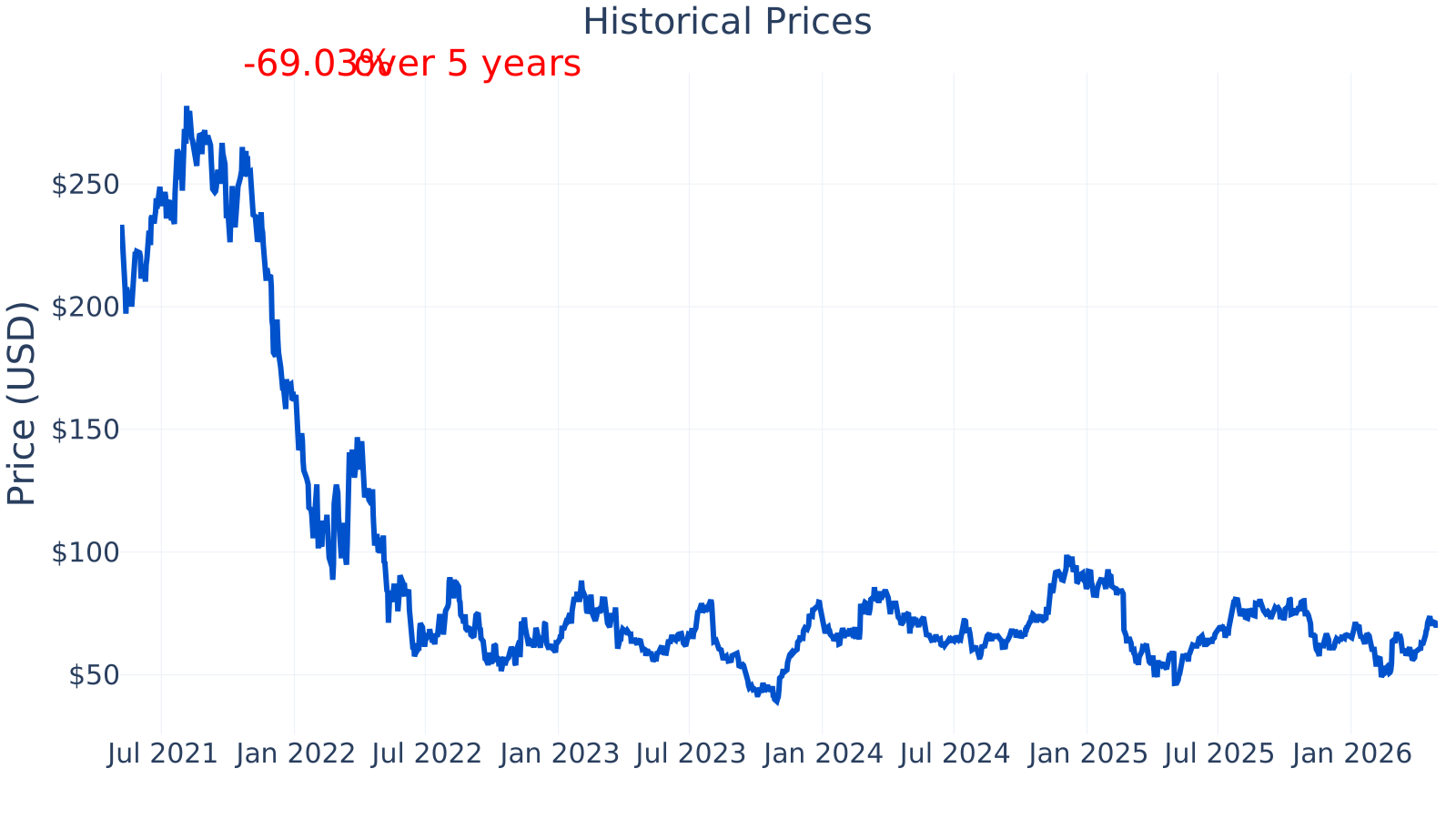
Block’s market capitalization is about $42.8B. The stock’s beta is 2.57, which signals that the share price has historically moved much more sharply than the broader market (in both directions). The company’s P/E ratio is about 34.2 versus an industry median around 29.6, while the net profit margin is about 5.4% versus an industry median around 6.7%. Year-over-year revenue growth is about 3.6%, which is below the cited industry median of about 18.3%. Debt-to-equity is about 40% versus an industry median around 25%. Trailing twelve-month free cash flow is about $2.42B, indicating the business has recently been generating meaningful cash after operating costs and capital spending.
Growth (Medium)
Block operates in digital payments and financial services software—areas that have benefited over the long term from the shift from cash to electronic payments, the growth of e-commerce, and the increasing use of software to run small businesses. These are broad, multi-year trends, and Block’s two-sided approach (seller tools through Square and consumer tools through Cash App) is designed to participate in both.
Strategically, the long-term growth logic relies on expanding adoption and deepening usage within each ecosystem. For sellers, that can mean more merchants using Square not only for payment acceptance but also for value-added software (such as business management features) and financial services. For consumers, it can mean increased activity and engagement within Cash App (such as payments, cards, and other money-management features). When these products are used more heavily, monetization can come from processing fees, subscription/service fees, and other unit economics that improve with scale—though competition can pressure pricing.
Revenue growth has slowed meaningfully compared with earlier periods. After very high growth rates in 2021 and mid-to-high growth in much of 2023–2024, the latest quarters shown are in the low single digits and include brief declines (for example, around -3.1% and -1.6% in 2025 before returning to about +3.6%). This kind of deceleration matters for a company often valued on expectations of sustained growth.
Free cash flow has improved substantially versus the low point shown in 2023 (about $79M), rising to roughly $1.20B by early 2025 and about $2.42B most recently in the metrics provided. For many long-term business models, consistently positive and growing free cash flow can be an important signal that operations are becoming more self-funding, though it should still be checked against the company’s full cash flow statement and management discussion in filings.
Potential catalysts discussed by companies in this type of industry often include increased monetization of existing customer bases, new product launches, and improved efficiency (higher gross profit and tighter expense control). For Block specifically, the most durable catalyst would typically be sustained growth in gross profit and cash generation from its core ecosystems, rather than revenue expansion driven by low-margin components.
Risks (High)
Block’s risk profile is shaped by competition, regulation, and business mix. Payments and consumer financial apps are crowded markets with large, well-capitalized players. Competitive pressure can show up as pricing pressure (lower take rates), higher incentive spending to acquire/retain users, or slower growth if customers choose alternatives.
Debt-to-equity is currently around 40%, above the industry median near 25%. While that level is not necessarily extreme for a mature operating company, the upward move relative to peers can reduce flexibility if the operating environment weakens or if the company needs to fund investment during a downturn.
Profitability has been volatile across recent years. The margin series shows losses through much of 2022–2023, followed by a sharp improvement in 2024–2025, with a recent level around 5.4%. The industry median shown is about 6.7%, so Block is currently slightly below that benchmark on net margin. The swing from negative margins to positive margins suggests execution and cost structure have improved, but it also indicates that profitability is not yet a long-established steady state.
Another key risk is exposure to transaction volumes and consumer/small-business health. If consumers spend less or small businesses process fewer payments, transaction-based revenue can slow. In addition, fintech firms face compliance and operational risks (fraud, cybersecurity incidents, outages, and evolving regulatory requirements). These risks can lead to higher costs and can harm trust, which is critical in payments.
In terms of competitive positioning, Block has recognizable brands (Square and Cash App) and a broad product set, which can be an advantage in retaining customers within an ecosystem. However, it is not operating in a “winner-takes-all” market. Major competitors span multiple categories, including large payment networks and processors, consumer finance apps, and integrated commerce platforms. Depending on the product area, competitors can include PayPal, Adyen, Stripe (private), Shopify (payments and commerce), Toast (restaurant-focused), and traditional banks and card-linked payment providers. Block’s positioning is often strongest where an integrated set of seller tools or a highly engaged consumer app creates switching costs and recurring usage, but those advantages must be maintained through ongoing product quality and economics.
Valuation
The current P/E ratio is about 34.2, slightly above the industry median near 29.6. Historically, the P/E shown has moved widely (including periods where it was much higher), and it has also included spans where a meaningful P/E was not displayed (often consistent with low or negative earnings periods). This history reinforces that earnings have been uneven, so a single-period P/E should be interpreted in the context of whether profitability is sustainable.
With revenue growth currently in the low single digits (about 3.6% year-over-year in the latest metric) and net margins around 5.4%, a valuation above the industry median tends to require confidence in future improvements—such as higher margins, re-acceleration in gross profit growth, or durable cash flow generation. On the other hand, the recent improvement in free cash flow and the return to positive net income in 2024–2025 can support higher valuation multiples than periods where profitability was negative, provided those improvements persist.
Because Block operates in categories where growth and profitability can change quickly with competition and macro conditions, valuation often remains sensitive to expectations about medium-term execution (user growth, monetization, and cost discipline) as well as the stability of earnings.
Conclusion
Block is a scaled fintech company with two major ecosystems (seller and consumer) and a business model that can generate significant gross profit when usage is high and products are well monetized. The company’s financial trajectory over the past few years shows improving profitability and stronger free cash flow, which are meaningful business quality signals compared with earlier loss-making periods.
At the same time, recent revenue growth has slowed to low single digits versus faster growth in prior years, and the stock has historically shown high volatility (beta 2.57). Competitive intensity in payments and consumer finance remains a central long-term uncertainty, alongside regulatory and operational risks. Valuation indicators point to a multiple modestly above the industry median, which places added emphasis on the durability of recent profitability and cash generation trends.
Sources:
- SEC EDGAR — Block, Inc. filings (Form 10-K, Form 10-Q)
- Block, Inc. Investor Relations — Shareholder letters / quarterly results materials (company-hosted)
- Wikipedia — “Block, Inc.” (basic company background only)
This article is for informational purposes only and does not constitute financial advice. Some content is AI-generated. See Disclaimer


