Stock Analysis · Block Inc (XYZ)
Overview
Block Inc. (listed here as XYZ) builds payment and commerce tools designed to help people and businesses send, spend, and accept money. The company is best known for its seller ecosystem (often associated with Square-branded point-of-sale hardware and software) and its consumer-focused products (often associated with Cash App). Across these ecosystems, Block aims to make it easier for small businesses to run day-to-day operations and for individuals to manage money digitally.
In its SEC filings, Block typically discusses its business in two main segments: Square (tools for sellers) and Cash App (consumer financial products). In addition, it has previously discussed Bitcoin-related activity as part of its offerings. At a high level, the company’s revenue is commonly associated with:
- Transaction-based revenue from sellers (payment processing and related fees)
- Subscription and services revenue (software, banking/financial services features, and other services sold to sellers)
- Cash App-related revenue (card interchange, instant deposit, and other consumer financial features)
- Bitcoin-related revenue (where reported, this can be large in “revenue” terms but tends to have relatively low gross profit per dollar of revenue, as described in company filings)
One simple way to interpret Block’s business model is that it tries to monetize both sides of commerce: (1) merchants who accept payments and need operating tools, and (2) consumers who transact and use money-management features. This creates opportunities to cross-sell more products as usage grows.
From 2021 to 2024, total revenue increased (about $17.7B to $24.1B) and gross profit also rose (about $4.3B to $8.9B). Over the same period, operating income moved from positive in 2021 to slightly negative in 2022–2023, then clearly positive in 2024—showing the business has recently generated much stronger operating profitability while continuing to invest heavily in research and development.
Key Figures
| Metric | Value | Industry ⓘ |
|---|---|---|
| Date | Feb 07, 2026 | |
| Context | ||
| Sector | Technology | |
| Industry | Software - Infrastructure | |
| Market Cap ⓘ | $34.12B | |
| Beta ⓘ | 2.67 | |
| Fundamental | ||
| P/E Ratio ⓘ | 11.26 | 25.66 |
| Profit Margin ⓘ | 13.08% | 6.68% |
| Revenue Growth ⓘ | 2.30% | 15.20% |
| Debt to Equity ⓘ | 35.99% | 19.82% |
| PEG ⓘ | 1.10 | |
| Free Cash Flow ⓘ | $1.83B | |
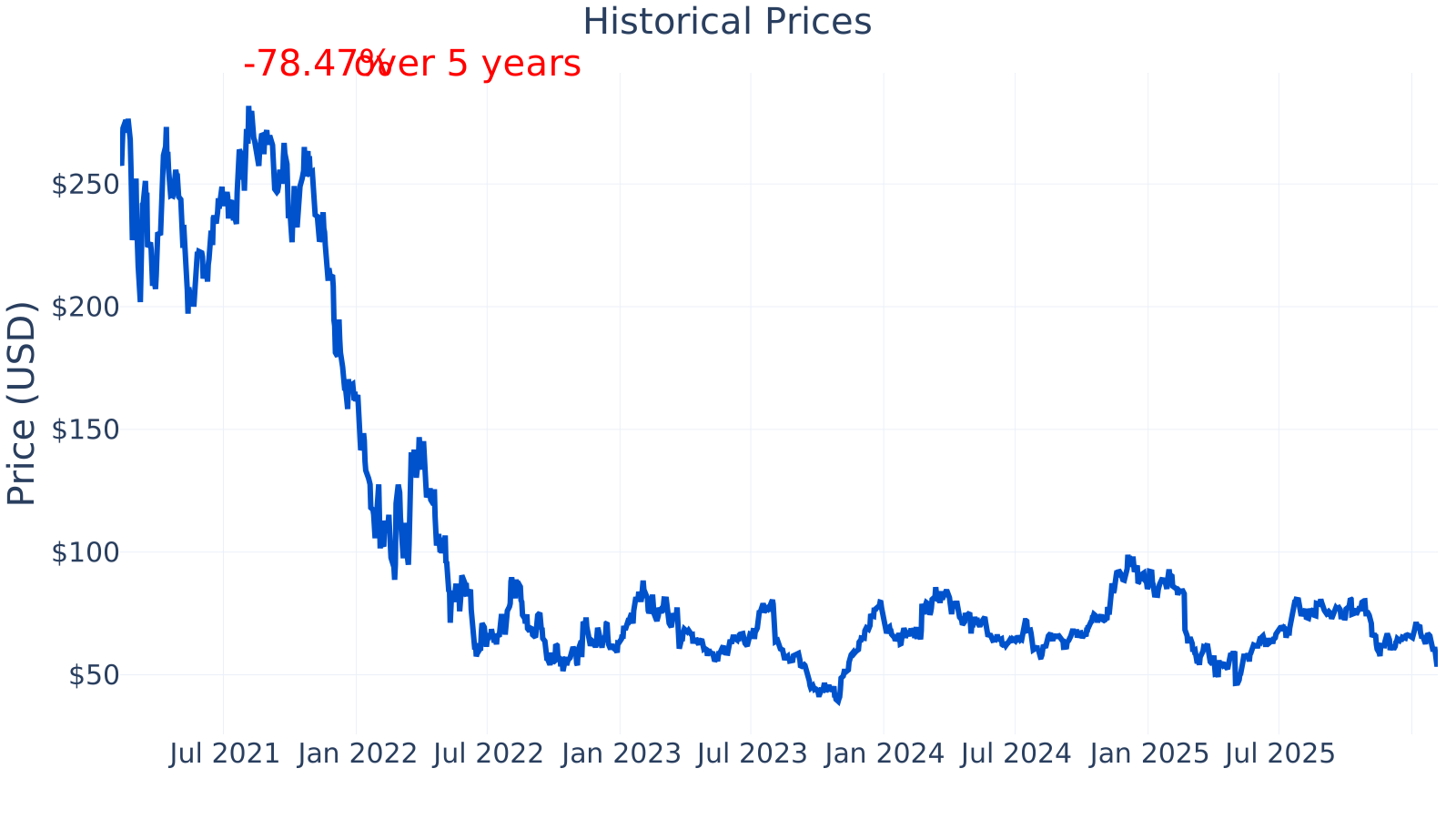
Block’s market capitalization is about $34.1B. The stock’s beta (~2.67) suggests it has historically moved more than the broader market (higher volatility). The company’s P/E ratio (~11.3) is below the industry median shown (~25.7), while its profit margin (~13.1%) is above the industry median shown (~6.7%). At the same time, the most recent year-over-year revenue growth (~2.3%) is notably below the industry median shown (~15.2%). Debt-to-equity is about 36.0% versus an industry median shown of about 19.8%. Trailing twelve-month free cash flow is about $1.83B, indicating meaningful cash generation in the most recent period.
Growth (Medium)
Block operates in broad areas that have long-term growth drivers: digital payments, seller software for small and mid-sized businesses, and consumer financial apps. These markets are influenced by ongoing shifts from cash to digital payments, increased use of integrated point-of-sale and business software, and consumer preference for mobile-first financial tools. Those are supportive backdrops, but the pace of company-specific growth can still vary based on competition, product execution, and economic conditions.
A core part of Block’s strategy is to deepen relationships inside each ecosystem. For sellers, the goal is often to move beyond payment acceptance into a wider “operating system” (software, payroll, banking-like features, and analytics). For consumers, the goal is typically to increase engagement through features that make the app more useful for everyday financial activity. In theory, broader product adoption can increase revenue per customer and improve unit economics over time.
The year-over-year revenue growth trend shows a sharp slowdown from very high growth rates in 2021 to low single-digit growth most recently (around 2.3%). That deceleration matters for long-term narratives because it shifts the focus from “fast expansion” to a mix of (a) re-accelerating growth through product adoption and (b) improving profitability through cost discipline and better monetization.
Free cash flow improved substantially over time—from negative in 2021 to over $1.1B by 2025 (March TTM shown) and about $1.83B in the latest metric snapshot. Sustainable free cash flow can help a company fund product investment, manage debt, and withstand economic slowdowns without relying as heavily on external financing.
Risks (High)
This article is for informational purposes only and does not constitute financial advice. Some content is AI-generated. See Disclaimer