Stock Analysis · SoundHound AI Inc (SOUN)
Overview
SoundHound AI Inc (SOUN) develops voice AI software that lets people talk naturally to products and services. In practice, its technology is used to power voice assistants and “voice-first” experiences in places like cars, restaurants, call centers, and smart devices. The company positions itself as an independent provider of voice AI (not tied to a single consumer platform), and it offers tools that help businesses design, deploy, and improve voice experiences.
In filings, SoundHound describes revenue that mainly comes from commercial agreements where customers pay to use its technology and related services. Depending on the contract, this can include usage-based revenue (tied to how often the voice system is used), software subscriptions, professional services to deploy solutions, and licensing arrangements. Public filings typically break revenue into a small number of categories, but the exact percentage split can vary by period and contract mix.
Main revenue sources (general structure described in company filings):
- Voice AI product revenue (fees tied to using SoundHound’s platform; may include usage-based and subscription components)
- Professional services (implementation, customization, and support services connected to deployments)
- Licensing / other arrangements (depending on customer contracts)
Over time, a key question for the business model is whether recurring/usage-based product revenue grows faster than service-heavy deployments, since software-like revenue tends to scale better once solutions are widely adopted.
Across the years shown, revenue rises from about $21.2M (2021) to $168.9M (2025), while the company also spends heavily on operating costs. Research and development remains a major expense category (tens of millions per year), reflecting continued investment in product capability and new use cases.
Key Figures
| Metric | Value | Industry ⓘ |
|---|---|---|
| Date | Mar 02, 2026 | |
| Context | ||
| Sector | Technology | |
| Industry | Software - Application | |
| Market Cap ⓘ | $3.61B | |
| Beta ⓘ | 2.88 | |
| Fundamental | ||
| P/E Ratio ⓘ | N/A | 25.64 |
| Profit Margin ⓘ | -8.29% | 7.25% |
| Revenue Growth ⓘ | 59.40% | 16.65% |
| Debt to Equity ⓘ | 0.91% | 24.64% |
| PEG ⓘ | N/A | |
| Free Cash Flow ⓘ | $76.14B | |
The latest snapshot indicates a market capitalization of about $3.6B and a high beta (~2.88), meaning the stock has historically moved much more than the broader market (in both directions). Profit margin is slightly negative at about -8.3% versus an industry median near +7.2%, while year-over-year revenue growth is much higher at about +59.4% versus an industry median near +16.7%. Debt-to-equity is very low at about 0.9% compared with an industry median near 24.6%. The P/E ratio is not shown here, which commonly happens when earnings are negative or not meaningful for that metric.
Growth (High)
SoundHound operates in voice AI and conversational software, an area benefiting from wider adoption of AI-driven interfaces across many industries. More companies are trying to automate customer interactions, add voice ordering, improve in-vehicle experiences, and reduce friction in support workflows. In that context, a vendor focused on business deployments (rather than consumer assistants) can find multiple paths to growth—if it can win and expand customer relationships.
The strategy described in company materials typically centers on: expanding the platform’s capabilities, increasing the number of industry solutions (for example, automotive and restaurants), and growing deployments that generate recurring or usage-linked revenue. A long-term growth narrative generally depends on converting early deployments into broader rollouts and increasing revenue per customer as usage rises.
The year-over-year growth rates shown are volatile but often very high, including multiple periods above 50% and some quarters well above 100%. The most recent value displayed is about +59.4%, which is meaningfully higher than the broader software-application industry median shown in the table. High growth can be a positive sign of demand and expanding contracts, but volatility can also reflect customer timing, contract structure, or a base that is still relatively small compared with larger software companies.
Free cash flow (trailing twelve months) is shown as negative in each period displayed (roughly -$77M to -$107M). For long-term business durability, the key consideration is whether revenue growth and gross profit expansion can eventually outpace operating spending and reduce cash burn over time.
Risks (High)
The largest business risk is execution: building voice AI that performs well in real-world environments is difficult, and commercial adoption often depends on reliability, integration quality, and ongoing improvement. In addition, many enterprise customers have long sales cycles, and deployments can require customization—factors that can delay revenue or increase costs.
Competition is another central risk. SoundHound participates in markets where large technology companies and well-funded AI providers operate. Competitors can include major platform ecosystems offering speech and assistant tooling, as well as enterprise-focused AI vendors. The company’s positioning as an independent provider can be a differentiator for customers who want flexibility across platforms, but it does not automatically make SoundHound the category leader in scale, distribution, or resources.
Profitability and operating leverage remain important. While net losses have narrowed significantly in the latest year shown in the overview flow (net income improves from a large loss in 2024 to a much smaller loss in 2025), the company’s margins have been negative for much of the period, and future results may depend on maintaining growth while controlling operating expenses.
Debt-to-equity trends sharply downward over time, reaching about 0.9% in the most recent point shown, well below the industry median near 27%. That suggests the capital structure is not heavily debt-funded at this moment. However, low debt does not remove financing risk—companies with negative free cash flow may still rely on cash reserves, equity issuance, or other funding sources to support operations.
Profit margin improves dramatically over the long period shown (from deeply negative levels to about -8.3% most recently). Even with that improvement, it remains below the industry median (around +7.4% in the latest point shown). This gap highlights that the company still needs to prove consistent profitability relative to typical software peers.
Valuation
For companies that are not consistently profitable, common valuation tools like the P/E ratio often become unavailable or not meaningful. In those cases, market value tends to be influenced more by expectations about future revenue growth, eventual margins, and the timing of a shift toward sustainable free cash flow.
The P/E chart does not show a meaningful company series across the period displayed, which is consistent with a business that has had negative earnings or results that make the metric unreliable. By contrast, the industry median P/E values shown are positive and generally range from the mid-30s to 60s across the period displayed, reflecting that many peers in the same broad industry classification are profitable.
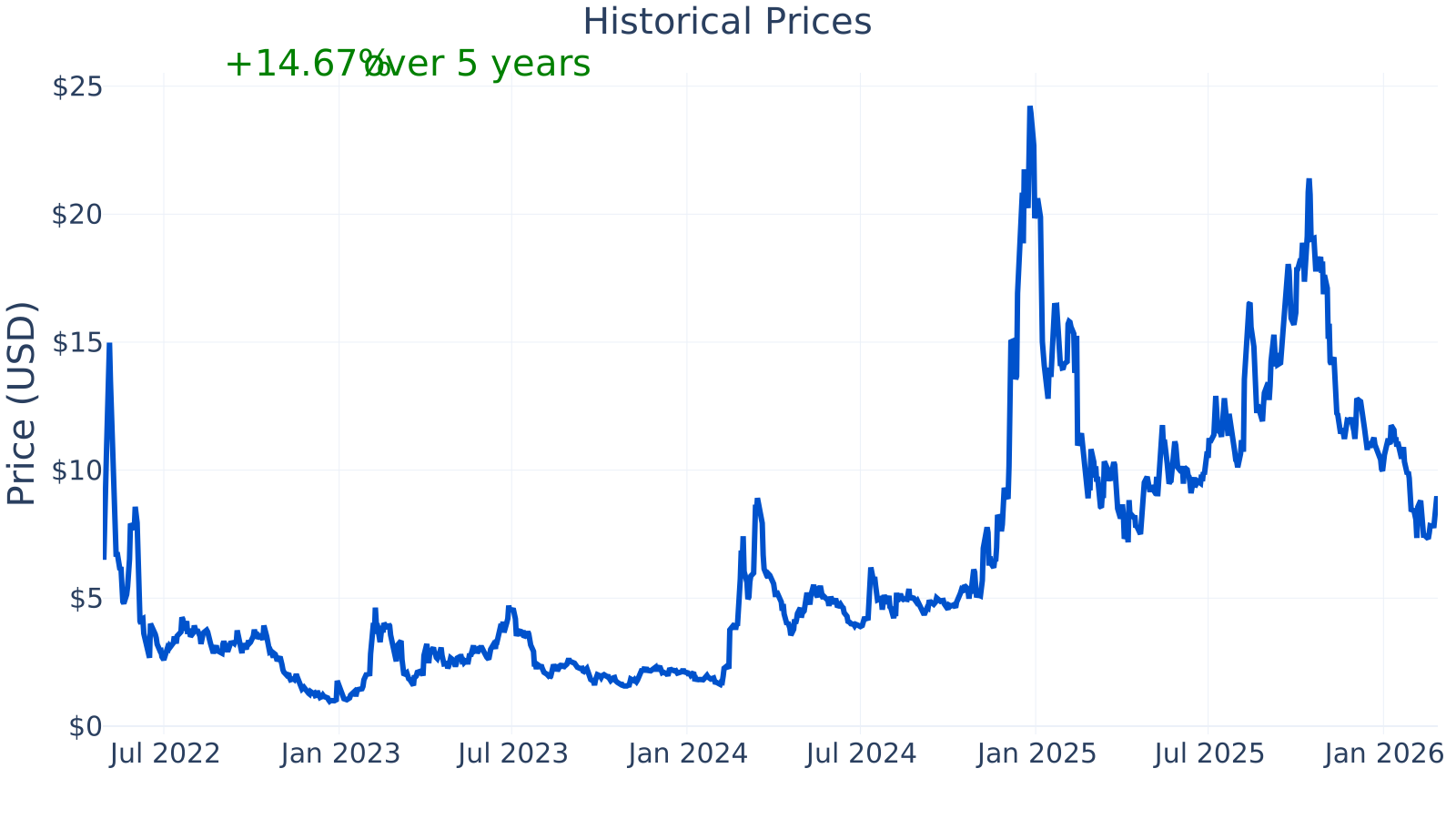
Separately, the historical stock-price path shown earlier indicates large swings over time. This kind of variability often implies that valuation can change quickly as market expectations shift around growth rates, customer wins, and progress toward profitability.
Conclusion
SoundHound AI is building voice AI software for businesses, with a growth profile that stands out versus typical application software peers in the figures shown. Revenue has expanded substantially over the multi-year period presented, and profit margin has improved to near break-even compared with earlier years, while leverage appears low based on the latest debt-to-equity reading.
At the same time, the company still shows negative margins and negative free cash flow in the periods displayed, and it operates in a highly competitive environment where larger players can influence pricing, distribution, and customer expectations. Over a long time horizon, the most important fundamentals to track are whether revenue growth remains durable, whether gross profit and operating costs trend toward consistent profitability, and whether cash usage moves toward sustainable levels.
Sources:
- SEC EDGAR — SoundHound AI Inc Form 10-K (Annual Report)
- SEC EDGAR — SoundHound AI Inc Form 10-Q (Quarterly Reports)
- SEC EDGAR — SoundHound AI Inc Form 8-K (Current Reports)
- SoundHound AI Inc — Investor Relations materials and press releases (company-hosted)
- Wikipedia — “SoundHound” (basic background and history)
This article is for informational purposes only and does not constitute financial advice. Some content is AI-generated. See Disclaimer


