Stock Analysis · Sonos Inc (SONO)
Overview
Sonos Inc. designs and sells home sound products that connect over Wi‑Fi, letting people stream music and other audio across one or multiple rooms. Its product lineup includes soundbars and speakers for TV audio, standalone speakers, subwoofers, portable speakers, and related accessories. Sonos also sells software features and services that support its hardware ecosystem.
Sonos reports revenue primarily from product sales, with additional contribution from software and services. Based on the company’s segment reporting in its annual filings, revenue is typically organized as:
- Products (the large majority of revenue; hardware such as speakers and soundbars)
- Software and services (a smaller portion; features and services tied to the Sonos platform)
Because Sonos focuses on premium audio, its business model depends heavily on consumer demand for discretionary electronics and on continued engagement with its multi-room platform.
Over recent years, total revenue has declined (from about $1.72B in FY2021 to about $1.44B in FY2025), while operating costs have remained substantial. Research and development spending has stayed elevated (roughly $230M–$305M across the period shown), reflecting ongoing investment in the product and software platform even as profitability has weakened.
Key Figures
| Metric | Value | Industry ⓘ |
|---|---|---|
| Date | Feb 07, 2026 | |
| Context | ||
| Sector | Technology | |
| Industry | Consumer Electronics | |
| Market Cap ⓘ | $2.06B | |
| Beta ⓘ | 1.99 | |
| Fundamental | ||
| P/E Ratio ⓘ | N/A | |
| Profit Margin ⓘ | -1.22% | |
| Revenue Growth ⓘ | -0.90% | |
| Debt to Equity ⓘ | 25.11% | |
| PEG ⓘ | N/A | |
| Free Cash Flow ⓘ | $122.47M | |
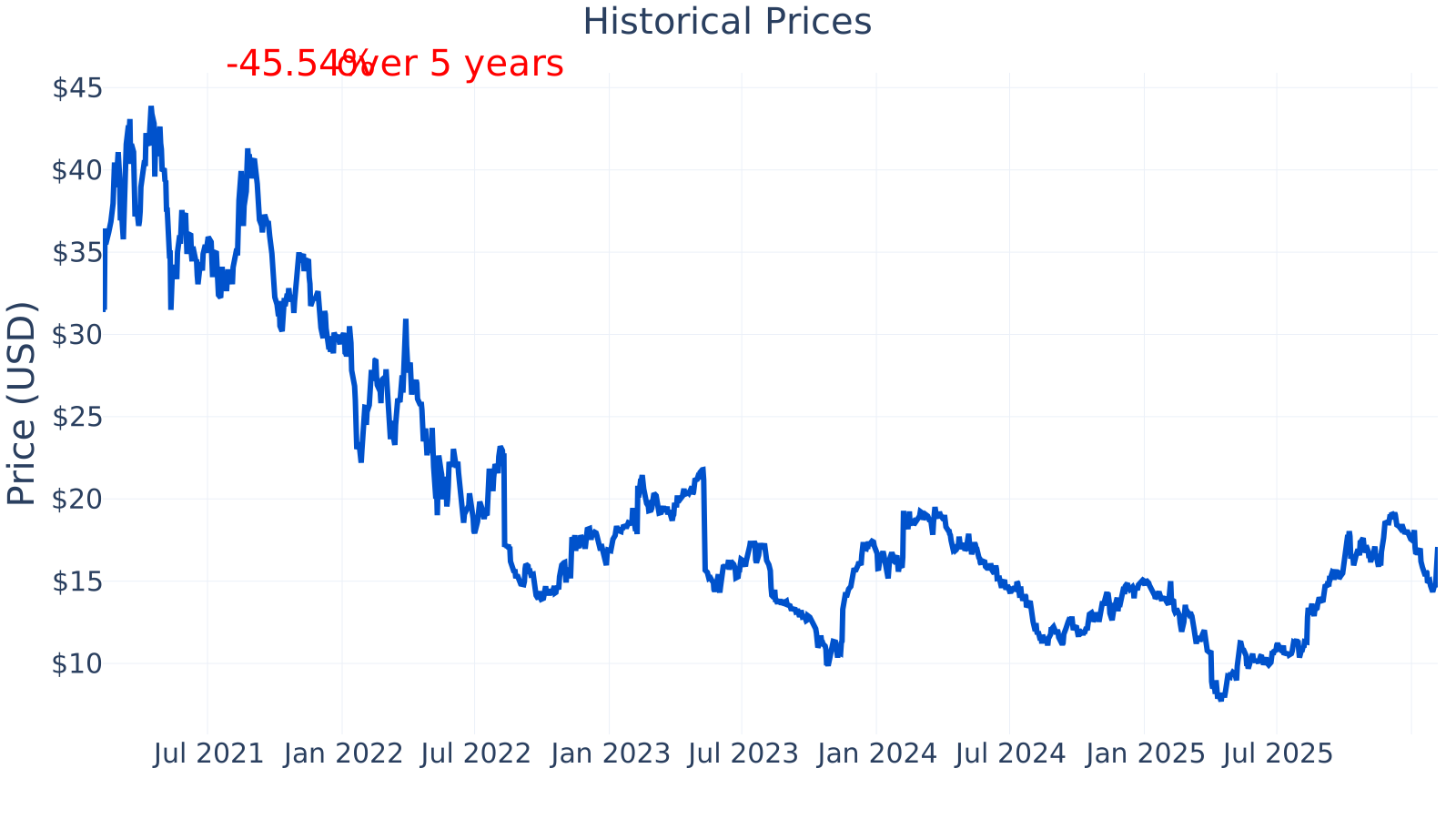
At the latest point shown, Sonos has a market capitalization of about $2.06B. The stock’s beta of ~1.99 indicates it has historically moved more than the overall market, which can mean larger swings up or down. Profitability is currently negative, with a net profit margin of about -1.22%. Revenue growth is close to flat to slightly negative at about -0.94% year over year. Leverage is moderate with debt-to-equity around 25%. Despite net losses, the company shows positive trailing twelve-month free cash flow of about $122.5M, which can happen when cash generation (for example, from working capital movements) is stronger than accounting earnings in a given period.
Growth (Medium)
Sonos operates in consumer electronics and home audio—markets tied to household spending, product replacement cycles, and competition for attention in the connected home. The long-term backdrop includes continued adoption of streaming and the broader trend toward connected devices in the home, but demand can be cyclical, with purchases often deferred when consumers feel pressure from inflation or uncertainty.
Sonos’s growth strategy generally centers on expanding its installed base (more households with at least one Sonos product) and encouraging repeat purchases as users add rooms, upgrade home theater setups, or buy additional components. This “ecosystem” approach can support repeat demand when customer satisfaction is strong and when products remain differentiated.
The year-over-year revenue pattern has been inconsistent. After very strong growth in parts of 2021, growth turned negative in multiple periods from 2022 through 2024, and the most recent value shown is slightly negative (around -0.94%). This suggests Sonos has recently faced a more challenging demand environment and/or tougher comparisons versus prior periods.
Free cash flow has also been volatile, shifting from strongly positive in 2021 (~$275M) to negative in 2023 (about -$95M), then back to positive in 2024 (~$152M) and lower but still positive in 2025 (~$65M at the March 2025 point shown, and ~$122M in the latest metrics section). For a hardware-focused company, this volatility can be influenced by inventory levels, supply chain timing, and the pace of sales.
Potential catalysts (in a neutral, informational sense) typically include successful new product launches, improved software experience that supports retention and repeat purchases, and stabilization in consumer discretionary demand. In addition, a return to consistent profitability would likely depend on a mix of revenue improvement and disciplined cost control.
Risks (High)
Sonos’s main risks are closely tied to its position as a premium consumer electronics brand. Demand can weaken quickly if consumers reduce spending on non-essential items. The company also faces product-cycle risk: if new devices do not resonate with customers or if execution issues arise (for example, software or user-experience problems), results can be affected.
Competition is a major factor. Sonos competes with large consumer electronics and platform companies that have extensive resources and ecosystems (such as Apple, Amazon, Google, and Samsung) as well as other audio specialists (for example, Bose). Larger competitors can bundle audio features into broader ecosystems, use pricing pressure, or rely on voice assistant platforms and device integration to influence customer choice. Sonos’s differentiation has historically been its multi-room audio experience, industrial design, and brand positioning in premium home sound, but maintaining that advantage requires sustained innovation and reliability.
Leverage appears moderate but has risen from low levels earlier in the period shown. Debt-to-equity increased from under 10% in 2021 to about 25% most recently, with a spike above 30% in late 2025 before easing. This is not necessarily extreme, but higher leverage reduces flexibility if profitability remains weak or if demand softens further.
Profitability has deteriorated meaningfully from 2021 to recent periods. Net profit margin moved from high single digits in 2021 to near zero by late 2022, and then negative through much of 2023–2025, reaching more negative levels at points (around -5% to -6%) before improving to about -1.22% most recently. Persistent negative margins can limit the ability to invest, return cash to shareholders, or absorb competitive pricing.
Valuation
Valuation for Sonos can be harder to interpret using a traditional price-to-earnings (P/E) ratio when earnings are low or negative. In the history shown, the P/E ratio was meaningful in 2021–early 2023 and then drops to 0 on the chart thereafter, which typically reflects periods where earnings were negative or the ratio became not meaningful for comparison.
Earlier periods show a wide range of P/E values (from the mid‑20s to much higher levels at certain points), highlighting that the market’s valuation has been sensitive to changes in profitability and expectations. With recent negative profit margins, investors often rely more on other reference points—such as revenue trends, gross margin stability, operating expense discipline, and free cash flow consistency—when forming a view of how the current stock price relates to business fundamentals.
Conclusion
Sonos is a recognizable premium home-audio company built around an ecosystem of connected speakers and home theater products, supported by software and services. The business has demonstrated the ability to generate meaningful revenue at scale, but recent years show pressure on both growth and profitability, with revenue trending down from FY2021 to FY2025 and net margins turning negative.
The long-term opportunity is tied to the connected home and streaming-driven audio use cases, along with Sonos’s potential to expand within existing households through repeat purchases. The key uncertainties are competitive intensity (including very large ecosystem players), the cyclicality of consumer electronics demand, and whether Sonos can return to consistent profitability while continuing to invest in product and platform quality. The stock’s historical volatility and the recent pattern of negative margins suggest that outcomes may depend heavily on execution and the broader consumer environment.
Sources:
- SEC EDGAR — Sonos, Inc. Form 10-K (Annual Report) (business overview, risk factors, segment/category disclosures)
- SEC EDGAR — Sonos, Inc. Form 10-Q (Quarterly Reports) (updates on financials, liquidity, and risk discussion)
- Sonos, Inc. Investor Relations — Annual Report materials and shareholder communications (company-hosted)
- Wikipedia — “Sonos” (basic company background and history)
This article is for informational purposes only and does not constitute financial advice. Some content is AI-generated. See Disclaimer