Stock Analysis · Sonic Automotive Inc (SAH)
Overview
Sonic Automotive, Inc. (SAH) is a U.S. automotive retailer. In plain terms, it sells new and used vehicles through franchised dealerships, and it also earns money after the sale through service/repairs, parts, and customer financing products. The company also operates EchoPark, a used-vehicle retailing business focused on a more “one-price” style experience and digital-friendly shopping. This mix matters because dealership profits are not only about selling cars: service departments and financing-related products can be meaningful sources of earnings, especially when new-vehicle demand softens.
Across its dealership operations, revenue typically comes from a few core buckets. The exact split can change with the car cycle (inventory levels, pricing, and consumer financing conditions).
- New vehicle sales (often the largest revenue line in strong new-car markets)
- Used vehicle sales (including used-focused retailing through EchoPark)
- Parts, service, and collision repair (work performed after the vehicle is sold)
- Finance and insurance (F&I) (arranging financing and selling protection products at the point of sale)
Because vehicle retailing has high “pass-through” costs (the vehicle itself is expensive and must be purchased before resale), a large amount of total revenue is consumed by the direct cost of vehicles. That structure makes operating efficiency and gross profit per vehicle especially important for long-term performance.
Over the 2021–2025 period shown, total revenue is in the ~$12–$15B range each year, while cost of revenue takes the majority of that amount. Gross profit remains much smaller than revenue (typical for auto retail). Interest expense increases notably from 2021 to 2024, highlighting how financing costs can become a larger headwind when rates are higher and/or debt levels rise.
Key Figures
| Metric | Value | Industry ⓘ |
|---|---|---|
| Date | Feb 23, 2026 | |
| Context | ||
| Sector | Consumer Cyclical | |
| Industry | Auto & Truck Dealerships | |
| Market Cap ⓘ | $2.28B | |
| Beta ⓘ | 0.92 | |
| Fundamental | ||
| P/E Ratio ⓘ | 17.91 | 19.15 |
| Profit Margin ⓘ | 0.78% | 2.54% |
| Revenue Growth ⓘ | -0.60% | 3.90% |
| Debt to Equity ⓘ | 389.25% | 157.49% |
| PEG ⓘ | 0.71 | |
| Free Cash Flow ⓘ | $437.60M | |
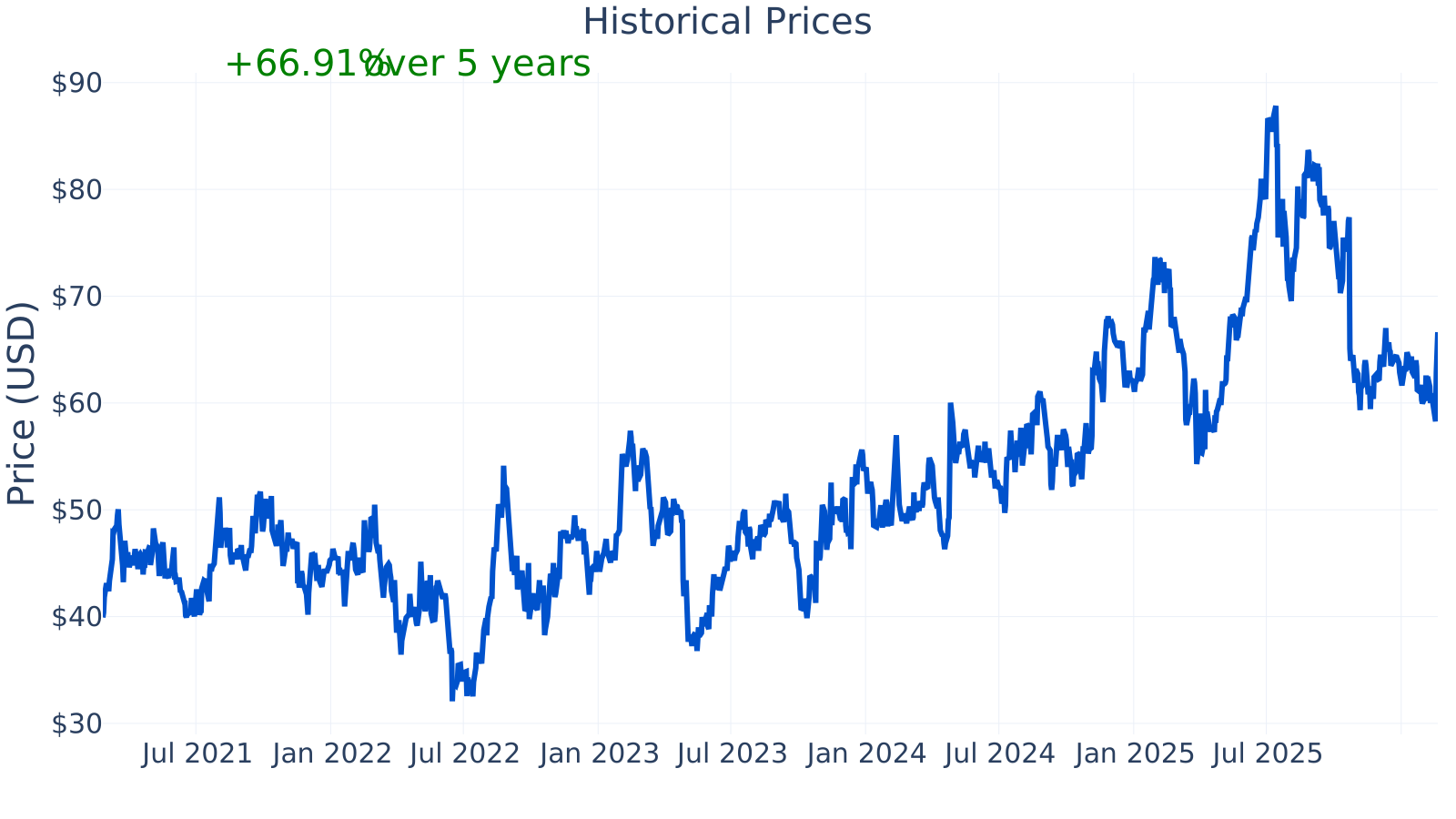
Sonic Automotive’s market capitalization is about $2.28B, and the stock’s beta (~0.92) suggests it has historically moved somewhat in line with, or slightly less than, the broader market. The company’s current P/E ratio is ~17.9, close to the auto dealership industry median shown (~19.1).
Two areas stand out versus the industry median in the table: profit margin and leverage. Sonic’s profit margin is shown at about 0.78% (vs an industry median around 2.54%), meaning a smaller portion of each dollar of sales is turning into net profit. Meanwhile, debt-to-equity is ~389% (vs an industry median around 157%), indicating a more debt-heavy capital structure than many peers.
Growth (Medium)
The auto dealership industry is mature and cyclical. Over long periods, unit growth tends to track drivers like population, replacement cycles for aging vehicles, and overall economic health rather than rapid structural expansion. That said, there are still growth paths for large retailers: gaining market share through acquisitions, building scale benefits (advertising, purchasing, systems), and expanding higher-margin revenue streams like service/parts and financing-related products.
Sonic’s strategy includes operating both traditional franchised dealerships and a used-vehicle-focused platform (EchoPark). Used vehicles are a large and persistent market, and a scaled used platform can benefit from process standardization, centralized sourcing, and online-to-offline customer acquisition. The main question for future growth is less about whether used vehicles exist as a market, and more about whether the company can generate consistent profitability through different pricing environments, varying used-vehicle supply, and changing consumer financing conditions.
The year-over-year revenue growth pattern shows how cyclical this business can be: very strong growth in 2021–2022, followed by a flatter/negative stretch during 2023–2024, and then improvement in parts of 2025 before turning slightly negative again at the end of 2025 (about -0.63% in the latest point shown). Relative to the industry median shown in the table, the latest year-over-year revenue change (about -0.6%) is below the industry median (~3.9%), suggesting the company’s recent top-line momentum has not been leading the peer group.
Free cash flow (cash generated after operating needs and capital spending) is important for long-term resilience because it helps fund debt reduction, buybacks/dividends, and reinvestment without relying on new borrowing. The trend shown is uneven: strong positive free cash flow in 2021–2022, negative in 2023–2024, and then a return toward positive territory by 2025. The latest trailing twelve-month free cash flow shown in the table is about $437.6M, which—if sustained—would represent a meaningful cash-generating profile for a company of this size. The large swings, however, fit with a retail model where inventory and financing working-capital needs can change quickly.
Risks (High)
This article is for informational purposes only and does not constitute financial advice. Some content is AI-generated. See Disclaimer