Stock Analysis · Snowflake Inc (SNOW)
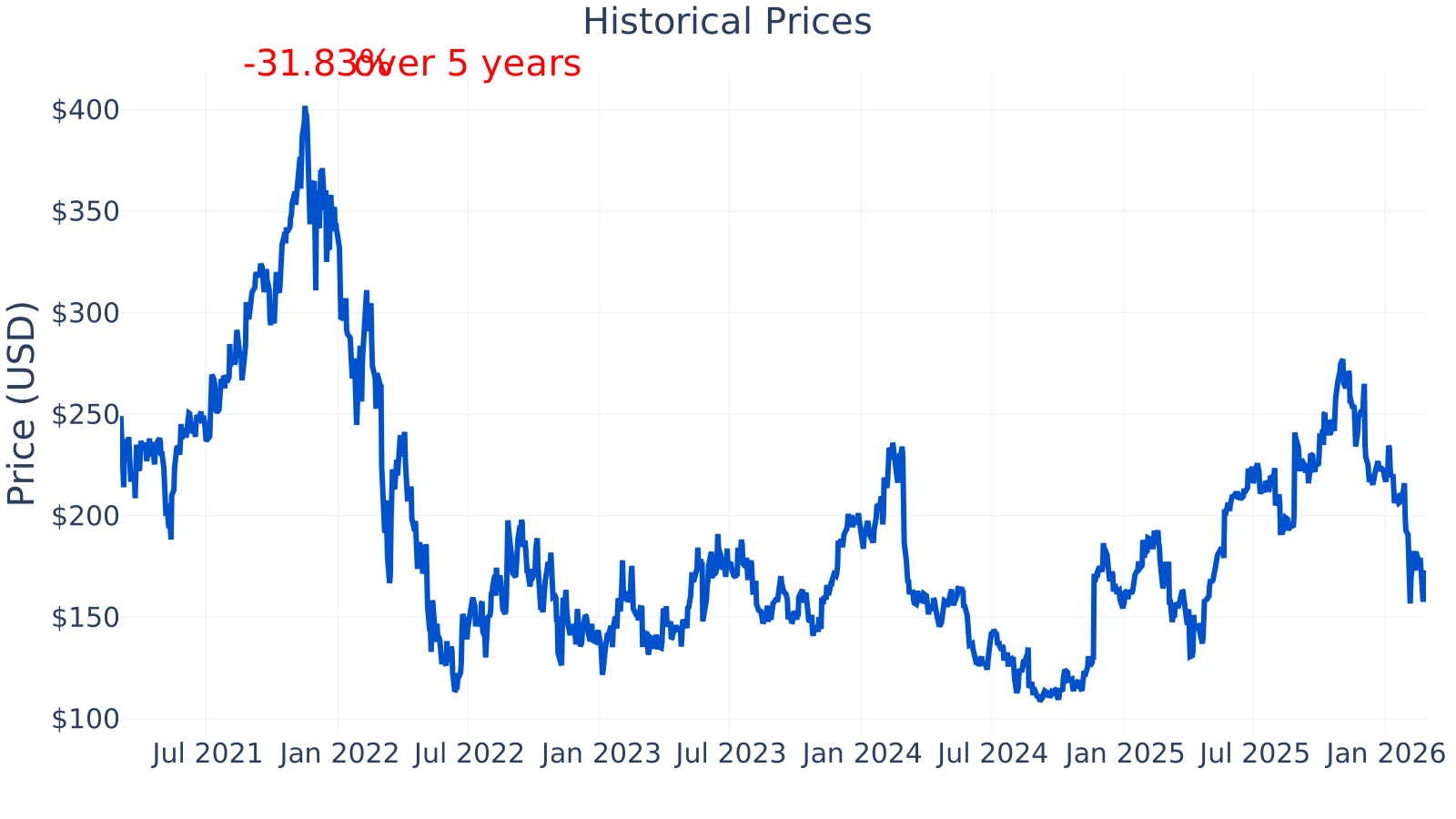
Overview
Snowflake Inc. is a software company focused on helping organizations store, combine, and analyze large amounts of information in the cloud. In practice, it provides a “data platform” that lets different teams (such as finance, marketing, product, and engineering) work on the same information securely, and share it across departments or with external partners when needed. Snowflake is designed to run on major cloud infrastructure providers, which is meant to give customers flexibility in where they operate and how they scale usage over time.
Snowflake primarily earns revenue by charging customers for using its platform. Based on the company’s public filings, revenue is mainly generated from:
- Product revenue (majority): usage of the Snowflake platform (including compute and storage-related consumption and platform capabilities sold as part of the offering).
- Professional services and other (smaller portion): implementation support, training, and related services.
Over the last several years, Snowflake has shown strong top-line expansion, with total revenue increasing from about $1.22B (fiscal year ended 2022-01-31) to about $4.68B (fiscal year ended 2026-01-31). At the same time, the company has continued to spend heavily on operating costs—especially research and development—so accounting profitability has remained negative even as the business scales.
One clear pattern is that revenue and gross profit have expanded significantly over time, but operating expenses have also risen sharply. Research and development is a particularly large cost line, which helps explain why operating income and net income remain negative despite a growing gross profit base.
Key Figures
| Metric | Value | Industry ⓘ |
|---|---|---|
| Date | Mar 02, 2026 | |
| Context | ||
| Sector | Technology | |
| Industry | Software - Application | |
| Market Cap ⓘ | $57.63B | |
| Beta ⓘ | 1.15 | |
| Fundamental | ||
| P/E Ratio ⓘ | N/A | 25.64 |
| Profit Margin ⓘ | -28.43% | 7.25% |
| Revenue Growth ⓘ | 30.10% | 16.65% |
| Debt to Equity ⓘ | 135.75% | 24.64% |
| PEG ⓘ | 5.60 | |
| Free Cash Flow ⓘ | $1.12B | |
Snowflake’s market capitalization is about $57.6B, and the stock’s beta (~1.15) suggests it has tended to move somewhat more than the broader market. The company’s profit margin is about -28.4%, while the industry median shown is ~7.2%, reflecting that Snowflake is still reporting GAAP net losses. At the same time, its year-over-year revenue growth is about 30.1%, above the industry median shown of ~16.7%. The debt-to-equity ratio is ~135.7% versus an industry median of ~24.6%, which is a notable difference and worth monitoring alongside the company’s cash generation. Trailing twelve-month free cash flow is about $1.12B, indicating the business has recently generated meaningful cash even while reporting accounting losses.
Growth (Medium)
Snowflake operates in cloud software for data storage and analytics—an area supported by long-term trends such as ongoing migration from on-premises systems to cloud services, rising volumes of business information, and broader adoption of AI and advanced analytics (which typically require well-organized, accessible information). From a strategic perspective, Snowflake’s emphasis on a centralized platform that can serve multiple teams and handle many types of workloads is aligned with how many large organizations want to manage information at scale.
Revenue growth has remained elevated, though it is lower than the exceptionally high rates visible earlier in the period. The most recent year-over-year growth shown is ~30%, which is still strong in absolute terms, especially compared with the industry median shown (about ~16.7%). A key point for long-term monitoring is whether Snowflake can sustain above-industry growth as it becomes larger and as customers optimize spending.
Free cash flow has trended upward over the period shown, reaching about $1.12B on a trailing twelve-month basis. For a business like Snowflake, improving cash generation can be an important milestone because it may provide more flexibility to invest in product development and go-to-market efforts without relying as heavily on external financing. That said, cash flow can fluctuate due to working-capital timing and the structure of customer billing and collections, so it is typically evaluated over multiple periods rather than a single quarter.
Potential catalysts for future growth discussed by companies in this area often include expanding the set of workloads that run on the platform (more use cases per customer), improving customer adoption across an enterprise, and enabling more sharing and collaboration across organizations. Snowflake’s continued investment in research and development also indicates a strategy focused on adding capabilities and keeping the platform competitive as customer needs evolve.
Risks (High)
Snowflake’s biggest fundamental risk is that, despite strong revenue growth, it still reports GAAP net losses. If operating expenses (especially sales and marketing and research and development) do not scale efficiently over time, the path to sustained GAAP profitability could remain uncertain. In addition, customer spending patterns can change: when economic conditions tighten, organizations may optimize cloud usage, which can slow consumption-based revenue growth.
The debt-to-equity ratio has increased sharply in the most recent periods shown, reaching roughly 136%, compared with an industry median of roughly 25%. This change is important to track because higher leverage can reduce flexibility if business conditions weaken. Interpreting this figure also benefits from reading the company’s latest 10-K/10-Q discussion of its capital structure (including any convertible notes) and the size of its cash and investments, since “debt-to-equity” alone does not show liquidity.
Snowflake’s profit margin remains negative (about -28% most recently), although it has improved substantially from earlier periods when losses were much larger (for example, around -91% in 2021). The gap versus the industry median (positive in the mid-single digits) highlights that Snowflake is still in a phase where the business model is prioritizing growth and product expansion over GAAP earnings.
Competition is another major risk. Snowflake faces large, well-resourced software and cloud providers that offer overlapping capabilities in cloud data warehousing, analytics, and broader data platforms. Key competitors commonly include:
- Cloud providers’ native offerings (for example, data warehouse and analytics services from the largest cloud platforms).
- Enterprise data and analytics vendors offering lakehouse/warehouse and governance tooling.
- Other cloud-focused data platforms that target similar workloads and budgets.
Snowflake’s competitive advantages described in company materials often center on cross-cloud support, ease of scaling, performance for certain workloads, and the ability to share information securely across organizations. However, whether these advantages remain durable depends on continued product execution, customer satisfaction, and the pace at which competitors improve integrated alternatives—especially when competitors can bundle services as part of broader cloud spending commitments.
Finally, stock-based compensation and share dilution can matter for long-term owners of the business. Even when free cash flow is positive, heavy equity compensation can increase share count over time, affecting per-share outcomes. This is typically evaluated directly in the company’s filings through share count trends and equity compensation disclosures.
Valuation
A commonly used valuation measure, the P/E ratio, is not meaningful when a company has negative net income under standard accounting, which is why the company’s P/E is shown as 0 here. In these situations, valuation discussions often shift toward other lenses—such as revenue multiples, free-cash-flow-based measures, and the relationship between growth rates and operating leverage—using figures from company filings and consistent peer comparisons.
Contextually, Snowflake combines high revenue growth (around 30% year over year) with negative profit margins (around -28%). That mix typically places more emphasis on execution risk: the valuation the market assigns tends to depend on expectations for (1) how long higher-than-industry growth can persist, (2) whether operating costs will grow more slowly than revenue over time, and (3) whether cash generation remains strong and durable. The company’s positive and rising free cash flow is a supportive indicator, while continued GAAP losses and the higher leverage indicated by debt-to-equity are elements that can weigh on valuation perception.
Conclusion
Snowflake is a cloud software company positioned in a long-term growth area: helping organizations consolidate, analyze, and share information at scale. Financially, it has delivered substantial revenue expansion over multiple years and has recently generated over $1B in trailing twelve-month free cash flow, which indicates meaningful cash-producing ability.
At the same time, the business still reports negative GAAP profitability, faces intense competition from large platform providers and enterprise software vendors, and shows a higher debt-to-equity ratio than the industry median in the figures shown. For long-term evaluation, the central questions are whether Snowflake can maintain strong growth while improving operating efficiency, and whether its platform differentiation remains strong as competitors expand their capabilities.
Sources:
- U.S. SEC EDGAR — Snowflake Inc. filings (Form 10-K, Form 10-Q)
- Snowflake Inc. Investor Relations — Annual Report materials and shareholder communications (company-hosted)
- Wikipedia — “Snowflake Inc.” (basic company background only)
This article is for informational purposes only and does not constitute financial advice. Some content is AI-generated. See Disclaimer


