Stock Analysis · Snap Inc (SNAP)
Overview
Snap Inc. is a technology company best known for Snapchat, a social media application focused on camera-based communication. People use Snapchat to message, share short-lived photos and videos, watch content from publishers and creators, and interact with augmented reality (AR) features such as Lenses. Snap also develops advertising tools that help businesses reach Snapchat users, and it operates additional products such as Spectacles (AR-enabled eyewear) and services for creators and developers.
Snap’s business model is primarily advertising-led: it provides free consumer services and generates most of its revenue by selling ad placements and performance-oriented advertising (ads designed to drive actions such as app installs or purchases). In its filings, Snap reports revenue largely as advertising revenue, with smaller contributions from other sources.
Main sources of revenue (largest to lowest):
- Advertising (substantially all revenue) — ads shown across Snapchat surfaces such as Stories, Spotlight, and Discover (Snap typically describes this as the primary driver of revenue).
- Other revenue (small) — may include items such as Snapchat+ subscription revenue and certain other non-ad revenues, depending on the period and company reporting.
From the company’s recent annual figures, revenue expanded materially from about $4.12B (2021) to about $5.93B (2025). Over the same period, Snap remained net-loss-making, which highlights that scale and monetization progress have not yet translated into consistent profitability.
Across 2021–2025, revenue rose (about $4.12B → $5.93B) and gross profit increased as well (about $2.37B → $3.26B). Operating losses narrowed meaningfully versus the peak loss period (operating income improved from about -$1.38B (2022) to about -$0.33B (2025)), but the company still recorded a net loss in each of the years shown.
Key Figures
| Metric | Value | Industry ⓘ |
|---|---|---|
| Date | Feb 07, 2026 | |
| Context | ||
| Sector | Communication Services | |
| Industry | Internet Content & Information | |
| Market Cap ⓘ | $8.82B | |
| Beta ⓘ | 0.80 | |
| Fundamental | ||
| P/E Ratio ⓘ | N/A | 14.12 |
| Profit Margin ⓘ | -7.76% | 10.23% |
| Revenue Growth ⓘ | 10.20% | 7.10% |
| Debt to Equity ⓘ | 206.05% | 10.16% |
| PEG ⓘ | 496.06 | |
| Free Cash Flow ⓘ | $437.19M | |
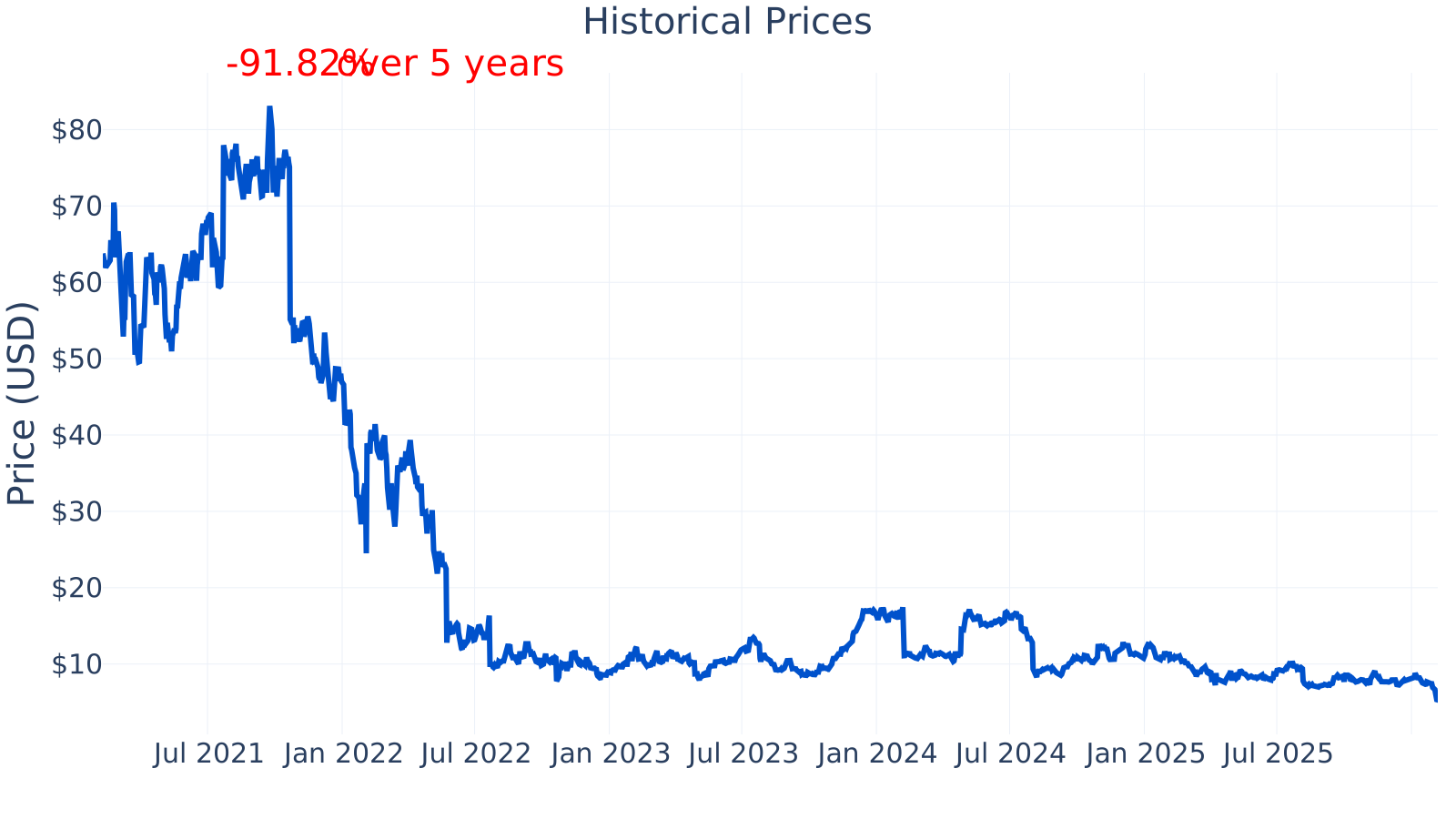
Snap’s market capitalization is about $8.82B. The stock’s beta (~0.80) suggests it has historically moved somewhat less than the broader market on average (though individual periods can differ significantly).
On fundamentals, two items stand out. First, Snap’s profit margin is negative (~-7.76%) versus an industry median around +10.23%, reflecting that the company is still not consistently profitable. Second, its year-over-year revenue growth (~10.2%) is above the listed industry median (~7.1%), indicating faster growth than a typical peer in this classification at the time shown.
Leverage is also elevated: debt-to-equity is ~206% versus an industry median around 10%, which can matter when business conditions weaken or when refinancing becomes more expensive. Finally, Snap shows positive trailing twelve-month free cash flow (~$437M), which is a helpful signal for liquidity, even while net income remains negative.
Growth (Medium)
Snap operates in digital advertising and social media—areas that have grown over time as marketing budgets shift toward mobile and measurable, performance-based ads. In that context, Snap’s strategy centers on expanding its audience engagement, improving ad targeting and measurement tools, and increasing the number of advertisers (including small and mid-sized businesses). It also invests in AR features and creator-focused content formats, which are intended to differentiate the user experience and create additional ad inventory.
Revenue growth has been uneven across the last few years: very high growth in 2021, a sharp slowdown around 2022–2023 (including negative periods), followed by a recovery into mid-teens growth in 2024 and around ~10% by late 2025. This pattern matters for a long-term view because it shows Snap’s results can be sensitive to the advertising cycle and changes in the ad market.
Free cash flow (a cash-based measure after operating needs and capital spending) moved from negative in 2021 to positive in 2022, dipped again around 2024, and turned positive again by 2025 (about $295M at the most recent point shown on the chart, with the table showing ~$437M on a trailing basis). Positive free cash flow can provide flexibility for continued product investment and balance sheet management, but the variability suggests execution and ad-market conditions remain important catalysts for sustained improvement.
Risks (High)
Snap’s most important risk is that it is still not consistently profitable. Even with revenue growth, the business must maintain cost discipline while continuing to invest in product development and infrastructure. The company’s margins have improved from very negative levels, but they remain below typical industry profitability levels.
Profit margin improved substantially over time (from roughly -33% in 2021 to about -7.76% in 2025), but it is still below the industry median (about +12.08% at the latest point shown on the chart). This gap highlights ongoing pressure from operating expenses and the cost structure required to run and grow a large-scale consumer platform.
Another key risk is balance-sheet leverage. Higher leverage can reduce flexibility during downturns, particularly for companies whose revenue is closely tied to advertising demand. It can also increase sensitivity to interest costs.
Snap’s debt-to-equity rose over time and is around 206% at the latest point shown, far above the industry median (roughly ~8.5%). This does not automatically imply distress, but it raises the importance of liquidity management and stable cash generation.
Competition is intense. Snap competes for user attention and ad budgets with much larger platforms, including:
- Meta (Instagram, Facebook)
- Alphabet (YouTube and broader digital advertising ecosystem)
- TikTok (ByteDance)
- Apple and Google indirectly, due to their control of mobile operating systems, app distribution, and aspects of ad measurement and privacy frameworks
In competitive positioning, Snap is a major player in camera-based social communication, particularly with younger audiences, and it has brand recognition in AR features. However, it is not the overall leader in global social advertising scale, and larger competitors can often invest more aggressively in product, infrastructure, and ad tooling.
Additional risks include dependence on the health of the advertising market, changes in privacy rules and platform policies that can affect ad targeting/measurement, and the need to continuously innovate to keep users engaged in a fast-changing consumer internet landscape.
Valuation
Because Snap has reported net losses in the periods reflected here, a traditional price-to-earnings (P/E) ratio is often not meaningful (P/E typically requires positive earnings). In the metric table, the industry median P/E is shown around 14.12, but Snap’s own P/E is not presented as a usable figure in the series provided, which is consistent with negative earnings.
In practice, when earnings are negative, valuation discussions often rely more on factors like revenue growth, the path toward operating profitability, and cash flow durability rather than a single earnings-based multiple. For Snap specifically, the combination of (1) mid-range revenue growth, (2) improving but still negative margins, and (3) comparatively high leverage means the market’s pricing tends to be especially sensitive to evidence of sustained margin improvement and consistent cash generation.
Conclusion
Snap is a consumer internet company primarily driven by advertising revenue, with products built around camera communication, content discovery, and augmented reality. The company has grown revenue over the last several years and has shown improvement in operating losses and profit margin, while also producing positive free cash flow on a trailing basis.
At the same time, the business still reports negative profitability, faces strong competition from much larger platforms, and carries a higher debt-to-equity level than the industry median. For long-term analysis, the key items to monitor are whether revenue growth remains durable across ad cycles, whether margins continue moving toward positive territory, and whether free cash flow stays consistently positive while leverage remains manageable.
Sources:
- Snap Inc. — Annual Report (Form 10-K) (Business overview, risk factors, financial statements)
- SEC EDGAR — Snap Inc. filings (Forms 10-K, 10-Q, 8-K)
- Wikipedia — “Snap Inc.” (basic company background and product overview)
This article is for informational purposes only and does not constitute financial advice. Some content is AI-generated. See Disclaimer


