Stock Analysis · Skywater Technology Inc (SKYT)
Overview
SkyWater Technology Inc. (SKYT) is a U.S.-based semiconductor manufacturer and engineering services provider. In simple terms, it helps customers turn chip designs into real, manufactured chips, and it can also support the earlier steps (process development, prototyping, and specialized manufacturing). This type of company is often described as a “foundry” plus technology services: instead of selling consumer products, it sells manufacturing capacity and know-how.
SkyWater’s revenue is primarily tied to producing semiconductors for customers and delivering related services. Based on company disclosure in its filings, revenue generally comes from a mix of wafer manufacturing and technology/engineering services, with customers spanning commercial markets and government-related programs. SkyWater’s filings are the best place to confirm the most recent breakdown; when a company does not provide a stable, single breakdown table (or when mix changes), focusing on the business model is more reliable than guessing percentages.
Main revenue streams (ordered from typically largest to smallest, depending on period and customer mix):
- Wafer and semiconductor manufacturing services (producing chips for customers on established process nodes and specialty flows)
- Technology services (engineering, process development, prototyping, and related services that support customers moving from design to manufacturing)
- Other / ancillary (items that can include certain program-related or one-time activities depending on reporting)
The company’s income profile has shifted materially over time: total revenue increased from about $163M (2021) to about $442M (2025), while profitability moved from deep losses toward positive net income in 2025, according to the multi-year income statement line items shown below.
Across 2021–2025, total revenue rose steadily (about $163M to $442M). Gross profit also improved (from negative in 2021 to about $88M in 2025). Net income turned positive in 2025 (about $119M), while operating income was still close to break-even, which suggests a meaningful portion of 2025 net income may be influenced by items below operating profit (such as taxes or other non-operating factors) rather than pure operating performance alone.
Key Figures
| Metric | Value | Industry ⓘ |
|---|---|---|
| Date | Mar 02, 2026 | |
| Context | ||
| Sector | Technology | |
| Industry | Semiconductors | |
| Market Cap ⓘ | $1.43B | |
| Beta ⓘ | 3.51 | |
| Fundamental | ||
| P/E Ratio ⓘ | 11.29 | 44.92 |
| Profit Margin ⓘ | 26.90% | 10.84% |
| Revenue Growth ⓘ | 126.60% | 16.00% |
| Debt to Equity ⓘ | 3.11% | 21.24% |
| PEG ⓘ | N/A | |
| Free Cash Flow ⓘ | -$53.20M | |
SkyWater is a small-cap semiconductor company (market cap about $1.43B) with high stock volatility (beta ~3.51). The latest P/E ratio is ~11.3 versus an industry median near ~44.9, while the latest profit margin shown is ~26.9% versus an industry median near ~10.8%. Revenue growth is shown as very high most recently (~126.6% year over year versus an industry median near ~16%), while the latest debt-to-equity is very low (~3.1% versus an industry median near ~21.2%). Free cash flow over the trailing twelve months is negative (about -$53.2M), which matters because it indicates cash outflow even if accounting earnings improved.
Growth (medium)
SkyWater operates in the semiconductor industry, which is structurally important to many areas of the economy (computing, industrial systems, communications, defense, automotive, and more). For a manufacturer like SkyWater, long-term growth typically depends on (1) sustained customer demand, (2) the ability to run its factory capacity efficiently, and (3) differentiation in specialty processes or trusted manufacturing where customers value reliability, security, or unique capabilities.
Revenue growth has been uneven but includes periods of rapid expansion. After strong growth through 2022–2024, the company showed negative year-over-year revenue growth in parts of 2025 before a sharp rebound later in 2025, ending with approximately +126.6% year over year. This pattern can be consistent with project timing, program ramps, and customer order volatility that smaller manufacturers can experience.
Cash generation has also fluctuated. Trailing free cash flow improved from large negative levels (2021–2023) to positive in 2024 and 2025, but the latest trailing value shown is negative again (about -$53.2M). For long-term business building, a key question is whether future growth can be funded while keeping free cash flow consistently positive, since chip manufacturing can require ongoing investment in equipment, facilities, and process upgrades.
Potential catalysts in this type of business (generally described, since the timing and magnitude can vary) include: adding or renewing large customer programs, ramping utilization of manufacturing capacity, expanding specialty process offerings, and winning “trusted” or security-sensitive work where supplier qualification can be a barrier to entry. In filings, investors typically look for indicators such as backlog trends, customer concentration disclosures, and capital expenditure plans to understand whether growth is likely to be durable.
Risks (high)
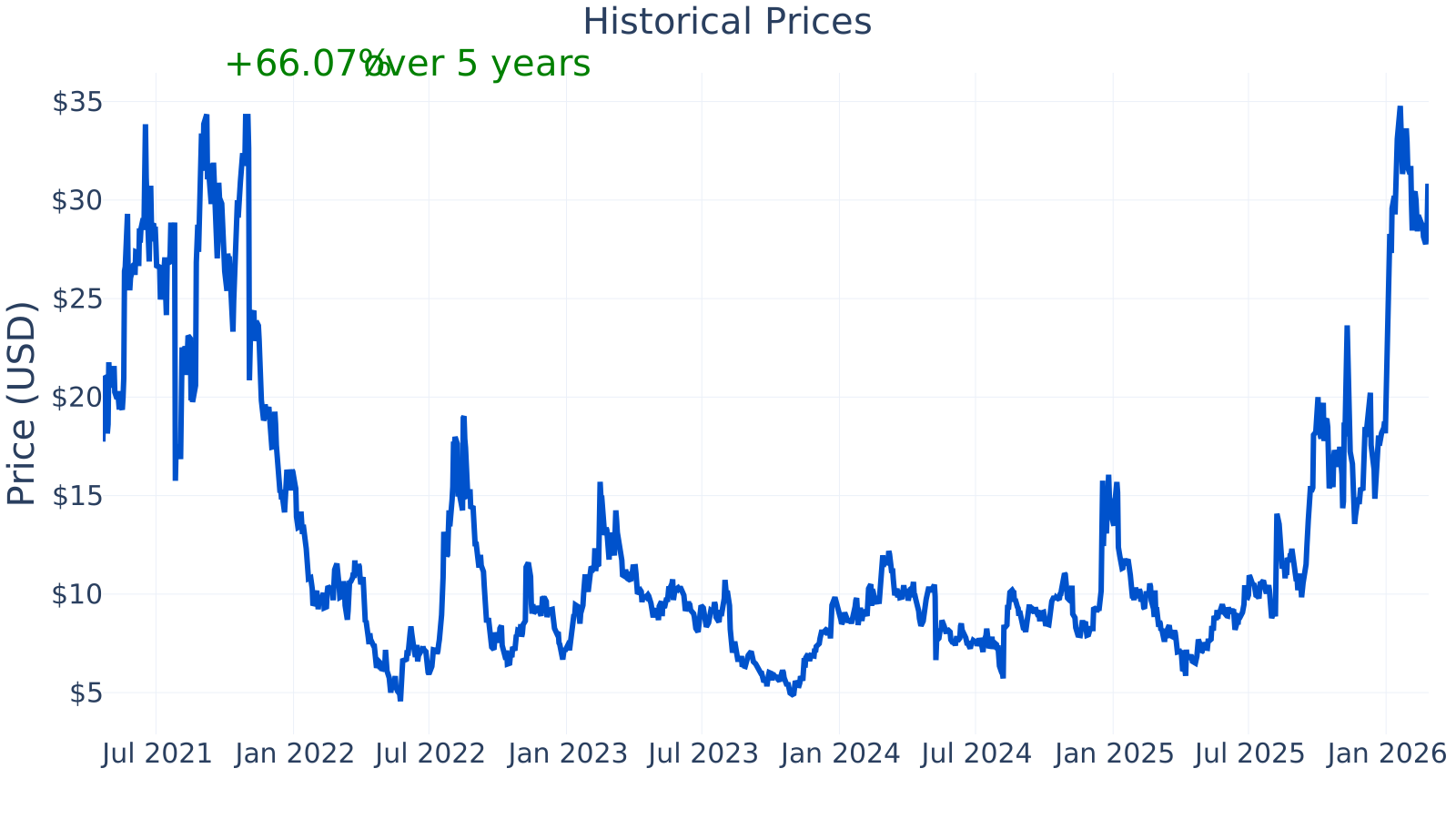
SkyWater’s risk profile is meaningfully influenced by its small size, cyclicality in semiconductor demand, and the operational realities of running a fabrication facility. High beta (~3.5) reflects that the stock has historically moved much more than the broader market, which can matter for long-term holders who may face large price swings.
Financial leverage appears to have changed dramatically over time. Earlier periods show debt-to-equity above 100% (and at times much higher), while the latest point is about 3.1%, well below the industry median (~21.2%). This can be a positive sign for balance-sheet flexibility, but it is still important to review the most recent filing notes to understand what drove the change (for example, equity changes, refinancing, repayments, or classification changes).
Profitability has also been volatile. The company showed negative profit margins for multiple years and then a sharp move to positive in late 2025 (around 26.9% most recently, above the industry median). Because the historical chart shows a long stretch of losses before this improvement, a core risk is whether recent profitability reflects sustainable operations (higher utilization, better pricing/mix, improved efficiency) versus temporary factors (timing effects, one-time items, or non-operating impacts).
Competitive positioning is another key risk area. SkyWater competes for manufacturing programs against much larger global foundries and specialty manufacturers. Large competitors may have deeper capital resources, broader process portfolios, and economies of scale. In many cases, a smaller company’s advantage comes from specialization (certain process technologies, customer service, domestic manufacturing, or trusted programs) rather than being the overall cost leader.
Main competitor categories (examples by type rather than a complete list):
- Large global foundries (very large-scale manufacturing with broad technology roadmaps)
- Specialty / analog / mixed-signal manufacturers and foundries (focused on specific process nodes and end markets)
- Integrated device manufacturers that also provide manufacturing services in some cases
Additional risks commonly highlighted in semiconductor manufacturing filings include customer concentration (a few customers accounting for a large share of revenue), execution risk when ramping programs, supply chain constraints for tools/materials, quality and yield challenges, and the need for ongoing capital expenditures.
Valuation
On a simple earnings-multiple basis, SkyWater’s latest P/E ratio (~11.3) is far below the shown industry median (~44.9). When a stock trades at a lower P/E than peers, it can reflect differences in expected growth, perceived durability of earnings, business risk, or the market’s view that current earnings may be unusually high or not repeatable.
For SkyWater, valuation interpretation hinges on earnings quality and consistency. The company recently showed strong profit margin improvement and very high year-over-year revenue growth, but it also shows negative trailing free cash flow and a history of losses. In other words, the lower P/E multiple exists alongside a business that is still proving the stability of its cash generation through a cycle. A long-term valuation discussion therefore tends to focus less on a single P/E snapshot and more on whether operating profit and free cash flow can remain durable as programs mature and investment needs continue.
Conclusion
SkyWater Technology is a U.S. semiconductor manufacturer and services provider whose financial trajectory has improved meaningfully over the past several years, including strong multi-year revenue growth and a recent turn to positive profitability. The latest metrics show a relatively low P/E versus the industry median, strong recent profit margin, and very low debt-to-equity, but also negative trailing free cash flow and a history of volatile results.
The long-term story depends on whether the company can convert growth into consistent operating earnings and reliable free cash flow while maintaining competitive differentiation in specialty and/or trusted manufacturing segments. The main uncertainties center on cyclicality, customer/program timing, and the sustainability of the recent profitability shift relative to the company’s longer track record.
Sources:
- SEC EDGAR — SkyWater Technology, Inc. filings (Form 10-K, Form 10-Q, Form 8-K)
- SkyWater Technology — Investor Relations materials and press releases
- Wikipedia — “SkyWater Technology” (basic company background)
This article is for informational purposes only and does not constitute financial advice. Some content is AI-generated. See Disclaimer


