Stock Analysis · Skyworks Solutions Inc (SWKS)
Overview
Skyworks Solutions Inc is a semiconductor company that designs and sells analog and mixed-signal chips used to connect devices wirelessly. In plain terms, its components help smartphones, connected home devices, cars, and industrial equipment send and receive signals (for example, cellular, Wi‑Fi, Bluetooth, and GPS) while managing power efficiently.
Skyworks’ products are typically sold to large electronics manufacturers and their supply chains. Revenue is largely tied to demand for end devices (especially phones), the number of radio “bands” and features inside each device, and how much content Skyworks wins per device design.
In its SEC filings, Skyworks describes its business as operating in a single segment and discusses end markets rather than reporting revenue by multiple business segments. The company highlights mobile as its largest end market, with additional exposure to broad markets such as automotive, industrial, and connected home.
Across recent fiscal years shown here, total revenue declined from about $5.5B (fiscal 2022) to about $4.1B (fiscal 2025). Over the same period, spending on research and development rose (from roughly $618M to $786M), while operating income and net income fell, indicating the company continued investing in product development even as sales softened.
Key Figures
| Metric | Value | Industry ⓘ |
|---|---|---|
| Date | Feb 07, 2026 | |
| Context | ||
| Sector | Technology | |
| Industry | Semiconductors | |
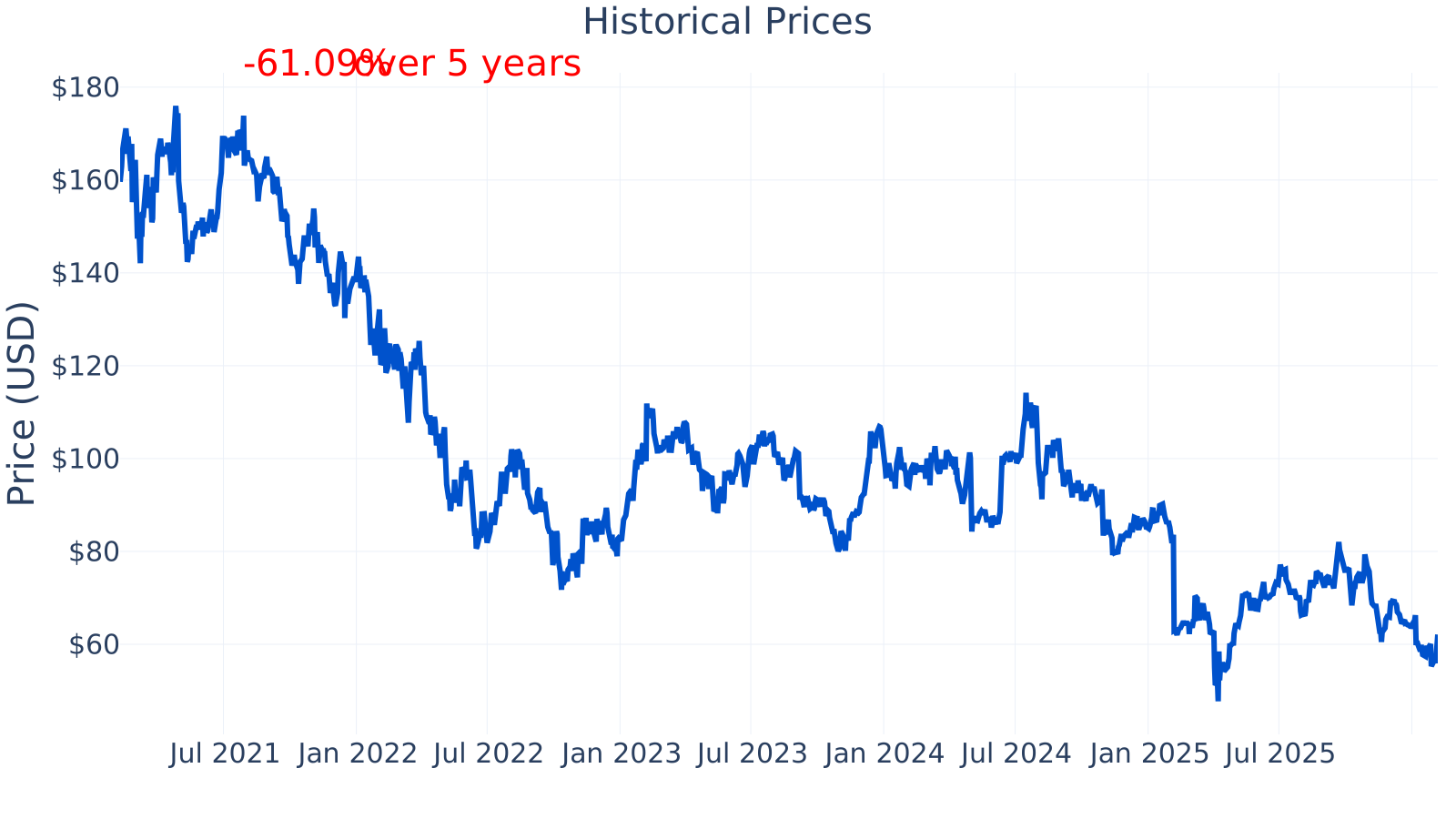
| Market Cap ⓘ | $9.34B | |
| Beta ⓘ | 1.32 | |
| Fundamental | ||
| P/E Ratio ⓘ | 23.79 | 45.89 |
| Profit Margin ⓘ | 9.73% | 9.42% |
| Revenue Growth ⓘ | -3.10% | 13.10% |
| Debt to Equity ⓘ | 17.30% | 25.62% |
| PEG ⓘ | 1.04 | |
| Free Cash Flow ⓘ | $1.09B | |
Skyworks’ market capitalization is about $9.3B. The stock’s beta of ~1.32 suggests it has tended to move more than the broader market. The P/E ratio is ~23.8, below the semiconductor industry median of ~45.9 in the table. Profit margin is about 9.7%, slightly above the industry median shown (~9.4%). Revenue growth year-over-year is -3.1% versus an industry median of +13.1%, indicating Skyworks has recently lagged many peers on top-line growth. Debt-to-equity is about 17%, below the industry median shown (~26%). Trailing twelve-month free cash flow is about $1.09B.
Growth (Medium)
The industries Skyworks serves—wireless connectivity and semiconductors—have structural long-term demand drivers. More devices need more connectivity, and modern electronics often require more complex radio components than older generations. However, the path is not always smooth: chip demand can fluctuate sharply with consumer electronics cycles and customer inventory adjustments.
Skyworks’ longer-term growth logic is tied to (1) increasing radio complexity in phones and other connected devices, (2) expansion in “broad markets” such as automotive and industrial connectivity, and (3) ongoing product development aimed at capturing more content per device. The company’s filings emphasize continuous investment in engineering (R&D) to support new designs and customer programs, which can matter because design wins can influence multi-year product cycles.
The chart shows a strong growth period in 2021, followed by several quarters of negative year-over-year revenue comparisons through much of 2023–2025, with a few quarters turning modestly positive before returning slightly negative most recently (around -3%). This pattern is consistent with a cyclical downshift after a stronger period rather than a steady expansion trend.
Free cash flow has remained substantial over time (roughly $1.0B–$1.6B across the periods shown), though it has fluctuated. Even when revenue and earnings pressure show up, steady cash generation can be an important support for ongoing R&D and balance sheet flexibility.
Risks (High)
Skyworks’ biggest business risk is exposure to demand swings in consumer electronics—especially smartphones. When handset unit volumes slow, when customers work down inventory, or when product transitions are uneven, suppliers can see sharp revenue changes. Another closely related risk is customer concentration: large device makers can represent a meaningful portion of sales, and changes in sourcing decisions (or the mix of in-house versus outsourced components) can affect results.
Competitive pressure is also significant. In radio-frequency components and connectivity solutions, Skyworks competes with other specialized suppliers and larger diversified chip companies. Competition often centers on performance, size, power efficiency, integration, reliability, and cost—areas that can shift quickly as standards evolve (for example, new cellular generations) and as customers redesign hardware platforms.
From a financial risk perspective, leverage looks moderate relative to many peers, which can reduce pressure during downturns.
Debt-to-equity trends down markedly from higher levels earlier in the period (around the mid-40% range in 2021–2022) to roughly 17% most recently, and it is below the industry median shown for the latest point. Lower leverage can help resilience when industry conditions weaken.
Profitability has been under pressure compared with earlier periods, even though Skyworks still posts a profit margin close to the industry median in the latest reading.
The profit margin declines from very high levels in 2021 (roughly 27%–30%) to around 9.7% most recently. This compression can reflect a mix of lower volume, pricing dynamics, and cost structure, and it increases the importance of execution if revenue growth remains uneven.
Regarding competitive advantages, Skyworks’ position is supported by specialized RF engineering, long customer qualification cycles, and the practical difficulty of redesigning radio front-ends once a device platform is set. That said, it is not a “winner-take-all” market; multiple suppliers can coexist, and customer sourcing strategies can shift over time.
Main competitors commonly discussed for RF components and related connectivity content include Qorvo, Broadcom (in certain RF and connectivity areas), and Murata (modules and components), among others. Relative positioning can vary by customer, device tier, and specific subcomponent.
Valuation
One simple way to contextualize valuation is the price-to-earnings (P/E) ratio compared with peers and with the company’s own history. Skyworks’ latest P/E of about 23.8 is below the semiconductor industry median shown in the table (~45.9), which can indicate the market is assigning a more cautious outlook to Skyworks’ earnings profile than to the median company in the group.
Historically in the periods shown, Skyworks’ P/E ratio often sits below the industry median, with Skyworks generally in the low-teens to 20s for much of 2022–2024 and moving into the 20s more recently. Interpreting this requires context: a lower P/E can reflect lower expected growth, higher perceived business concentration, or more cyclical earnings. At the same time, a company with meaningful cash generation and moderate leverage may sustain a valuation even during weaker demand periods—though the key uncertainty is whether revenue growth and margins stabilize or continue to face pressure.
Conclusion
Skyworks Solutions is a wireless-focused semiconductor supplier whose results are closely linked to demand in mobile devices and broader connected markets. The company has continued to fund product development while managing leverage at a level that appears moderate compared with the industry median shown.
The recent picture is mixed: revenue growth has been inconsistent and often negative over the last several years, and profit margins have compressed substantially from earlier highs. At the same time, free cash flow remains meaningful, and the valuation metrics shown (such as P/E relative to the industry median) suggest the market is pricing Skyworks with more caution than many peers.
For long-term, fundamentals-oriented readers, the key points to monitor over time are whether revenue growth returns more consistently (especially outside smartphones), whether margins stabilize as demand normalizes, and whether customer concentration and competitive dynamics remain manageable.
Sources:
- SEC EDGAR — Skyworks Solutions Inc. Form 10-K (Annual Report)
- SEC EDGAR — Skyworks Solutions Inc. Form 10-Q (Quarterly Report)
- Skyworks Solutions — Investor Relations materials (company-hosted filings and presentations)
- Wikipedia — “Skyworks Solutions” (basic company background)
This article is for informational purposes only and does not constitute financial advice. Some content is AI-generated. See Disclaimer


