Stock Analysis · Skyline Corporation (SKY)
Overview
Skyline Corporation (ticker: SKY) operates in the Residential Construction industry within the Consumer Cyclical sector. In practical terms, the company participates in housing-related demand that tends to rise and fall with the broader economy, consumer confidence, and financing conditions (such as interest rates).
Because residential construction is cyclical, results can look very strong during housing up-cycles and can cool off when affordability tightens or demand softens. That cyclicality is an important lens for understanding Skyline’s revenue swings, profit margins, and valuation over time.
Public filings typically break down revenue by operating segments and/or product lines. (The specific mix and percentages should be taken directly from the most recent annual report/10-K segment disclosures.)
Across the periods shown, total revenue and profitability move meaningfully over time: revenue rises from about $1.42B (quarter ended 2021-03-31) to about $2.61B (2023-03-31), then drops to about $2.02B (2024-03-31) before increasing again to about $2.48B (2025-03-31). Over the same points, net income also fluctuates (about $84.8M in 2021-03-31, up to about $401.8M in 2023-03-31, down to about $146.7M in 2024-03-31, then about $198.4M in 2025-03-31), consistent with a cyclical business where pricing, volumes, and costs can change quickly.
Key Figures
| Metric | Value | Industry ⓘ |
|---|---|---|
| Date | Feb 07, 2026 | |
| Context | ||
| Sector | Consumer Cyclical | |
| Industry | Residential Construction | |
| Market Cap ⓘ | $4.67B | |
| Beta ⓘ | 1.05 | |
| Fundamental | ||
| P/E Ratio ⓘ | 22.29 | 12.00 |
| Profit Margin ⓘ | 8.10% | 8.48% |
| Revenue Growth ⓘ | 1.80% | -4.90% |
| Debt to Equity ⓘ | 7.48% | 34.53% |
| PEG ⓘ | N/A | |
| Free Cash Flow ⓘ | $259.69M | |
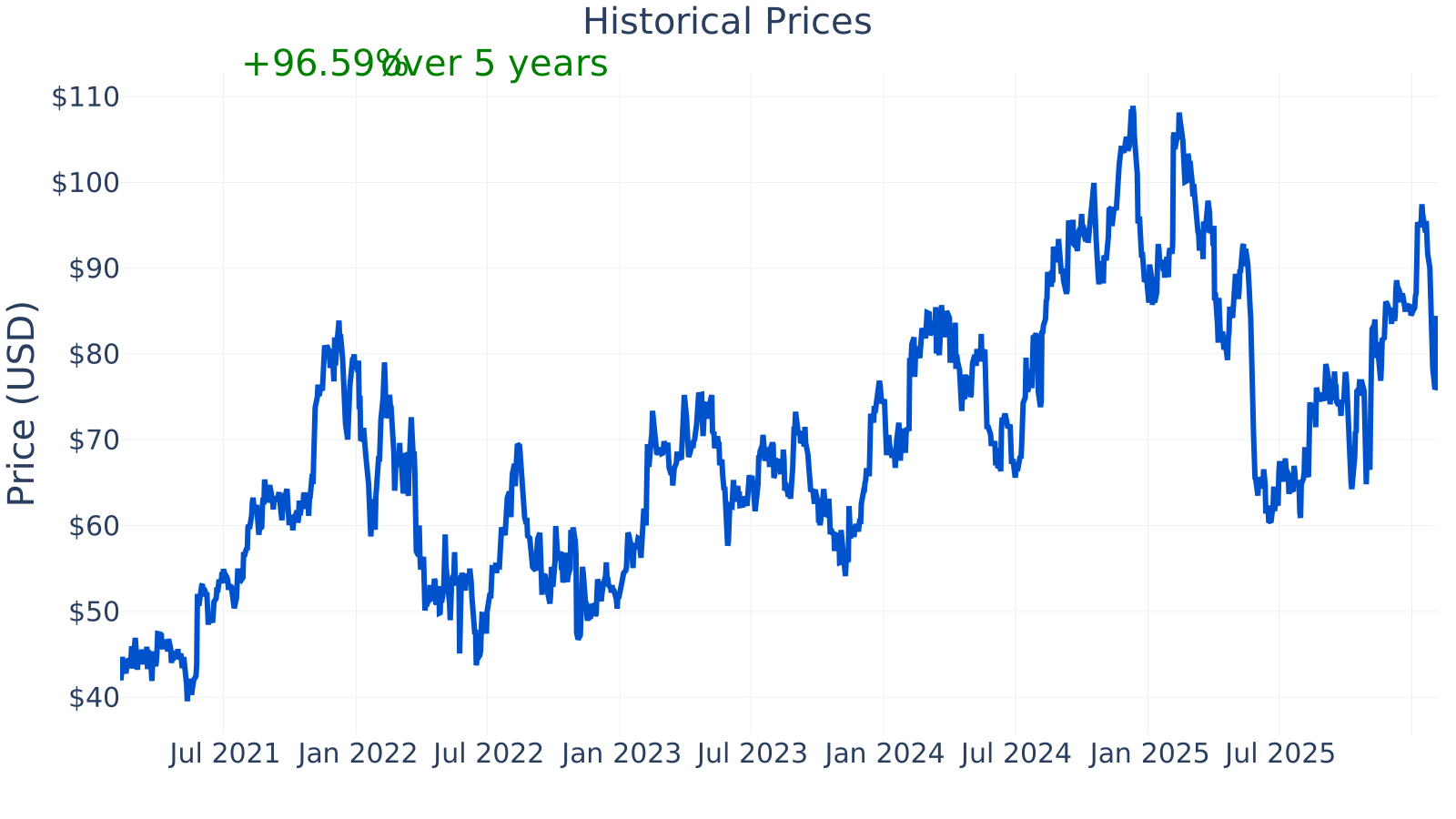
Skyline’s market capitalization is about $4.67B. The stock’s beta (~1.06) suggests price moves have been somewhat similar to the overall market on average (though beta is backward-looking and can change).
On profitability, the latest profit margin is ~8.1%, slightly below the industry median of about 8.5%. Growth is modest in the latest year-over-year reading: about +1.8% versus an industry median of about -4.9%, indicating Skyline is growing a bit faster than the median peer at that snapshot in time.
Balance-sheet leverage appears comparatively low: latest debt-to-equity is ~7.5% versus an industry median of about 34.5%. Free cash flow over the trailing twelve months is about $259.7M, which can matter for flexibility (for example, reinvestment, buybacks, or simply maintaining a financial cushion through down cycles).
Growth (Medium)
Residential construction is a large, essential end market, but it is also highly sensitive to affordability, mortgage rates, and consumer sentiment. That means long-term demand can exist alongside sharp short-term swings. For a company like Skyline, a key question is less “does housing exist?” and more “how stable and scalable is performance across cycles?”
Revenue growth shows pronounced cycle effects. Growth was very strong across several quarters in 2021–2022 (often well above +40% year over year), turned negative through much of 2023 (down to roughly -42% at the low point), and then returned to positive territory during 2024 before cooling to about +1.8% by 2025-12-31. This pattern is consistent with a market where volumes and pricing can normalize after a surge, then recover as conditions improve.
Free cash flow over the trailing twelve months also varies: approximately $145.9M (2021-03-31), $192.5M (2022-03-31), peaking near $364.0M (2023-03-31), then easing to about $169.8M (2024-03-31) and about $190.3M (2025-03-31). For cyclical businesses, sustained positive free cash flow through different conditions is often watched as an indicator of operational resilience, even if the level fluctuates.
Potential long-term catalysts for companies in residential construction typically include improved affordability (for example, lower financing costs), favorable demographic or household formation trends, and product or geographic expansion discussed in company filings. The strength and timing of these drivers can be uneven and are often outside management’s control, which is why balance-sheet flexibility can matter.
Risks (High)
The main risk is cyclicality. Residential construction companies can experience rapid shifts in demand, pricing, and customer financing availability. That can lead to volatile revenue growth and profitability, as seen in the swings from strong growth to contraction and back to modest growth.
On leverage, Skyline’s debt-to-equity ratio trends low relative to the industry median across the period shown. The latest is about 7.5%, versus an industry median near 34.5%. Lower leverage can reduce financial risk in downturns, though it does not remove exposure to demand shocks and margin pressure.
Profit margin expanded significantly into 2022–2023 (reaching the mid-teens at its high points), then compressed materially through 2024 (down to the mid-6% range), and partially recovered by late 2025 (around 8.1%). Margin compression can happen when input costs rise, pricing power weakens, sales mix changes, or volumes fall and fixed costs weigh more heavily. This variability highlights that competitive positioning and cost control matter, but they operate within a market that can shift quickly.
Competitive advantages in residential construction commonly come from scale, manufacturing efficiency, distribution reach, brand reputation, dealer/partner networks, and customer service—items usually described qualitatively in annual reports. Whether Skyline is a “leader” depends on the specific niche and the peer set used; in most construction-related categories, competition is active and products can be compared on price, delivery timelines, and perceived quality.
Competitors are other public and private companies in residential construction and related housing supply segments. Skyline’s placement versus peers is often evaluated through a combination of (1) profitability versus industry medians, (2) leverage versus peers, and (3) consistency of growth through cycles. In the latest snapshot provided, Skyline shows lower leverage than the median peer, profitability close to (slightly below) the median, and year-over-year growth above the median, but those relationships can change meaningfully at different points in the cycle.
Valuation
Skyline’s latest P/E ratio is about 22.29 versus an industry median near 12.00, indicating the stock trades at a higher earnings multiple than the median peer group at this point in time. Historically in the period shown, Skyline’s P/E moved widely—dropping into the low teens and single digits in parts of 2022, then rising into the 20s–30s across much of 2024–early 2025, before ending near the low 20s by 2025-11-12. Meanwhile, the industry median P/E remained materially lower throughout.
A higher P/E can be associated with expectations of better durability, higher quality earnings, stronger balance-sheet position, or superior long-term growth versus peers. However, for cyclical companies, P/E ratios can be difficult to interpret because “E” (earnings) can be temporarily high or low depending on where the business is in the cycle. In Skyline’s case, the combination of moderate current growth, profit margins that have compressed from prior peaks, and a P/E above the industry median suggests the valuation is placing a meaningful weight on future normalization, execution, and resilience compared with peers.
Conclusion
Skyline Corporation operates in a cyclical segment of the economy, and its financial history reflects that: revenue growth and profit margins have moved sharply across the last several years. The company shows comparatively low balance-sheet leverage versus the industry median, which can be a stabilizing factor in downturns, and it has generated positive free cash flow across the periods shown, though at varying levels.
At the same time, recent profitability is below earlier peak margins and is currently close to (slightly below) the industry median, and the stock’s P/E multiple is above the peer median. Taken together, the main long-term discussion points are (1) how the company performs through housing cycles, (2) whether margins can remain stable or improve, and (3) whether the higher-than-median valuation multiple is sustained by longer-term execution and resilience relative to competitors.
Sources:
- SEC EDGAR — Skyline Corporation filings (Form 10-K, Form 10-Q)
- Skyline Champion Corporation Investor Relations — SEC Filings / Annual Reports (company-hosted)
- Wikipedia — “Skyline Champion Corporation” (basic company background)
This article is for informational purposes only and does not constitute financial advice. Some content is AI-generated. See Disclaimer