Stock Analysis · Six Flags Entertainment Corporation (FUN)
Overview
Six Flags Entertainment Corporation (FUN) operates regional amusement parks and related entertainment properties. In simple terms, it earns money by bringing guests to its parks and selling them access (tickets and passes) plus in-park spending (food, drinks, merchandise, and other add-ons). Demand tends to be seasonal, with a large share of attendance and revenue typically concentrated in warmer months and around holidays.
The company’s revenue is generally built from a mix that is common across theme-park operators:
- Admissions (single-day tickets, season passes, and memberships)
- In-park spending (food & beverage, merchandise, games, and other guest spending)
- Other revenue (such as sponsorships, licensing, or venue-related arrangements, depending on the year and park portfolio)
Exact percentages can shift year to year based on pricing strategy, attendance, and the mix between single-day visitors and passholders, so the most reliable breakdown is typically found in the company’s annual report (Form 10‑K) segment and revenue disclosures.
From a “money in vs. money out” perspective, recent years show a business that can generate sizable gross profit, but where operating costs, interest expense, and taxes can meaningfully affect bottom-line results.
One notable pattern in the multi-year view is that revenue rose substantially from 2021 to 2025 (from about $1.34B in 2021 to about $3.10B in 2025), while profitability swung sharply, ending with a large net loss in 2025. This kind of divergence often points to major one-time items, restructuring/merger-related impacts, higher financing costs, or cost inflation that outpaced pricing in that period (the detailed “why” is typically explained in the 10‑K/10‑Q narrative).
Key Figures
| Metric | Value | Industry ⓘ |
|---|---|---|
| Date | Mar 02, 2026 | |
| Context | ||
| Sector | Consumer Cyclical | |
| Industry | Leisure | |
| Market Cap ⓘ | $1.65B | |
| Beta ⓘ | 0.35 | |
| Fundamental | ||
| P/E Ratio ⓘ | N/A | 27.73 |
| Profit Margin ⓘ | -56.44% | 7.37% |
| Revenue Growth ⓘ | -2.30% | 7.30% |
| Debt to Equity ⓘ | 42.62% | 42.62% |
| PEG ⓘ | 3.72 | |
| Free Cash Flow ⓘ | -$152.20M | |
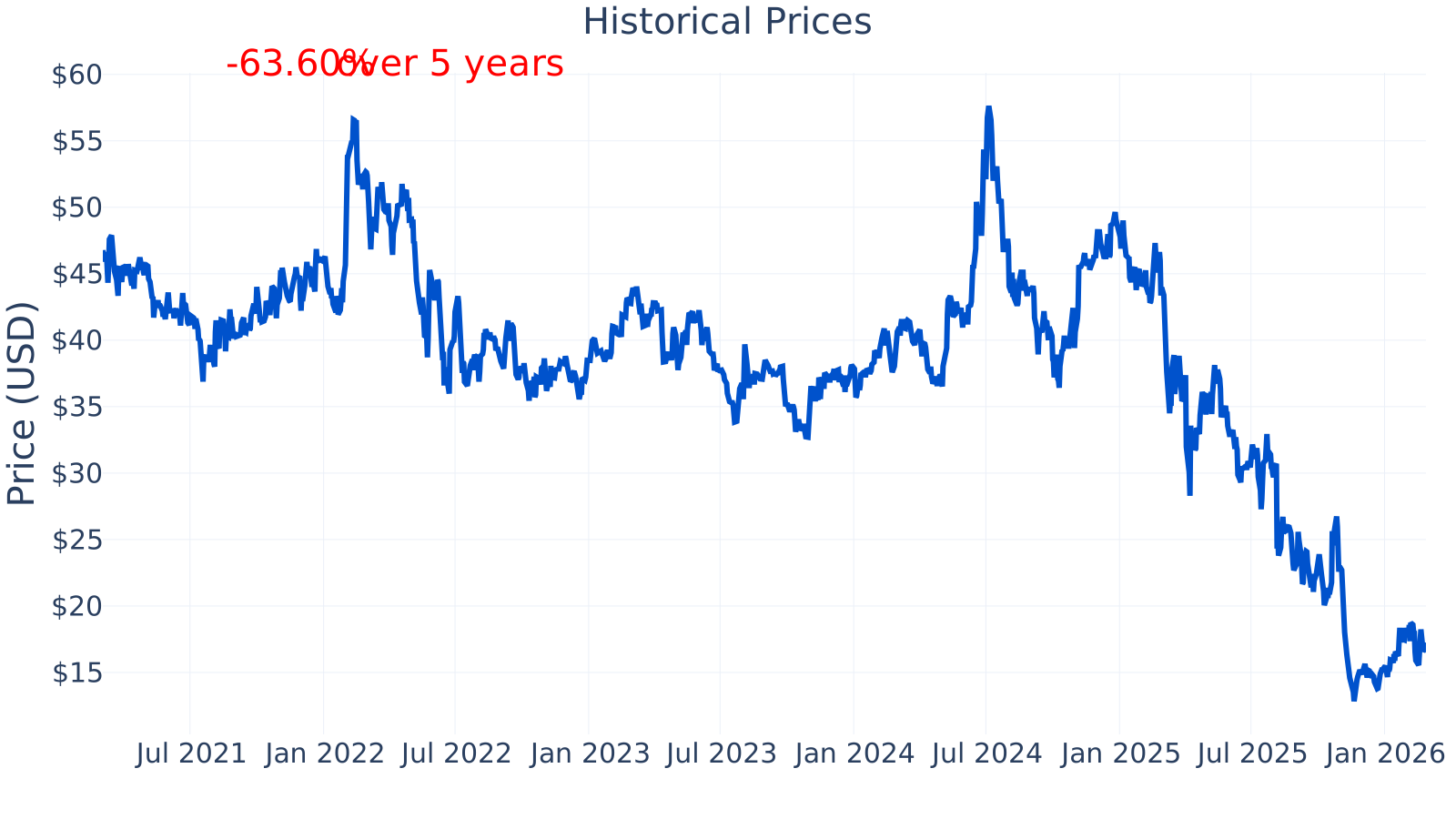
At the latest point shown, Six Flags has a market capitalization of about $1.65B. The stock’s beta of ~0.35 suggests it has historically moved less than the overall market on average (though beta can change over time and does not capture business-specific risk).
Operationally, two figures stand out versus the leisure industry median: profit margin is negative (about -56%) compared with an industry median near +7%, and year-over-year revenue growth is slightly negative (about -2.3%) versus an industry median near +7.3%. The company’s debt-to-equity is about 43%, in line with the industry median shown.
Free cash flow over the trailing twelve months is negative (about -$152M), meaning that after operating cash flows and capital expenditures, more cash went out than came in over that period.
Growth (Medium)
Amusement parks sit within the broader “out-of-home experiences” category. Over long periods, demand is often supported by population growth, tourism flows, and consumers allocating part of their budgets to experiences. At the same time, this is not a “straight-line” growth area: results can fluctuate with weather, the economic cycle, and consumer confidence.
For Six Flags specifically, the most important growth levers typically come from pricing and product mix (admissions pricing, season pass/membership penetration, and premium add-ons), in-park spending per guest (food, beverage, merchandise), and operational execution (staffing, park hours, and guest experience). New rides and refreshed park offerings can help support attendance and pricing power, but they require capital investment and take time to pay back.
The year-over-year revenue growth pattern shown is highly volatile across quarters, with very strong growth readings in parts of 2024 and early-to-mid 2025, followed by a return to slightly negative growth by late 2025. This kind of swing can happen when the comparison period is unusually weak/strong, when pricing/attendance changes quickly, or when the business structure changes (for example, portfolio changes or corporate actions).
Free cash flow improved materially from deeply negative levels in 2021 to positive territory in 2022–2024, but then turned negative again in 2025. For a park operator, free cash flow can be pressured by a combination of higher capital spending (new attractions and maintenance), higher interest costs, and weaker operating results. A sustained return to positive free cash flow is often an important marker of financial flexibility in this industry.
Risks (High)
The biggest risks for regional amusement park operators tend to be straightforward and practical. First, results are seasonal and weather-sensitive. A weak peak season (due to heat, storms, or fewer high-attendance days) can have an outsized impact on the full year. Second, the business is exposed to consumer spending cycles; when households cut discretionary purchases, visits and in-park spending can soften.
Cost structure is another key risk. Parks have meaningful fixed and semi-fixed costs (labor, maintenance, utilities, insurance), and the company may face cost inflation that is difficult to fully offset with ticket pricing in the short run.
Financial risk matters as well because theme parks are capital-intensive and many operators use debt to fund investments. Changes in interest rates and refinancing conditions can influence profitability.
The leverage picture is somewhat difficult to interpret across the full timeline shown because the debt-to-equity series includes periods where the ratio is negative or extremely high, which can occur when shareholders’ equity is very small or negative. At the most recent point, debt-to-equity is about 43%, roughly in line with the industry median displayed, but the earlier volatility signals that the balance-sheet structure has not been stable throughout the period.
Margins show a clear shift: the company posted positive profit margins through much of 2022–2024, then turned negative in late 2024 and deteriorated further in 2025. Compared with the industry median (generally positive across the timeline), the recent underperformance suggests either weaker operating results, higher costs, higher depreciation/interest, or significant non-recurring charges. The detailed drivers typically appear in Management’s Discussion and Analysis (MD&A) in SEC filings.
On competitive positioning, Six Flags is a well-known brand in regional theme parks, but it competes with a wide set of alternatives for leisure spending. Competitors can include:
- Large destination theme park operators (for vacation-based trips)
- Other regional amusement park chains (direct local competition)
- Local entertainment substitutes (water parks, cinemas, concerts, sporting events, and other paid attractions)
Competitive advantages in this industry usually come from brand recognition, park locations near dense populations, season pass ecosystems, and operational scale (purchasing, marketing, and standardized processes). However, the industry is still competitive because guests can switch destinations easily, and new rides/events are often required to keep offerings fresh.
Valuation
A common starting point for valuation is the price-to-earnings (P/E) ratio, but it is only meaningful when earnings are positive and reasonably stable. In the history shown, Six Flags’ P/E appears for some periods (generally in the single digits to teens in parts of 2022–2024) and is not meaningful (shown as 0) in multiple periods, which typically happens when earnings are negative or otherwise unsuitable for a standard P/E comparison.
When a company has recent net losses and negative free cash flow, valuation discussions often shift toward questions such as: whether cash generation can normalize, whether margins can recover, and how much balance-sheet flexibility exists while management funds capital investment. Relative comparisons to the industry median P/E (around the high‑teens to high‑20s in many periods shown) can be less informative if the company’s earnings profile is unstable.
In that context, whether the current stock price is “expensive” or “cheap” cannot be determined from P/E alone here; it depends heavily on the credibility and timing of a return to durable profitability and positive free cash flow, plus the expected capital needs of the parks.
Conclusion
Six Flags is a consumer leisure business built around regional amusement parks, where financial results depend on attendance, guest spending, and operating discipline in a seasonal and competitive environment. The company’s recent picture combines substantial revenue scale with sharp profitability deterioration and negative recent free cash flow, which raises the importance of execution and financial resilience.
From a long-term, fundamentals-focused perspective, the most decision-relevant items to monitor over time are: (1) whether profit margins stabilize and return to positive territory, (2) whether free cash flow turns consistently positive after capital spending needs, and (3) whether the balance sheet remains flexible enough to handle down seasons and refinancing cycles.
Sources:
- SEC EDGAR — Company filings (Form 10‑K, Form 10‑Q, Form 8‑K) for Six Flags Entertainment Corporation
- Six Flags Entertainment Corporation — Investor Relations materials and SEC filing documents (company-hosted)
- Wikipedia — “Six Flags” (basic company background and history)
This article is for informational purposes only and does not constitute financial advice. Some content is AI-generated. See Disclaimer


