Stock Analysis · Sirius XM Holding Inc (SIRI)
Overview
Sirius XM Holding Inc is an audio entertainment company best known for its subscription-based satellite radio service in the United States. Its content includes music, sports, news, talk, and comedy channels, and it is distributed primarily through vehicles (factory-installed radios and aftermarket devices) as well as through streaming apps and connected devices. The business model is centered on recurring subscriptions, supported by advertising and partnerships that help bring new listeners into the service.
In simple terms, Sirius XM aims to be a “paid audio” option that complements free radio and on-demand streaming. The company’s long history of relationships with automakers is an important part of how it reaches customers, since many new vehicles include Sirius XM capability and trial subscriptions that can convert into paying subscribers.
Main revenue sources are typically concentrated in subscriptions, with additional contributions from advertising and other services. In company reporting, revenue is commonly discussed in categories such as subscriber revenue, advertising revenue, and other revenue (for example, certain fees and ancillary services). Exact percentages can change by year and depend on how the company breaks out line items in its filings.
Across the years shown, total revenue stays in a relatively narrow range (roughly the high-$8B area), while profitability and operating results vary more. One notable feature is the sharp deterioration in operating income and net income in 2024, followed by a return to positive operating income and net income in 2025. Interest expense remains a meaningful recurring cost each year, reflecting the importance of debt financing in the company’s capital structure.
Key Figures
| Metric | Value | Industry ⓘ |
|---|---|---|
| Date | Feb 07, 2026 | |
| Context | ||
| Sector | Communication Services | |
| Industry | Entertainment | |
| Market Cap ⓘ | $7.30B | |
| Beta ⓘ | 0.95 | |
| Fundamental | ||
| P/E Ratio ⓘ | 5.54 | 50.96 |
| Profit Margin ⓘ | 9.41% | 4.93% |
| Revenue Growth ⓘ | 0.20% | 5.20% |
| Debt to Equity ⓘ | 83.94% | 80.15% |
| PEG ⓘ | 0.66 | |
| Free Cash Flow ⓘ | $1.25B | |
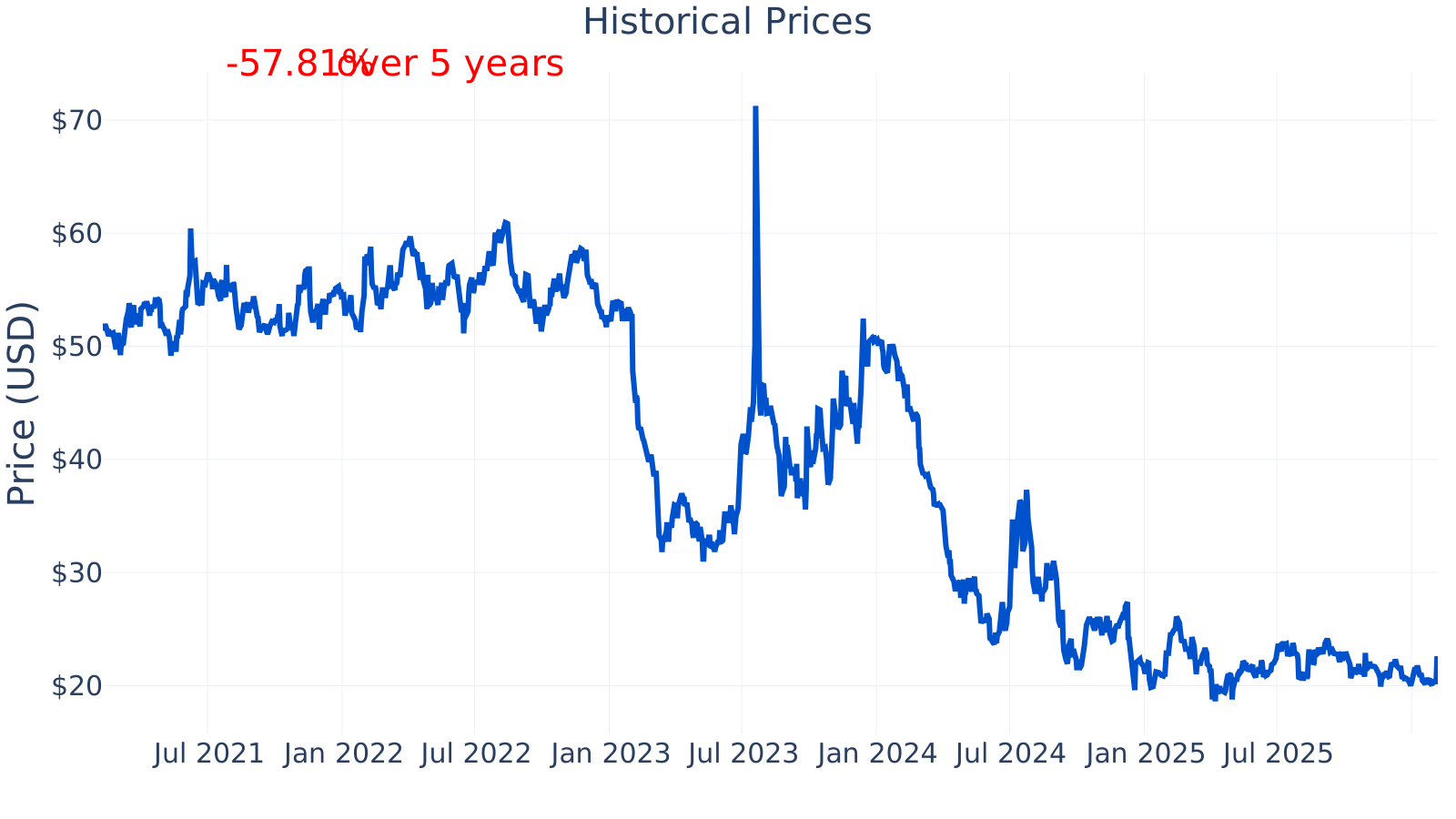
Sirius XM’s market capitalization is about $7.3B, placing it in the mid-cap range. The stock’s beta of about 0.95 suggests it has historically moved somewhat similarly to the broader market, though company-specific events can still drive significant swings.
On profitability, the latest profit margin shown is about 9.4%, above the industry median of about 4.9%. However, the time series shows profitability has not been stable in recent periods. Revenue growth (year over year) is roughly 0.2%, well below the industry median of about 5.2%, highlighting that the company has recently been closer to a “mature/low-growth” profile than a high-growth entertainment business.
Debt-to-equity is about 83.9%, slightly above the industry median (about 80.1%), indicating meaningful leverage. Free cash flow over the trailing twelve months is about $1.245B, which is an important metric for a subscription business, especially given the company’s interest expense and other fixed obligations.
Growth (Low)
The revenue growth pattern shown is modest overall, with multiple quarters around flat to slightly negative growth from 2023 through much of 2025, and only a small positive reading at the end of 2025. This points to a business that appears more focused on retaining customers and managing pricing, costs, and churn than on expanding revenue rapidly.
From an industry perspective, audio entertainment continues to evolve toward streaming and on-demand listening. Sirius XM participates in this shift through streaming options, but it also relies on its satellite distribution and its strong presence in cars. Long-term growth depends on how effectively it can maintain the value proposition of paid audio (exclusive content, convenience in vehicles, and bundled offerings) in a world where many alternatives are free or included in broader subscriptions.
Free cash flow remains substantial but has trended down over the period shown (from about $1.53B in 2021 to about $0.91B in 2025 on a trailing basis at the March data points). For a mature subscription business, free cash flow can be a key support for ongoing operations, debt service, and capital allocation choices, but a sustained decline may reduce flexibility over time.
Potential catalysts for future improvement are typically tied to operational execution (reducing subscriber churn, improving conversion from trials, pricing and packaging changes, and disciplined cost management) and to how the company adapts its product for connected vehicles and newer in-car infotainment systems. The company’s filings also commonly discuss strategic initiatives around content, distribution partnerships, and technology improvements as levers to protect and potentially expand its subscriber base.
Risks (Medium)
Leverage is a central risk factor. The latest debt-to-equity reading is about 83.9%, and interest expense is consistently significant in the company’s income flow. Higher interest costs, refinancing needs, or weaker cash generation can matter more for a leveraged company than for a lightly levered one. The historical pattern (including periods with unusual negative values tied to equity levels) also suggests that balance-sheet dynamics have not always been straightforward, so investors typically rely on the latest filings to understand current capitalization and covenants.
Profitability has been volatile. While the latest margin is positive (about 9.4%), the chart shows a deep dip into negative territory across several quarters in 2024 and 2025 before returning to positive. This kind of swing can be driven by non-cash charges, restructuring, impairments, or other one-time factors, but the practical takeaway is that reported earnings can vary significantly from period to period even when revenue is comparatively steady.
Competition is another core risk. Consumers have many audio choices, including free terrestrial radio, ad-supported music streaming, paid on-demand music services, and podcasts available across many platforms. In vehicles specifically, modern infotainment systems make switching between audio apps easy, which can reduce the uniqueness of any single provider over time.
On competitive advantages, Sirius XM’s strengths have historically included nationwide satellite coverage, a long-standing position in the U.S. vehicle ecosystem (including trials in many new vehicles), and curated/exclusive programming that differentiates it from purely algorithmic music services. At the same time, it is not the dominant player across all audio listening—especially for on-demand streaming—so its leadership is more concentrated in paid satellite radio and certain in-car subscription use cases rather than across the entire audio market.
Other practical risks include: dependence on automaker relationships and the health of the auto market (which can influence new-car trials), subscriber churn, content costs (including talent and sports rights), and the ongoing need to keep the product compelling as consumer expectations shift toward personalization and seamless app-based experiences.
Valuation
The latest P/E ratio shown is about 5.5, far below the industry median of about 51.0. Historically, the company’s P/E has moved significantly over time, and the chart indicates that in several recent periods the P/E is not displayed (set to zero in the series when it becomes non-meaningful, such as during losses or extreme values). This matters because the P/E ratio is easiest to interpret when earnings are positive and relatively stable.
In context, a low P/E can reflect multiple realities: a market expectation of limited growth, higher business risk, balance-sheet leverage, or recent earnings volatility. For Sirius XM specifically, the combination of very low recent revenue growth, meaningful debt, and fluctuating profitability can help explain why valuation multiples may look low versus the broader entertainment industry median, where many companies are valued more like growth businesses.
Because reported earnings have shown periods of losses, valuation often benefits from being viewed alongside cash generation and debt obligations, not only earnings-based multiples. Free cash flow and the cost of servicing debt can be particularly important for understanding how much flexibility the business has over time.
Conclusion
Sirius XM appears to fit the profile of a mature subscription audio business with relatively steady revenue at the multi-year level, meaningful but variable profitability, and substantial free cash flow generation. Recent years show limited top-line growth and periods of pronounced earnings volatility, alongside a capital structure where debt and interest expense are important ongoing considerations.
From a long-term, fundamentals-focused perspective, the key points to weigh are the company’s ability to keep its in-car subscriber funnel working (trials converting to paid users), manage churn in a highly competitive audio landscape, and sustain cash generation while maintaining a manageable leverage profile. The valuation metrics shown (including a low current P/E versus the industry median) align with a market view that emphasizes these tradeoffs: stable-ish revenue and cash flow potential on one side, and growth constraints, competition, and leverage-related risk on the other.
Sources:
- SEC EDGAR — Sirius XM Holding Inc filings (Form 10-K, Form 10-Q)
- Sirius XM Investor Relations — Annual Report materials and shareholder information
- Wikipedia — “Sirius XM” (basic company background)
This article is for informational purposes only and does not constitute financial advice. Some content is AI-generated. See Disclaimer


