Stock Analysis · Sitime Corporation (SITM)
Overview
SiTime Corporation designs and sells precision timing solutions—small semiconductor devices that keep electronic systems synchronized. In simple terms, these products help devices “keep accurate time” so they can communicate reliably and operate smoothly. SiTime’s offerings are commonly described as silicon-based timing products (such as oscillators and clock solutions) that are used across many end markets, including industrial equipment, communications and networking hardware, automotive systems, consumer devices, and data center infrastructure.
The company is “fabless,” meaning it typically designs its products and relies on specialized manufacturing partners to produce the chips. This model can allow a company to focus resources on engineering and product development while using external foundries and packaging/test partners for production.
In its SEC filings, SiTime generally presents revenue as coming from a single operating segment (timing solutions). Specific revenue splits by product family or end market can vary by year and are not always disclosed as fixed percentages in a simple breakdown.
Main sources of revenue (from largest to lowest, based on how the business is described in filings):
- Product revenue from timing devices (the core business; typically the overwhelming majority of revenue)
- Other/ancillary revenue (generally not a major driver and often not separately material)
Across the years shown, revenue and gross profit move up and down with demand cycles, while operating expenses (especially R&D and selling/general/administrative) remain relatively high. This mix helps explain why the company can show strong revenue rebounds yet still report net losses when expenses outpace gross profit.
Key Figures
| Metric | Value | Industry ⓘ |
|---|---|---|
| Date | Feb 07, 2026 | |
| Context | ||
| Sector | Technology | |
| Industry | Semiconductors | |
| Market Cap ⓘ | $11.01B | |
| Beta ⓘ | 2.54 | |
| Fundamental | ||
| P/E Ratio ⓘ | N/A | 45.89 |
| Profit Margin ⓘ | -13.13% | 9.42% |
| Revenue Growth ⓘ | 66.30% | 13.10% |
| Debt to Equity ⓘ | 0.40% | 25.62% |
| PEG ⓘ | 3.38 | |
| Free Cash Flow ⓘ | $19.60M | |
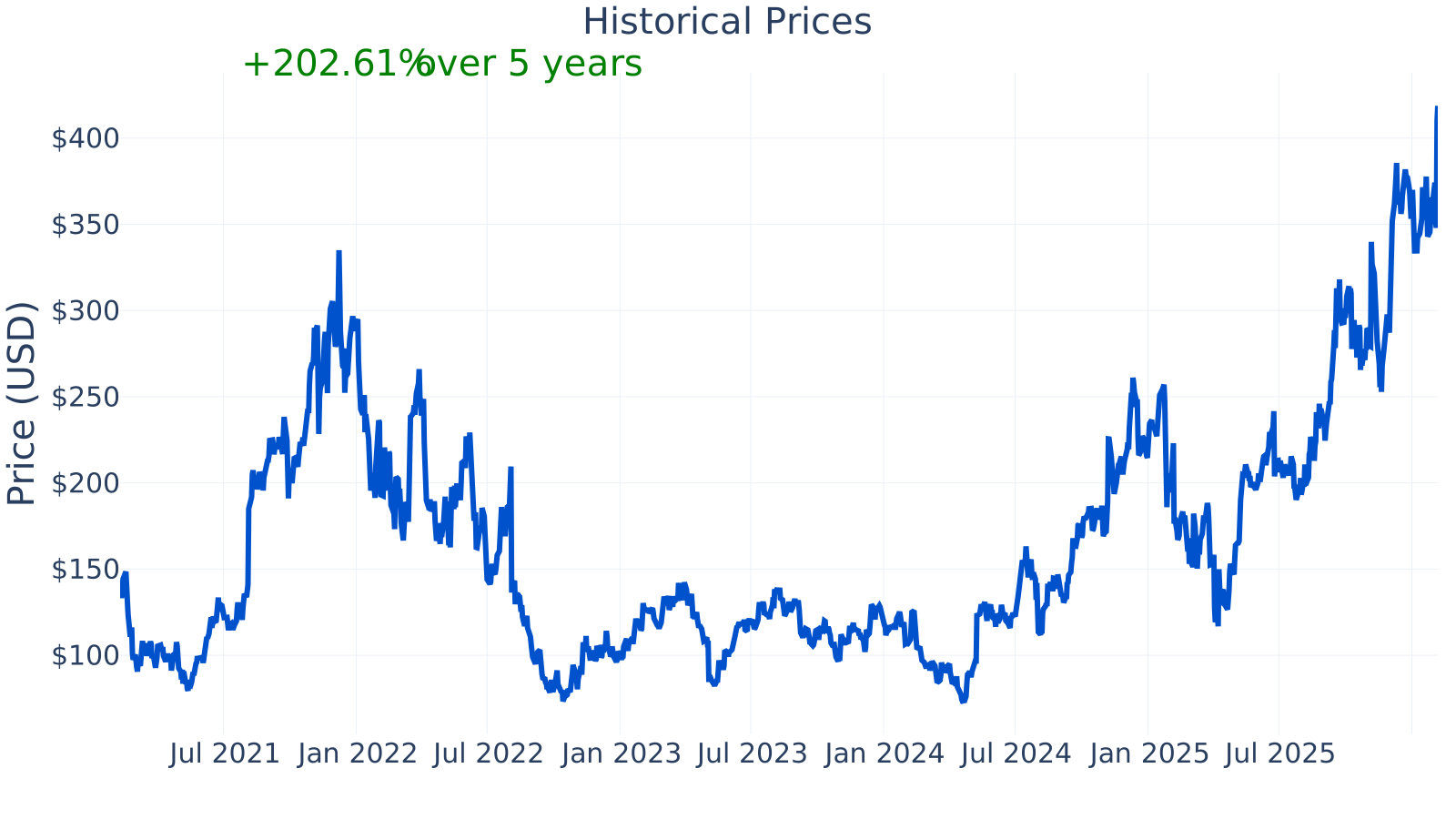
SiTime’s market capitalization is about $11.0B. The stock has historically shown large swings (its beta is ~2.54, which indicates higher volatility than the overall market).
On the profitability side, the company’s latest profit margin is about -13.1%, below the semiconductor industry median shown (~9.4%). Despite that, recent year-over-year revenue growth is about 66.3%, which is higher than the industry median shown (~13.1%).
Capital structure is conservative: debt-to-equity is ~0.4%, far below the industry median shown (~25.6%). Free cash flow over the trailing twelve months is positive at about $19.6M, but this figure has been volatile in recent years.
Growth (Medium)
SiTime participates in the broader semiconductor industry, where demand is influenced by long product cycles, inventory corrections, and end-market shifts. Within semiconductors, precision timing components tend to benefit from long-term trends such as increased connectivity, higher data throughput, more sensors in vehicles and industrial systems, and the continued build-out of network and computing infrastructure. These trends can increase the number of timing devices per system and raise performance requirements, which can support a role for specialized timing suppliers.
Strategically, SiTime emphasizes engineering-intensive product development, which is visible in the company’s operating cost structure: research and development spending is a major component of expenses in the financial statements. For a timing-solution supplier, the logic is straightforward—winning designs in customers’ products can translate into multi-year revenue streams, but it often requires sustained investment to keep pace with performance needs and qualification requirements.
The revenue growth pattern is cyclical: very strong growth in 2021–2022, followed by a sharp contraction through 2023, then a rebound into 2024–2025, including a recent reading around +66% year-over-year. This kind of “downcycle then recovery” is common in semiconductors, but it also means growth can look extremely strong coming off a low base.
Free cash flow has not followed a straight line. It was positive in 2021 and 2022, turned negative during 2023–2025 (as shown), and most recently is positive on a trailing basis in the metrics table. For long-term business durability, sustained positive free cash flow typically matters because it can help fund R&D and operations without relying on external financing; however, the history here suggests cash generation can be uneven through cycles.
Risks (High)
Semiconductor demand cycles are a major risk. When customers reduce orders due to inventory corrections or softer end-market demand, revenue can fall quickly. SiTime’s historical pattern—rapid growth, then steep declines, then recovery—illustrates how exposed the business can be to these cycles.
Profitability is another key risk. The profit margin trend shows a move from positive levels in 2021–2022 to deeply negative levels through 2023–2024, with improvement more recently but still negative (about -13% at the latest reading). This indicates the business has recently operated in a mode where operating costs exceed gross profit, which can persist if revenue does not scale fast enough or if spending remains elevated.
The margin chart highlights that the company has been below the industry median for an extended period. Even with improving revenue, reaching consistently positive margins may depend on a mix of stronger volume, product mix, pricing discipline, and managing operating expenses.
On financial leverage, SiTime appears conservatively financed. Low debt can reduce the risk of forced refinancing during downturns, but it does not remove operational risk (such as revenue volatility or margin pressure).
Debt-to-equity is extremely low (around 0.4% most recently) and well below the industry median shown. This suggests the balance sheet is not heavily dependent on borrowing, which can provide flexibility during weaker periods.
Competition is a structural risk. Precision timing is an established category with well-capitalized rivals. Competitors include large analog and mixed-signal semiconductor suppliers that offer timing products alongside broader portfolios, as well as other specialized timing providers. In practice, this can create pressure through pricing, bundled offerings, or customer preference for suppliers with broader platforms.
SiTime’s potential competitive advantages—based on how timing specialists typically compete and how the company describes its focus in filings—can include deep timing expertise, product performance, and design-win momentum in target end markets. Whether it is a “leader” depends on the specific timing subcategory and customer application; the competitive set varies by performance tier and end market, and large competitors may have scale advantages.
Supply-chain dependence is also relevant. As a fabless company, SiTime relies on external manufacturing and assembly/test partners. Capacity constraints, quality issues, or geopolitical disruptions affecting suppliers can impact product availability, costs, and delivery commitments.
Valuation
Valuation is often challenging for companies with volatile or currently negative earnings. The P/E ratio can become less meaningful when earnings are negative or near zero, and the historical P/E series here includes many periods where it is not shown (set to zero), consistent with times when a standard P/E is not informative.
When the company did have a meaningful P/E reading, it ranged from moderately high to extremely high (for example, values above 100 at points), while the semiconductor industry median shown in the same periods was much lower (often in the ~15–45 range). Separately, the metrics table includes a PEG ratio of ~3.38, which is commonly interpreted as indicating that the valuation may be high relative to expected growth assumptions, though PEG can be sensitive to forecasting inputs and earnings normalization.
Given the mix of (1) strong recent revenue growth, (2) still-negative profit margins, and (3) a history of earnings variability through cycles, the current market price effectively reflects expectations that profitability improves as revenue scales and that the company sustains a differentiated position in timing solutions. How justified that pricing is depends heavily on whether margins normalize and whether growth persists beyond the rebound phase of the cycle.
Conclusion
SiTime is a specialized semiconductor company focused on precision timing devices used across a range of electronic systems. The business operates in an industry with meaningful long-term technology tailwinds, but also pronounced cyclical behavior. Recent results show a strong revenue rebound, while profitability remains below the industry median and has been negative in recent periods.
From a financial structure perspective, the company carries very low debt relative to equity, which can help resilience. The main areas to monitor over time are whether revenue growth translates into consistently positive margins and steadier free cash flow, and how the company maintains differentiation against larger semiconductor competitors that also sell timing products.
Sources:
- SEC EDGAR — SiTime Corporation Form 10-K (Annual Report)
- SEC EDGAR — SiTime Corporation Form 10-Q (Quarterly Reports)
- SiTime Corporation Investor Relations — Press releases and shareholder materials
- Wikipedia — “SiTime” (basic company background)
This article is for informational purposes only and does not constitute financial advice. Some content is AI-generated. See Disclaimer