Stock Analysis · Sinclair Broadcast Group Inc (SBGI)
Overview
Sinclair Broadcast Group Inc. is a U.S. media company best known for owning and operating local television stations. Through these stations, Sinclair delivers local news and syndicated programming to audiences in many U.S. markets, and it sells advertising time to businesses that want to reach those viewers. Beyond the traditional TV business, the company also has operations tied to sports and other content distribution, reflecting a broader effort to generate revenue from both viewers and distribution partners.
From the company’s filings, Sinclair generally describes revenue as coming mainly from a mix of advertising and fees paid by cable/satellite/virtual TV providers to carry its local stations (often called distribution or retransmission-related revenue). In addition, it can generate revenue from content-related activities (for example, sports and other programming offerings) and other smaller lines of business. Exact percentages can shift year to year due to political advertising cycles, changes in distribution contracts, and the performance of its other businesses.
Looking across recent years, total revenue declined from about $6.1B (2021) to about $3.9B (2022) and $3.1B (2023), before rising to about $3.5B (2024). Profitability has also swung significantly: net income was negative in 2021 and 2023, very high in 2022, and positive in 2024. These sharp moves suggest results can be heavily influenced by non-recurring items (such as gains/losses, tax items, or large one-time charges), along with the inherently cyclical nature of advertising.
Key Figures
| Metric | Value | Industry ⓘ |
|---|---|---|
| Date | Feb 08, 2026 | |
| Context | ||
| Sector | Communication Services | |
| Industry | Broadcasting | |
| Market Cap ⓘ | $953.97M | |
| Beta ⓘ | 0.95 | |
| Fundamental | ||
| P/E Ratio ⓘ | N/A | |
| Profit Margin ⓘ | -1.35% | |
| Revenue Growth ⓘ | -15.70% | |
| Debt to Equity ⓘ | 1222.80% | |
| PEG ⓘ | 0.89 | |
| Free Cash Flow ⓘ | $211.00M | |
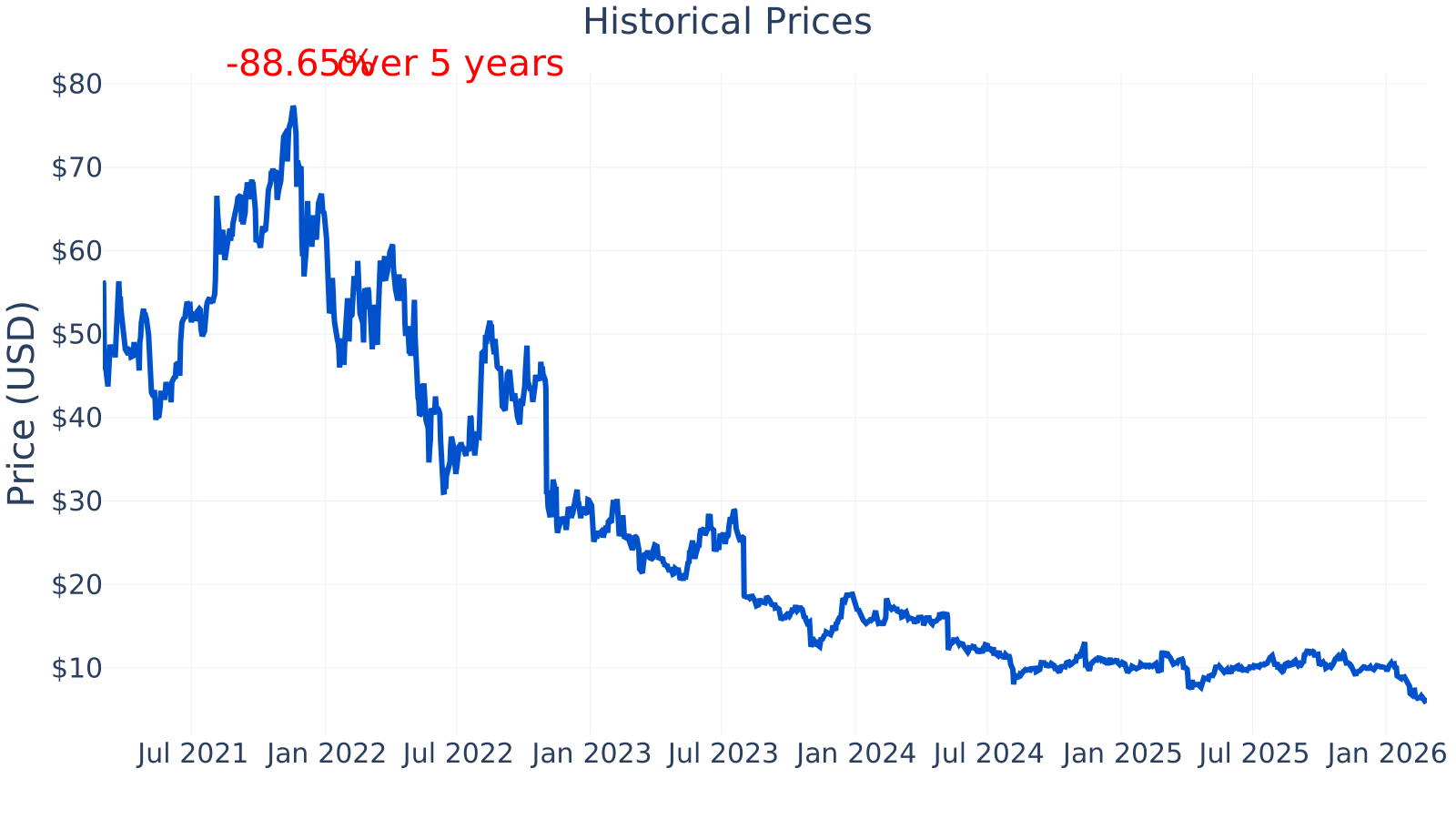
Sinclair’s market capitalization is about $954M, placing it in the smaller end of publicly traded media companies. The beta of 0.95 suggests the stock has historically moved roughly in line with the broader market (though individual periods can still be volatile).
Recent profitability and growth metrics indicate pressure: profit margin is about -1.35% (slightly negative), and year-over-year revenue growth is about -15.70% in the most recent period shown. At the same time, trailing twelve-month free cash flow is about $211M, which indicates the company has recently generated meaningful cash after operating and capital spending—an important factor for a business with significant debt obligations.
One metric stands out as especially important for context: debt-to-equity is about 1,223%, which is very high. In simple terms, this indicates a heavily leveraged balance sheet and suggests that changes in interest rates, refinancing conditions, and operating performance can have an outsized impact on equity holders.
Growth (Low)
Local broadcast television is a mature industry. It can still produce sizable cash flows, but long-term growth is challenged by ongoing shifts in how audiences consume video (more streaming and on-demand viewing) and how advertisers allocate budgets across platforms. That said, local stations can retain relevance because they deliver local news, weather, and community coverage that is harder to replicate nationally, and because live events (including sports) tend to remain valuable for advertisers.
The year-over-year revenue pattern shown is uneven, with deep declines through 2022–2023, a rebound during parts of 2024, and a return to declines in 2025 (down to about -15.70% in the most recent point shown). This profile highlights that Sinclair’s top line can be cyclical and sensitive to the advertising environment, distribution arrangements, and the mix of one-time items.
Free cash flow has also dropped sharply from 2021 levels (about $1.25B) to much lower recent levels (down to about $28M as of 2025-03-31), before the latest table shows $211M on a trailing basis. For long-term business momentum, a key question is whether free cash flow can be sustained at levels that comfortably cover interest costs and any required debt repayment, while still funding necessary investment in content, technology, and station operations.
Potential catalysts in this business model tend to be cyclical rather than purely structural—such as political advertising cycles and renegotiations of distribution-related fees. While these can lift results in certain periods, they do not necessarily change the long-run industry direction.
Risks (Very High)
This article is for informational purposes only and does not constitute financial advice. Some content is AI-generated. See Disclaimer