Stock Analysis · Silicon Motion Technology (SIMO)
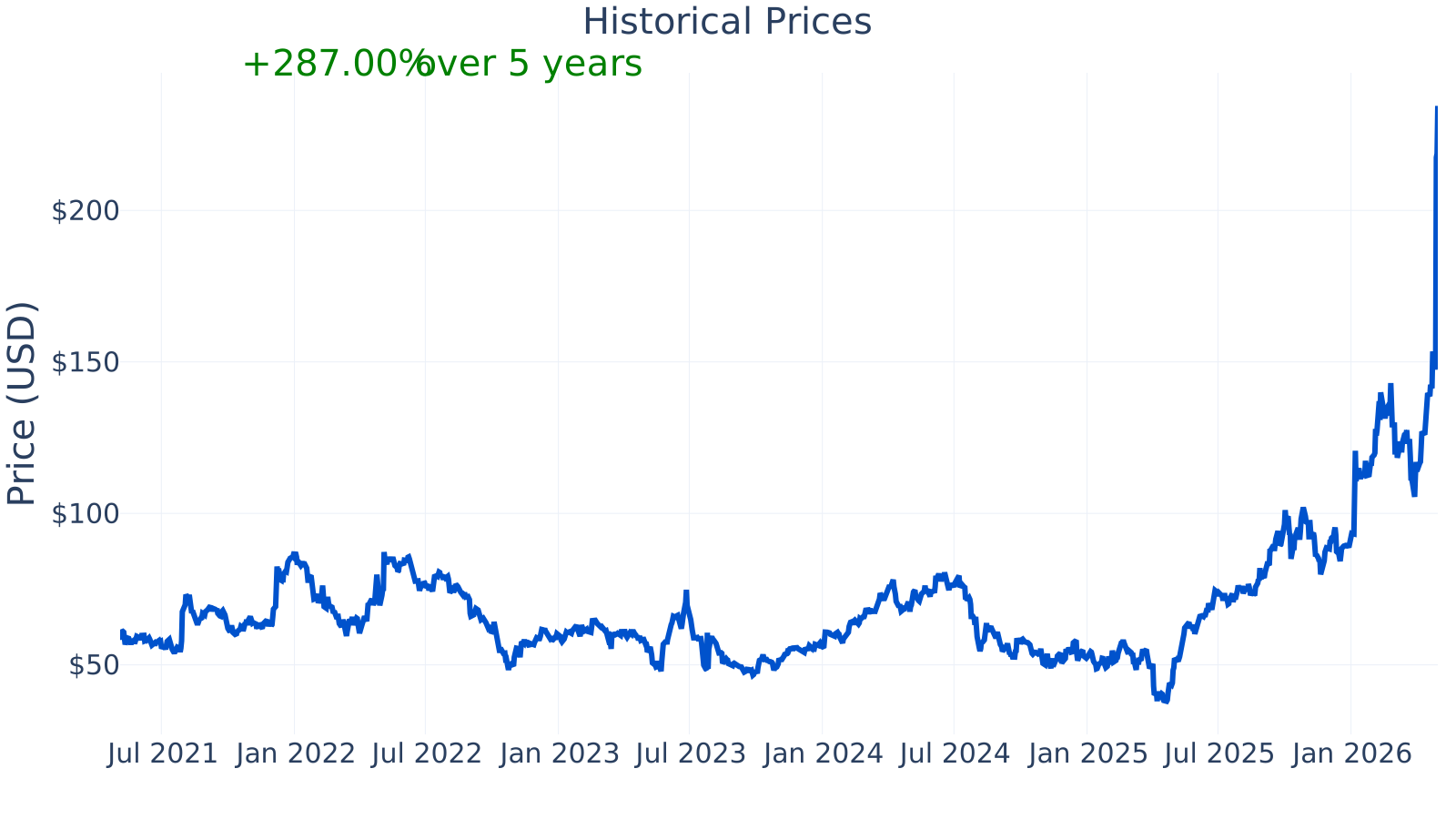
Overview
Silicon Motion Technology is a semiconductor company that designs specialized chips (controllers) used inside storage devices. In simple terms, its products help “manage” how data is written, read, protected, and moved in devices that use NAND flash memory. These controllers are commonly found in SSDs (solid-state drives), embedded storage inside phones and other electronics, and removable storage like memory cards and USB flash drives.
The company’s revenue is mainly tied to global demand for flash storage and to customer ordering patterns, which can be cyclical. Silicon Motion is a “fabless” semiconductor company, meaning it designs chips but typically relies on external manufacturing partners to produce them. This model often makes research and development (R&D) a central operating cost, since differentiation comes from design quality, compatibility, and performance rather than owning factories.
Main revenue streams (exact percentages can vary by year and are typically detailed in the company’s annual report/10-K):
- Client storage controllers (controllers for SSDs used in PCs and other client devices)
- Embedded storage controllers (controllers for embedded storage inside devices)
- Mobile/removable storage solutions (controllers for memory cards, USB flash drives, and related products)
The overview of how revenue turns into profit (and where major costs sit) is illustrated below.
Over the 2021–2025 period shown, total revenue moved through a down-cycle (notably in 2023) and later recovered, while R&D remained a large, consistent investment line item—highlighting how product development is a core part of the business model.
Key Figures
| Metric | Value | Industry ⓘ |
|---|---|---|
| Date | May 04, 2026 | |
| Context | ||
| Sector | Technology | |
| Industry | Semiconductors | |
| Market Cap ⓘ | $7.97B | |
| Beta ⓘ | 1.08 | |
| Fundamental | ||
| P/E Ratio ⓘ | 52.35 | 53.51 |
| Profit Margin ⓘ | N/A | 6.16% |
| Revenue Growth ⓘ | 45.70% | 19.70% |
| Debt to Equity ⓘ | N/A | 20.71% |
| PEG ⓘ | 0.70 | |
| Free Cash Flow ⓘ | -$81.68M | |
Silicon Motion’s market capitalization is about $8.0B, and the stock’s beta of ~1.08 suggests price moves broadly in line with the overall market. The latest P/E ratio is ~52.3, close to the industry median (~53.5), while the PEG ratio (~0.70) indicates the valuation may look lower when set against expected growth assumptions (PEG depends heavily on forecasts and can shift quickly). Recent year-over-year revenue growth is ~45.7% versus an industry median near 19.7%, but free cash flow (TTM) is about -$81.7M, showing that cash generation has recently been under pressure despite the revenue rebound.
Growth (Medium)
Silicon Motion operates in the broader semiconductor and storage ecosystem, where long-term demand is supported by persistent growth in data creation and storage needs across PCs, mobile devices, consumer electronics, and data-centric computing. However, the company’s end-markets are also known for pronounced cycles: customers may over-order during strong demand periods and later reduce orders while working through inventory.
From a strategy standpoint, the company’s focus on storage controllers aligns with continued transitions in storage technology (for example, ongoing SSD adoption and periodic upgrades in performance and capacity). A key “real-world” growth driver is that storage devices regularly need new controller generations to support new flash memory characteristics and higher performance requirements. That dynamic can create recurring product refresh opportunities when the storage market is healthy.
The revenue growth pattern shows a sharp swing: strong growth in 2021, a significant contraction through much of 2023, and then a return to positive growth in 2024–2026, including a recent year-over-year increase around 67.3% (latest quarter shown). This type of volatility is common in semiconductor-adjacent businesses exposed to inventory cycles.
Free cash flow over time shifted from positive levels (roughly $122M in 2022, then $97M–$103M range in 2023–2024, and about $74M in 2025) to negative (~-$81.7M) in the most recent period shown. For long-term business resilience, sustained positive free cash flow matters because it supports R&D investment and provides flexibility during downturns. A period of negative free cash flow can happen during working-capital swings (like inventory and receivables changes) or heavier investment cycles, but it is still a key item to monitor over multiple quarters.
Risks (High)
The largest risk is cyclicality. Demand for flash storage components can rise and fall quickly, and customer inventory corrections can cause abrupt revenue declines. This can pressure profitability even if the company’s long-term markets grow. Another important risk is customer and supply-chain concentration: in semiconductors, a limited number of large customers (or manufacturing partners) can have outsized influence on pricing, volumes, and delivery timing.
Competition is a meaningful factor. Storage controllers are a specialized niche, but it is still contested by other semiconductor vendors, and some large storage device makers also develop internal solutions. Competitive advantages in this space tend to come from engineering execution, firmware/software maturity, quality and reliability records, power efficiency, and the ability to support new flash memory generations quickly. Leadership can be product-specific (strong in certain controller categories) rather than absolute across all storage segments, so comparing positioning depends on the exact product line and customer base described in company filings.
Leverage appears very low: debt-to-equity is around 0.3%–0.5% across the periods shown, versus an industry median closer to roughly 21%–33% depending on the date. Low leverage can reduce financial risk during down-cycles, although it does not remove demand and pricing risks.
Profitability has been volatile but recently improved. Net profit margin fell from above 20% in 2021–2022 to high-single digits around late 2023, then climbed back to about 15.1% in the latest period shown. In the more recent quarters displayed, the company’s margin is also above the industry median (~7.2% at the latest point shown). Margin strength can improve with higher volumes, better pricing/mix, or cost control—but it can also compress quickly if the cycle turns.
Valuation
Valuation is often discussed using multiples such as the price-to-earnings (P/E) ratio, which compares the stock price to earnings. For cyclical businesses, P/E ratios can shift dramatically because earnings themselves expand and contract with the cycle.
The P/E ratio shown varies widely over time, from the low teens in 2022 to much higher levels in parts of 2024–2025, and then down again to about 11.5 at the latest point shown (with the industry median around 53.8 at that same date). Interpreting this requires caution: a lower P/E can reflect stronger earnings in the recent period, a cheaper price relative to earnings, or both; a higher P/E can reflect weaker earnings, higher expectations, or both. The latest snapshot in the metrics table shows a P/E around 52.3, which is close to the industry median (~53.5), indicating that the market is pricing the company in line with peers on that specific measure at that point in time.
In context, the valuation discussion for Silicon Motion generally comes down to whether earnings and cash flow are expected to be durable across a full cycle. Periods of strong year-over-year revenue growth and recovering margins can support higher valuation levels, while negative free cash flow and the historical pattern of sharp revenue swings can justify more conservative assumptions.
Conclusion
Silicon Motion is a specialized semiconductor designer focused on controllers that enable flash-based storage products. The business participates in long-term growth tied to expanding data storage needs, while also experiencing pronounced semiconductor-style cycles that can cause significant revenue and profit variability.
The company shows several stabilizing traits—most notably very low leverage and a demonstrated ability to generate healthy profit margins in stronger parts of the cycle. At the same time, recent negative free cash flow and the history of sharp revenue swings highlight that results can change meaningfully from year to year.
From a long-term perspective, the most decision-relevant facts to track over time are consistency of cash generation, the durability of margins through weaker demand periods, and evidence in filings that product execution and customer relationships remain strong despite intense competition and periodic inventory corrections.
Sources:
- SEC EDGAR — Silicon Motion Technology Corp. Forms 10-K and 10-Q
- Silicon Motion Technology — Investor Relations (company press releases and financial reports)
- Wikipedia — “Silicon Motion” (basic company background)
This article is for informational purposes only and does not constitute financial advice. Some content is AI-generated. See Disclaimer


