Stock Analysis · Shopify Inc (SHOP)
Overview
Shopify Inc. is a technology company that provides tools for businesses to set up, run, and grow an online (and increasingly offline) store. In simple terms, it offers a “build-your-store” platform plus add-ons that help merchants manage products, payments, shipping, marketing, and customer relationships. Shopify’s customers range from small businesses to larger brands, and the company earns money both from subscription plans and from activity that happens on the platform (for example, payment processing).
In its financial reporting, Shopify groups revenue into two main categories, which are broadly:
- Merchant solutions (typically the largest share): revenue tied to merchant activity on Shopify’s platform (for example, payments, and other merchant-related services).
- Subscription solutions: recurring fees for access to Shopify’s platform and certain features.
These categories are described in Shopify’s annual report (Form 10-K), along with additional detail by product/service lines. The overall mix can shift over time depending on how much merchants process and sell using Shopify services versus how much comes from fixed subscription fees.
The long-term picture visible in the company’s financial flow is that total revenue has increased materially from 2021 through 2024, while profitability has been more volatile—showing a significant loss in 2022, followed by a return to positive operating income and net income in subsequent years. This underlines how Shopify’s earnings can swing depending on cost structure and other non-operating factors, even when sales continue to grow.
Key Figures
| Metric | Value | Industry ⓘ |
|---|---|---|
| Date | Feb 13, 2026 | |
| Context | ||
| Sector | Technology | |
| Industry | Software - Application | |
| Market Cap ⓘ | $144.42B | |
| Beta ⓘ | 2.82 | |
| Fundamental | ||
| P/E Ratio ⓘ | 117.72 | 27.28 |
| Profit Margin ⓘ | 10.65% | 7.09% |
| Revenue Growth ⓘ | 30.60% | 15.80% |
| Debt to Equity ⓘ | 1.40% | 25.00% |
| PEG ⓘ | 1.12 | |
| Free Cash Flow ⓘ | $2.01B | |
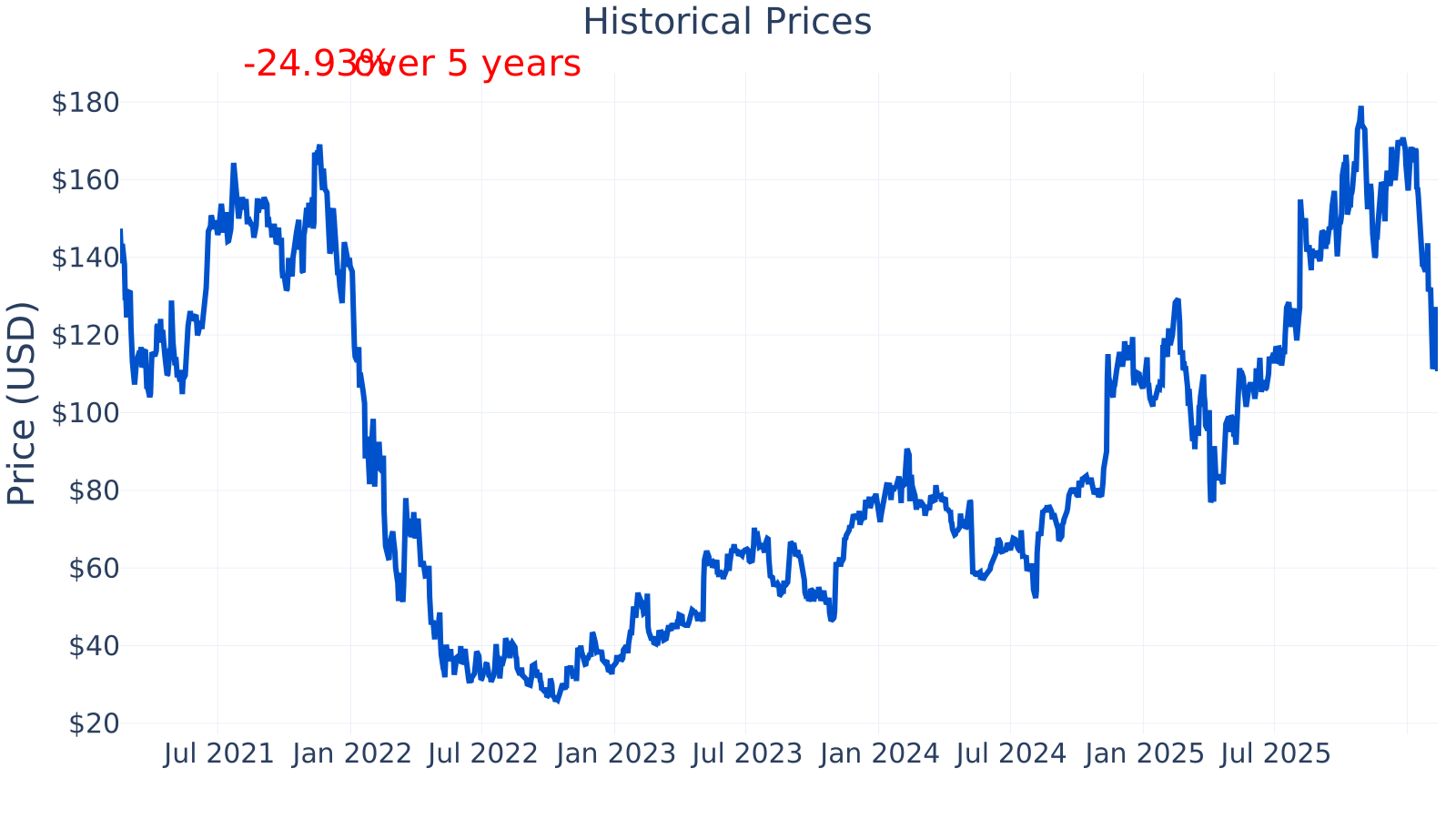
Shopify’s market capitalization is about $144.4B, placing it among the larger publicly traded software-focused companies. The stock’s beta of 2.82 indicates that its price has historically moved much more than the overall market, which helps explain the large swings visible in the price history (notably the sharp decline in 2022 and the strong rebound afterward). On fundamentals, the company shows a profit margin of ~10.65% versus an industry median around 7.10%, and year-over-year revenue growth of ~30.6% versus an industry median near 15.8%. Leverage appears low with debt-to-equity around 1.4% compared with an industry median near 25%. Trailing twelve-month free cash flow is about $2.01B. The P/E ratio is ~117.7 versus an industry median around 27.3, indicating the shares trade at a meaningfully higher earnings multiple than many peers.
Growth (medium)
Shopify operates in the broad e-commerce and digital commerce enablement space, where long-term demand is tied to businesses continuing to sell online, adopt new payment methods, and integrate sales across channels (online store, marketplaces, social, and physical locations). The underlying trend—companies investing in digital storefronts and modern checkout experiences—has been durable over many years, even though consumer spending cycles can create ups and downs.
Strategically, Shopify’s growth logic centers on increasing the number of merchants using its platform and expanding the number of services each merchant uses. This “more merchants + more services per merchant” approach can support growth if Shopify continues to make its tools valuable and easy to adopt, and if it remains competitive in payments and other merchant-facing services.
Recent year-over-year revenue growth has generally stayed in the 20%–30%+ range after the exceptionally high rates seen in 2021. The latest value shown is about 30.6%, which is above the industry median displayed (about 15.8%). This suggests Shopify has recently been growing faster than many companies in its application software peer set, although growth has clearly normalized from the surge levels during the early pandemic period.
Free cash flow (a practical measure of how much cash a business generates after operating costs and capital spending) has increased notably in the period shown—from roughly $98.8M (TTM ending 2023-03-31) to about $1.05B (TTM ending 2024-03-31) and then to about $1.73B (TTM ending 2025-03-31), with the latest TTM figure listed at about $2.01B. For long-term business quality, sustained positive free cash flow can matter because it can help fund product development and provide resilience during weaker demand periods.
Risks (high)
This article is for informational purposes only and does not constitute financial advice. Some content is AI-generated. See Disclaimer