Stock Analysis · ServiceNow Inc (NOW)
Overview
ServiceNow Inc. is a software company that provides a cloud-based platform designed to help organizations run “digital workflows.” In simple terms, it helps large and mid-sized companies organize and automate work that often involves many steps, approvals, and handoffs between teams. ServiceNow started with IT service management (help desks, incident tracking, and change management) and expanded into broader areas such as employee workflows (HR service delivery), customer workflows (case management), and creator tools that let companies build their own internal applications on top of the platform.
The business model is mainly subscription-based software delivered over the internet (Software-as-a-Service). Customers typically sign multi-year agreements, and the platform becomes deeply integrated into day-to-day operations, which can make switching providers difficult once it is widely adopted.
In its financial reporting, ServiceNow primarily groups revenue into subscription revenue (recurring platform access) and professional services & other revenue (implementation, training, and related services). Subscription revenue is the dominant driver of the business, while services tend to be a smaller portion and often support platform adoption rather than act as a standalone profit center.
Main revenue sources (high-level):
- Subscription revenue: recurring fees for access to the platform and its workflow products (largest share of revenue in company filings).
- Professional services & other: implementation and related services (smaller share of revenue in company filings).
From 2021 to 2025, total revenue increased from about $5.9B to about $13.3B, while gross profit also expanded (about $4.5B to $10.3B). Over the same period, the company continued to invest heavily in research and development, rising from roughly $1.4B to $3.0B, reflecting an emphasis on product expansion and platform capabilities.
Key Figures
| Metric | Value | Industry ⓘ |
|---|---|---|
| Date | Feb 07, 2026 | |
| Context | ||
| Sector | Technology | |
| Industry | Software - Application | |
| Market Cap ⓘ | $106.30B | |
| Beta ⓘ | 0.98 | |
| Fundamental | ||
| P/E Ratio ⓘ | 60.32 | 27.79 |
| Profit Margin ⓘ | 13.17% | 6.02% |
| Revenue Growth ⓘ | 20.70% | 15.80% |
| Debt to Equity ⓘ | 24.71% | 25.15% |
| PEG ⓘ | 0.88 | |
| Free Cash Flow ⓘ | $4.58B | |
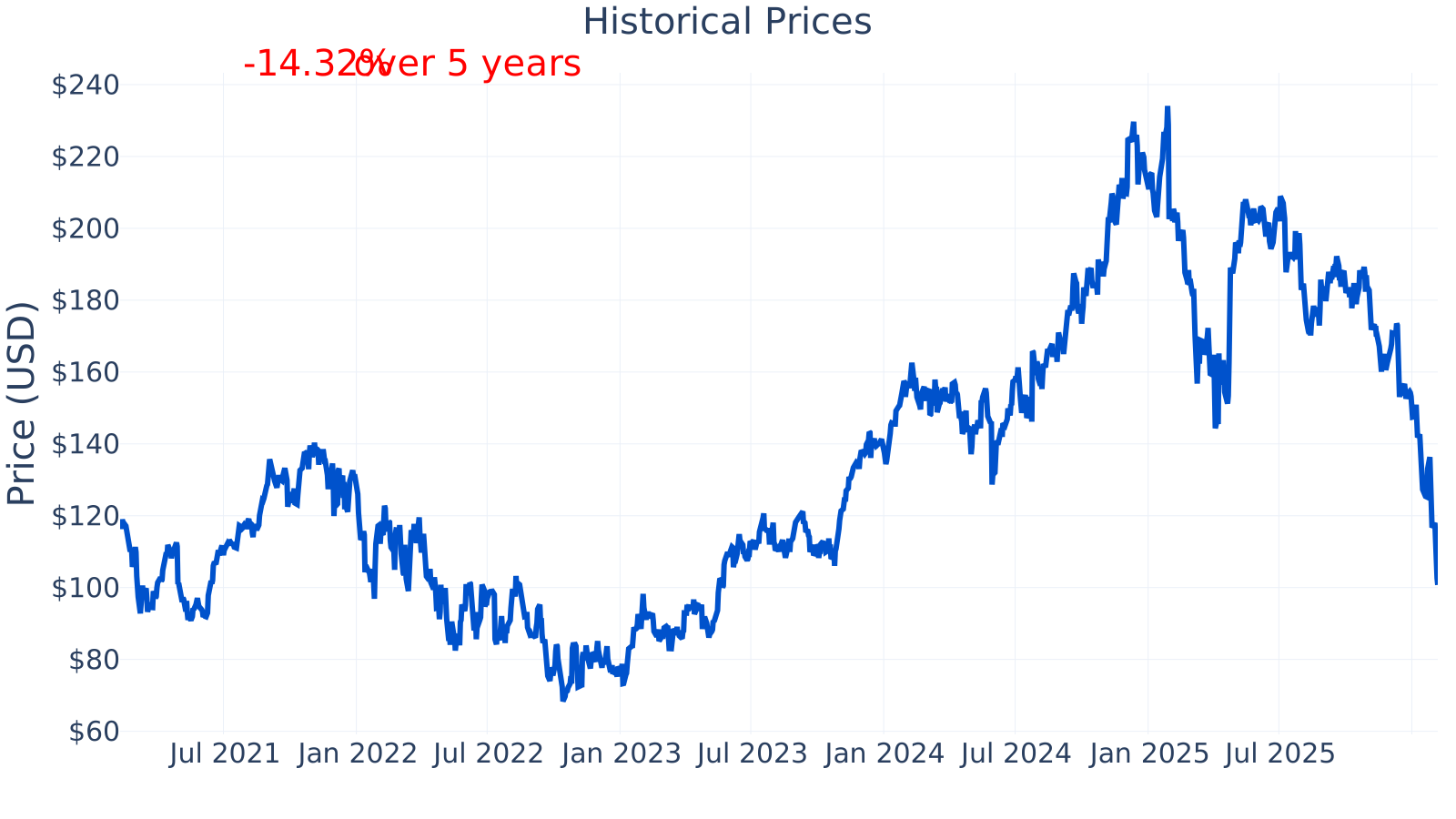
ServiceNow’s market capitalization is about $106.3B, placing it among the larger enterprise software companies. The stock’s beta of ~0.98 suggests its price has historically moved roughly in line with the broader market (though any single stock can still be volatile). Profitability stands out versus the application software peer median: the company’s profit margin is ~13.17% compared with an industry median near 6.03%. Growth is also higher than the peer median, with about 20.7% year-over-year revenue growth versus an industry median around 15.8%. Balance-sheet leverage appears moderate, with debt-to-equity of ~24.71%, broadly in line with the industry median (~25.15%). The company also produced meaningful cash generation, with free cash flow (TTM) of about $4.58B.
Growth (medium)
ServiceNow operates in enterprise software, a segment supported by long-running trends: companies moving more work into cloud applications, replacing manual processes with automated workflows, and improving how internal teams (IT, HR, finance, security, customer operations) coordinate. These trends are structural rather than one-time events, which can support multi-year demand as organizations modernize their operations.
ServiceNow’s strategy focuses on expanding the platform across more departments inside the same customer (often called “land and expand”), while also building additional products that use a common data model and workflow engine. This platform approach can support growth because new use cases can be added without replacing the core system already in place.
Revenue growth has remained strong but has generally cooled from the very high levels seen in 2021. Quarterly year-over-year growth moved from roughly 30%+ in 2021 toward the low- to mid-20% range in 2023–2024, with values around 18%–22% during much of 2025 and ending near 20.66%. This pattern is consistent with a business that is scaling to a larger revenue base, where maintaining 30%+ growth becomes mathematically harder over time.
Cash generation has increased meaningfully over several years. Trailing twelve-month free cash flow rose from about $1.57B (2021) to about $3.67B (2025), and the latest level shown is about $4.58B. For long-term business durability, expanding free cash flow can matter because it provides flexibility to reinvest, manage debt, and withstand slower spending periods.
Potential catalysts described in company materials typically include broader platform adoption across non-IT workflows, continued enterprise standardization on fewer strategic software platforms, and product evolution (including AI-enabled capabilities and developer tools) that can increase the platform’s usefulness and expand spending per customer over time.
Risks (medium)
This article is for informational purposes only and does not constitute financial advice. Some content is AI-generated. See Disclaimer