Stock Analysis · SentinelOne Inc (S)
Overview
SentinelOne Inc is a cybersecurity software company. Its products are designed to help organizations prevent, detect, and respond to malicious activity across computers (endpoints), servers, cloud workloads, and user identities. In simple terms, it sells tools that aim to spot suspicious behavior quickly and help security teams investigate and stop attacks.
The company primarily operates as a subscription software business. Customers generally pay recurring fees to use SentinelOne’s platform, with contracts that can scale based on the number of devices, workloads, or users protected. This recurring model typically makes revenue more predictable than one-time product sales, but it also means results depend heavily on renewals and expansions over time.
In its filings, SentinelOne describes revenue largely in terms of subscription revenue and professional services (such as deployment and support). Percentages by stream can vary by period, so the most reliable breakdown is the company’s own reported categories for the specific fiscal year.
Main revenue sources (typical structure for the company’s reporting):
- Subscription revenue (recurring software access; typically the large majority of total revenue)
- Professional services and other revenue (implementation and support-related services; typically smaller)
Looking at the recent revenue-and-cost structure, revenue has expanded materially over the last several fiscal years (reaching about $1.00B for the fiscal year ended 2026-01-31). At the same time, operating expenses remain high—especially research & development and selling, general & administrative—which has kept operating income and net income negative.
Key Figures
| Metric | Value | Industry ⓘ |
|---|---|---|
| Date | Mar 16, 2026 | |
| Context | ||
| Sector | Technology | |
| Industry | Software - Infrastructure | |
| Market Cap ⓘ | $4.93B | |
| Beta ⓘ | 0.78 | |
| Fundamental | ||
| P/E Ratio ⓘ | N/A | 27.17 |
| Profit Margin ⓘ | -45.02% | 7.12% |
| Revenue Growth ⓘ | 20.20% | 15.80% |
| Debt to Equity ⓘ | 0.67% | 24.92% |
| PEG ⓘ | N/A | |
| Free Cash Flow ⓘ | $58.24M | |
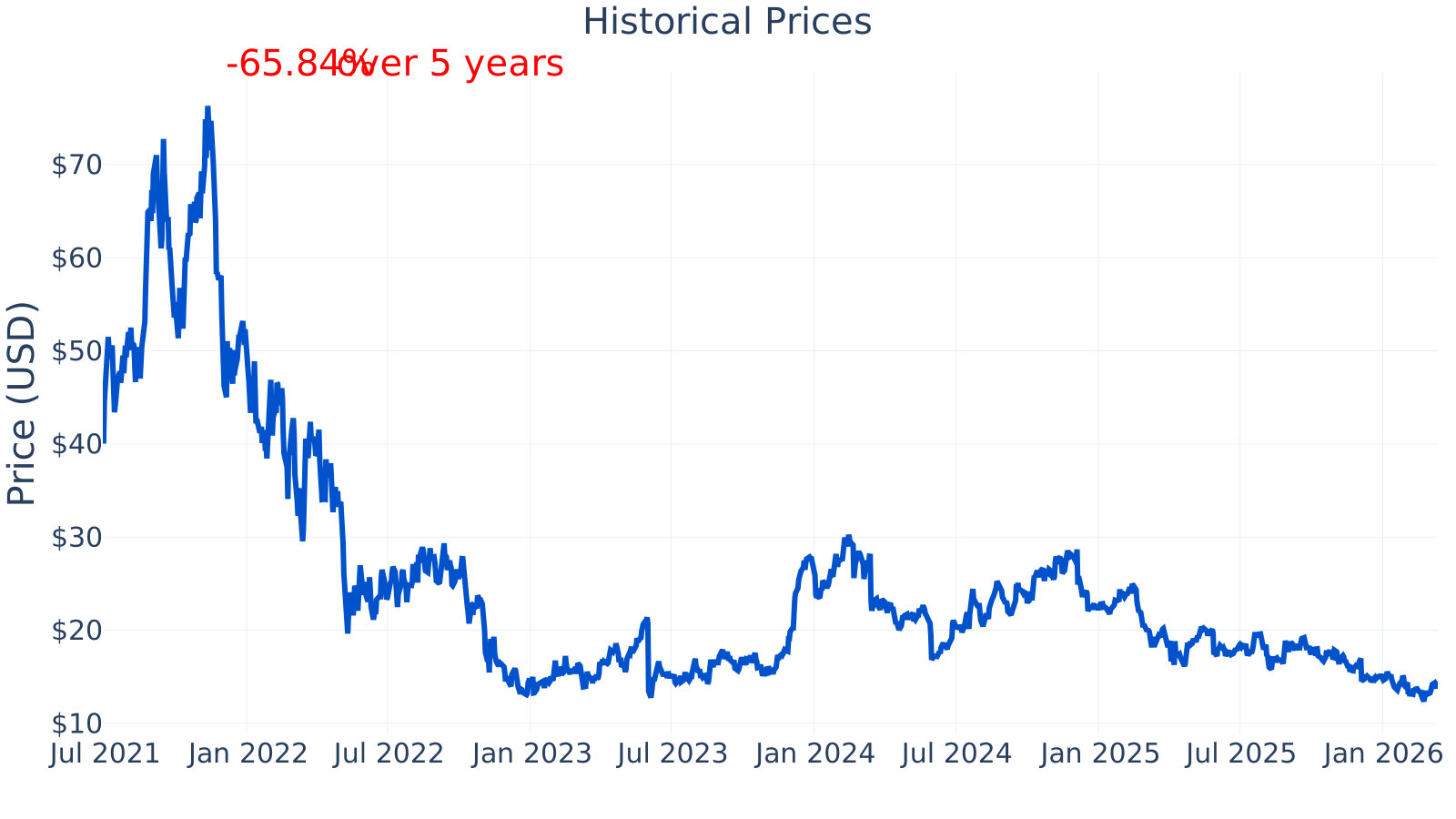
At the latest point shown, SentinelOne’s market capitalization is about $4.93B. The stock’s beta is ~0.78, which indicates its price has historically moved somewhat less than the overall market on average (though individual periods can differ significantly).
Profitability remains a central issue: the latest profit margin is about -45.0%, compared with an industry median around +7.1%. On the growth side, the latest year-over-year revenue growth is about +20.2%, above the industry median of ~15.8%. Balance-sheet leverage appears low, with debt-to-equity near 0.7% versus an industry median near 24.9%. Free cash flow over the trailing twelve months is positive at roughly $58.2M.
Growth (Medium)
Cybersecurity is generally considered a long-term growth area because attacks continue to evolve, more business activity moves online, and organizations face regulatory and operational pressure to strengthen protection. Within that broad market, endpoint, cloud, and identity security are especially important as companies adopt remote work and cloud infrastructure.
SentinelOne’s strategy centers on a platform approach—expanding from endpoint protection into broader coverage (such as cloud workloads and identity) and aiming to unify detection and response workflows. If executed well, this approach can support growth by increasing the amount each customer uses over time (expansion) and by making the product “stickier” inside an organization.
The revenue growth trend shows a clear slowdown from very high early growth rates to more moderate levels over time, with the most recent point around +20% year-over-year. For a maturing software company, the key question becomes whether it can maintain healthy growth while improving efficiency.
Free cash flow has improved notably over the period shown, moving from negative levels to positive—ending around +$58M on a trailing twelve-month basis. This can matter for long-term durability because consistently positive free cash flow can reduce reliance on external funding and can provide flexibility for product investment.
Risks (High)
The main risk is that SentinelOne is still not profitable on a net income basis. Even with rising revenue, operating costs have remained substantial, and the company has posted significant losses. If the company cannot keep improving operating efficiency (for example, by growing revenue faster than expenses), profitability could remain elusive for longer than expected.
Competition is another major risk. Cybersecurity is crowded and fast-moving, and customers often compare vendors closely on efficacy, performance, ease of management, and total cost. Larger competitors may have broader product suites, longer operating histories, and more extensive customer relationships. SentinelOne’s positioning depends on continued product performance and successful platform expansion.
Customer spending cycles also matter. Security is mission-critical, but budgets can still tighten, purchase decisions can slow, and contract expansions can become harder to win—especially for newer platform modules. Retention, upsell success, and sales execution are therefore important operational drivers.
Financial leverage appears low. The latest debt-to-equity is about 0.7%, well below the industry median shown (around 24.9%). Low leverage can reduce financial risk, but it does not remove operating risk tied to losses and the need to manage cash carefully.
Profit margin has improved significantly from extremely negative levels earlier in the period (worse than -100%) to around -45% most recently, but it remains far below the industry median (now positive). This highlights progress, while also showing that the company still has meaningful distance to cover to reach profitability comparable to many established software peers.
Competitive landscape (examples of well-known peers customers may evaluate alongside SentinelOne):
- CrowdStrike (endpoint and broader security platform)
- Microsoft (security offerings integrated with its enterprise ecosystem)
- Palo Alto Networks (broad cybersecurity platform across network, cloud, and endpoint)
- Trellix / Sophos / Trend Micro and other endpoint-focused vendors
Competitive advantage is typically described in terms of product effectiveness, data-driven detection, and the ability to consolidate security tools into a single platform. Whether SentinelOne is “the leader” depends on the specific sub-segment and customer use case; the market includes very large, well-capitalized players and multiple specialist vendors.
Valuation
Traditional valuation measures like the price-to-earnings (P/E) ratio often become less meaningful when a company has negative earnings. In those cases, investors commonly focus more on revenue growth, gross margin trends, operating leverage, and cash flow trajectory.
The P/E series shown is effectively not available (displayed as 0) because the company’s earnings are negative during the period, while the industry median P/E remains around the high-20s to ~30 range. As a result, comparisons based on P/E are not informative here. A valuation discussion for SentinelOne is therefore more dependent on whether the company can sustain growth while continuing to improve margins and cash generation over time, and how confidently the market prices that path.
Conclusion
SentinelOne operates in a cybersecurity market with structural long-term demand drivers, and it has grown revenue to roughly $1.0B (fiscal year ended 2026-01-31). The company has also shown a meaningful improvement in cash generation, with trailing twelve-month free cash flow turning positive (about $58M).
At the same time, the company remains materially unprofitable on a net margin basis (about -45%), and it competes against large, established vendors in a crowded category. The fact pattern is therefore a mix: improving operating trajectory and low balance-sheet leverage, alongside ongoing losses and substantial competitive pressure. Long-term outcomes are likely to depend on execution—maintaining solid growth while continuing to reduce losses and convert more of revenue into durable free cash flow.
Sources:
- U.S. Securities and Exchange Commission (SEC EDGAR) — SentinelOne Inc filings (Form 10-K, Form 10-Q)
- SentinelOne Investor Relations — SEC filings and shareholder materials (company-hosted)
- Wikipedia — “SentinelOne” (basic company background)
This article is for informational purposes only and does not constitute financial advice. Some content is AI-generated. See Disclaimer


