Stock Analysis · Semrush Holdings Inc (SEMR)
Overview
Semrush Holdings, Inc. is a software company focused on helping businesses improve their online visibility and marketing performance. In simple terms, it provides tools that support activities such as search engine optimization (SEO), paid search, content marketing, social media, and competitive research. The platform is typically used by marketing teams, agencies, and small-to-mid-sized businesses that want to understand how people find them online and how to reach more customers through digital channels.
The company’s business model is largely subscription-based software, meaning customers pay recurring fees to access its toolkit. This type of model is often valued for predictability, because revenue can be less dependent on one-time projects and more tied to renewals and upgrades over time.
In its filings, Semrush primarily reports revenue as a single stream from providing access to its platform (subscriptions), rather than breaking it out into detailed product-by-product percentages. As a result, a simple way to think about its revenue sources is:
- Subscription revenue from the Semrush platform (primary source)
- Other revenue (if any) is not presented as a major separate category in reported revenue
At a high level, the company’s spending is concentrated in two areas typical for software businesses: building and improving the product (research and development) and acquiring/serving customers (sales and marketing, plus general administration).
From 2021 to 2025, revenue increased from about $188.0M to $443.6M. Over the same period, costs and operating expenses also grew, with research and development and selling/general/administrative expenses representing the largest ongoing investments. Profitability improved notably in 2023–2024, then weakened again in 2025 as operating income and net income turned negative.
Key Figures
| Metric | Value | Industry ⓘ |
|---|---|---|
| Date | Mar 09, 2026 | |
| Context | ||
| Sector | Technology | |
| Industry | Software - Application | |
| Market Cap ⓘ | $1.81B | |
| Beta ⓘ | 1.55 | |
| Fundamental | ||
| P/E Ratio ⓘ | N/A | 27.00 |
| Profit Margin ⓘ | -4.27% | 7.87% |
| Revenue Growth ⓘ | 14.60% | 16.65% |
| Debt to Equity ⓘ | 4.35% | 25.51% |
| PEG ⓘ | N/A | |
| Free Cash Flow ⓘ | $53.34M | |
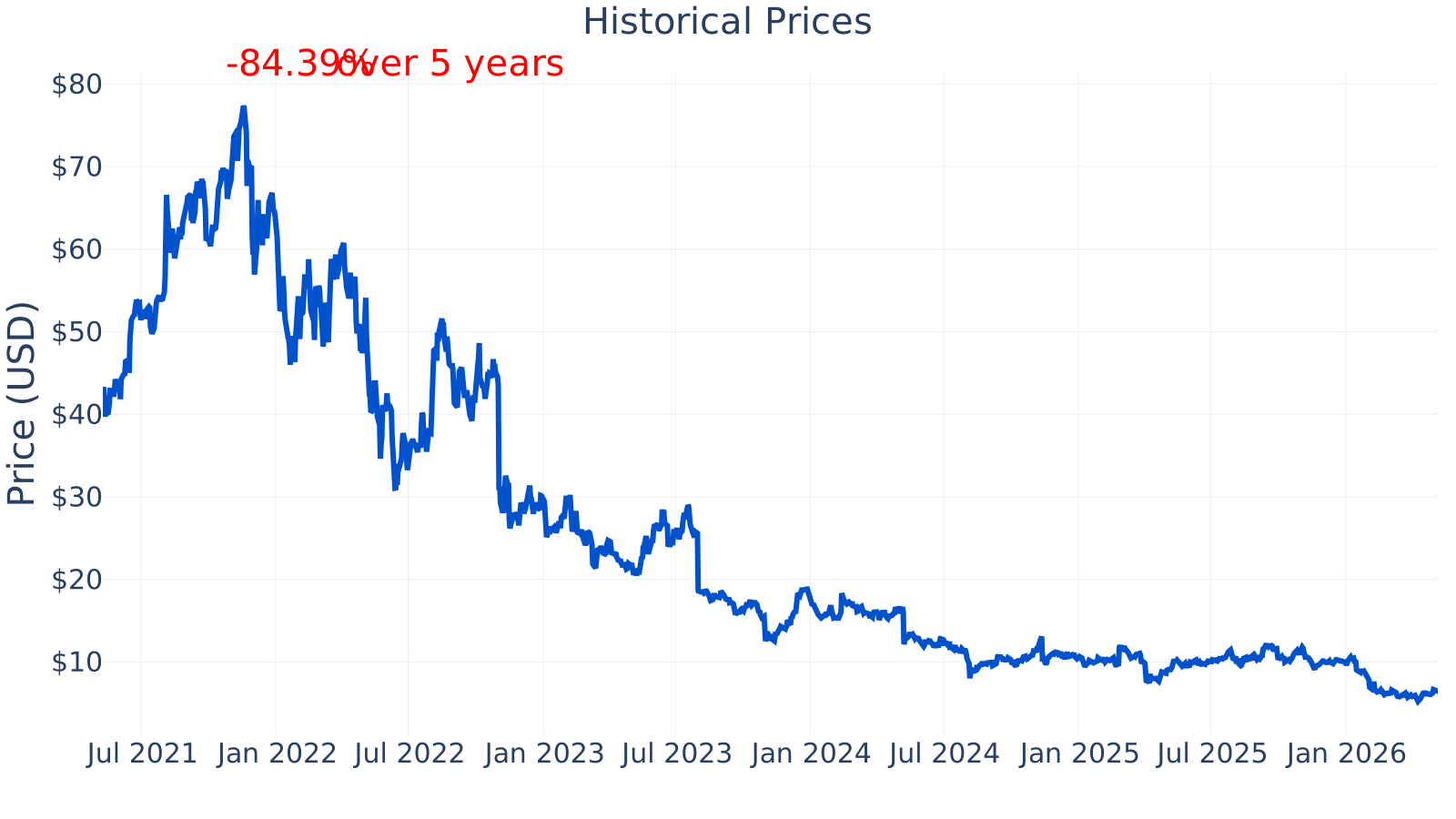
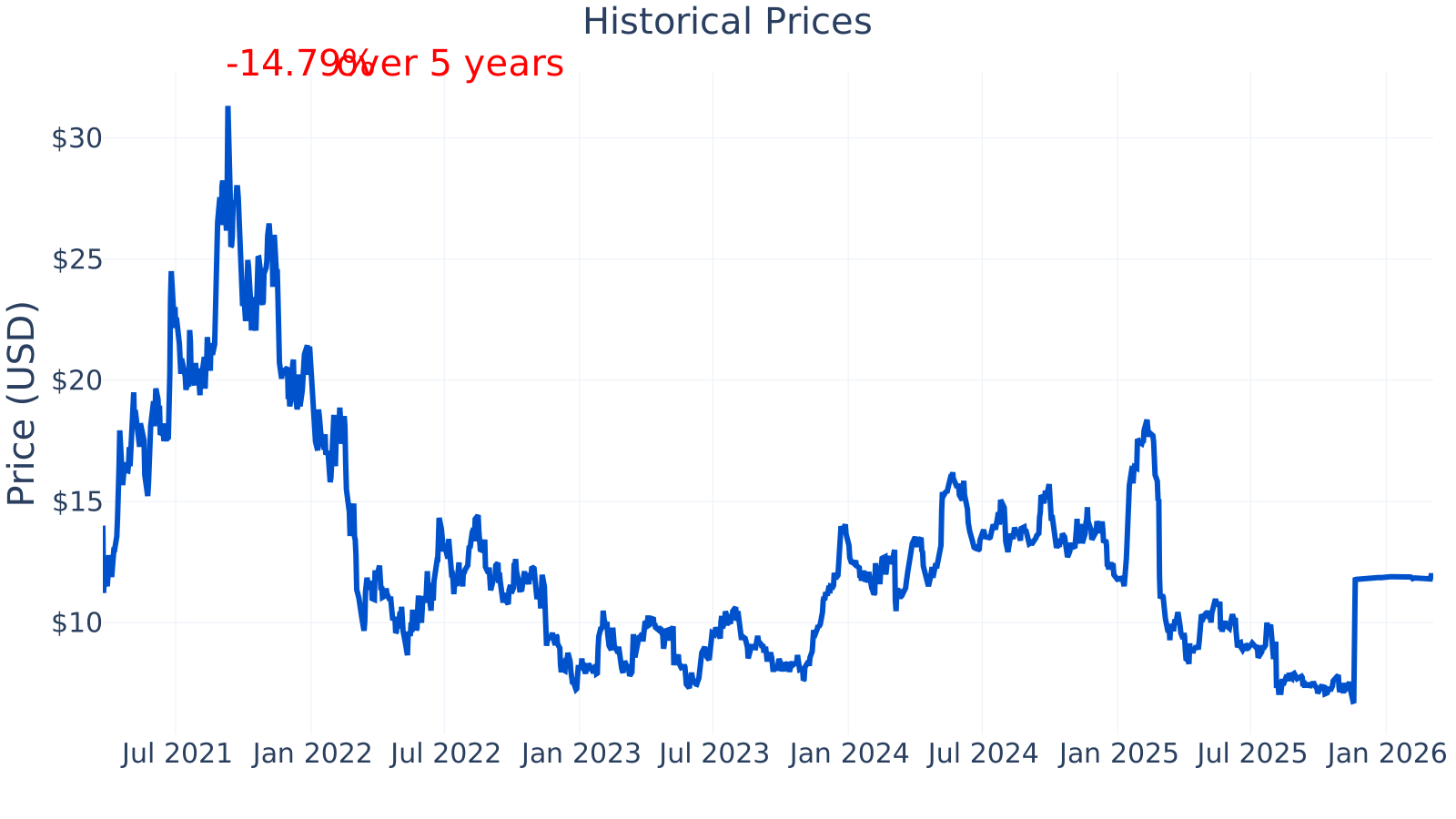
Semrush’s market capitalization is about $1.81B, placing it in the small-to-mid-cap range. The stock has a beta of 1.55, which is commonly interpreted as meaning the share price has tended to move more than the broader market (higher volatility).
On profitability, the latest profit margin shown is about -4.3%, compared with an industry median near 7.9%. On growth, the most recent year-over-year revenue growth displayed is about 14.6%, slightly below the industry median near 16.7%.
Capital structure looks conservative versus many software peers: debt-to-equity is about 4.3% (industry median about 25.5%). Free cash flow (trailing twelve months) is about $53.3M, indicating the core operations have recently produced more cash than they used, after capital spending.
Growth (Medium)
Semrush operates in the broader digital marketing software space, which is supported by long-term trends such as businesses shifting customer acquisition and branding efforts toward online channels. Demand for tools that help measure marketing performance, understand competitors, and improve content and search visibility tends to rise as online competition increases.
Strategically, a subscription software platform can scale as customers add more users, upgrade plans, or expand use cases across marketing functions. The company’s continued investment in research and development (visible in its expense profile over time) aligns with a strategy of expanding features and maintaining product relevance in a fast-changing environment.
The year-over-year revenue growth rate has gradually slowed from very high growth levels in 2021–2022 to the mid-teens most recently (about 14.6%). This pattern is common as a company matures, but it can also raise the importance of keeping customer retention strong and finding new expansion opportunities.
Cash generation has improved versus earlier periods shown, moving from negative free cash flow in 2023 to positive levels in 2024 and 2025 (with the latest trailing figure around $53.3M). For a software business, sustained positive free cash flow can increase flexibility to fund product development, marketing, or acquisitions without relying as much on external financing.
Risks (High)
A key risk is competition. The markets for SEO and digital marketing analytics tools are crowded, and customers can compare multiple platforms. Competitive pressure can show up through pricing, higher marketing costs to acquire customers, or churn (customers leaving) if a rival product is perceived as better or cheaper.
Another risk is that parts of Semrush’s value proposition depend on external platforms and ecosystems (for example, search engines and social platforms) that can change algorithms, data availability, or policies. When those environments shift, marketing workflows may change and software providers may need to adapt quickly.
Profitability consistency is also an important consideration. While Semrush reached profitability in 2024, the latest profit margin shown is negative again, suggesting earnings can swing with spending levels and growth investments.
Leverage appears low: the latest debt-to-equity ratio is about 4.3%, and it has remained well below the industry median across the periods shown. Lower leverage can reduce financial risk during weaker operating periods, although it does not remove business risk.
Profit margin improved from deeply negative levels in 2022–2023 to positive territory in 2023–2024, then declined again into negative territory by the latest period (about -4.3%). Relative to the industry median (roughly 8.2% in the latest point shown), this indicates Semrush has recently underperformed many peers on bottom-line profitability.
In terms of competitive positioning, Semrush is a well-known brand in SEO and marketing analytics, but it is not the only major platform in this space. Commonly recognized competitors include Ahrefs, Moz, and broader marketing/analytics and advertising ecosystems from large technology companies (which can substitute for parts of the workflow). The competitive landscape makes sustained differentiation—through data quality, workflow integration, and user experience—important.
Valuation
Because Semrush has recently shown fluctuating profitability, traditional valuation measures like the price-to-earnings (P/E) ratio can be hard to interpret. When earnings are small or volatile, P/E can look very high or may not be meaningful in some periods.
In the periods where P/E is shown, Semrush’s P/E ratio is substantially higher than the industry median (for example, roughly 149–213 for Semrush versus about 46–64 for the median at points shown). This typically implies the market has priced in stronger future improvement than the average peer group, or that current earnings are still relatively low compared with the company’s market value.
Given the latest context—mid-teens revenue growth, positive free cash flow, but a recently negative profit margin—valuation perceptions are likely to be sensitive to whether margins stabilize and whether growth re-accelerates or continues to slow.
Conclusion
Semrush is a subscription software company in digital marketing analytics, a category supported by the ongoing importance of online customer acquisition and brand visibility. Over multiple years, the company has expanded revenue meaningfully and has recently produced positive free cash flow, while maintaining relatively low leverage compared with many software peers.
At the same time, the business operates in a highly competitive environment, and profitability has been inconsistent—improving into positive territory in 2024 before turning negative again in the latest period shown. Valuation signals based on P/E appear elevated versus the industry median when earnings are positive, which can indicate higher expectations for future performance and can increase sensitivity to execution outcomes.
Sources:
- U.S. SEC EDGAR — Semrush Holdings, Inc. filings (Form 10-K, Form 10-Q)
- Semrush Investor Relations — Company reports and shareholder materials (annual/quarterly reporting)
- Wikipedia — “Semrush” (basic company background)
This article is for informational purposes only and does not constitute financial advice. Some content is AI-generated. See Disclaimer