Stock Analysis · Sea Ltd (SE)
Overview
Sea Limited is a consumer internet company focused on Southeast Asia and other selected markets. It operates three well-known business lines: e-commerce (Shopee), digital entertainment (Garena), and digital financial services (SeaMoney). In simple terms, it combines an online shopping marketplace, a games publisher/platform, and a set of payment and lending products that are often used inside (and sometimes outside) its own apps.
In the company’s reporting, revenue is primarily described through these operating segments, and each segment tends to have different “engines” for monetization (for example: e-commerce fees and advertising; games bookings/recognition; and transaction fees/interest income in financial services). The mix can change meaningfully over time as growth rates and profitability shift across segments, so investors typically follow each segment separately in the company’s filings.
Main sources of revenue (by business line)
- Shopee (E-commerce): marketplace-related revenue streams such as transaction-based fees and advertising/marketing services (varies by market and period).
- SeaMoney (Digital financial services): payment-related fees and, where applicable, credit-related revenue (such as interest income), subject to local regulations and risk management.
- Garena (Digital entertainment): revenue linked to online games and related digital content (often influenced by the performance of a small number of major titles).
Across 2021 to 2025, the company’s revenue increased substantially (from about $10.0B in 2021 to about $22.9B in 2025), while profitability also improved over the same period (net income moving from a sizable loss in 2021 to a profit in 2025). Operating expenses rose in absolute dollars, but operating income turned positive and expanded as revenue scaled.
Key Figures
| Metric | Value | Industry ⓘ |
|---|---|---|
| Date | Mar 16, 2026 | |
| Context | ||
| Sector | Consumer Cyclical | |
| Industry | Internet Retail | |
| Market Cap ⓘ | $50.91B | |
| Beta ⓘ | 1.63 | |
| Fundamental | ||
| P/E Ratio ⓘ | 34.13 | 33.24 |
| Profit Margin ⓘ | 6.88% | 6.54% |
| Revenue Growth ⓘ | 38.40% | 11.60% |
| Debt to Equity ⓘ | 26.59% | 26.93% |
| PEG ⓘ | 0.60 | |
| Free Cash Flow ⓘ | $4.22B | |
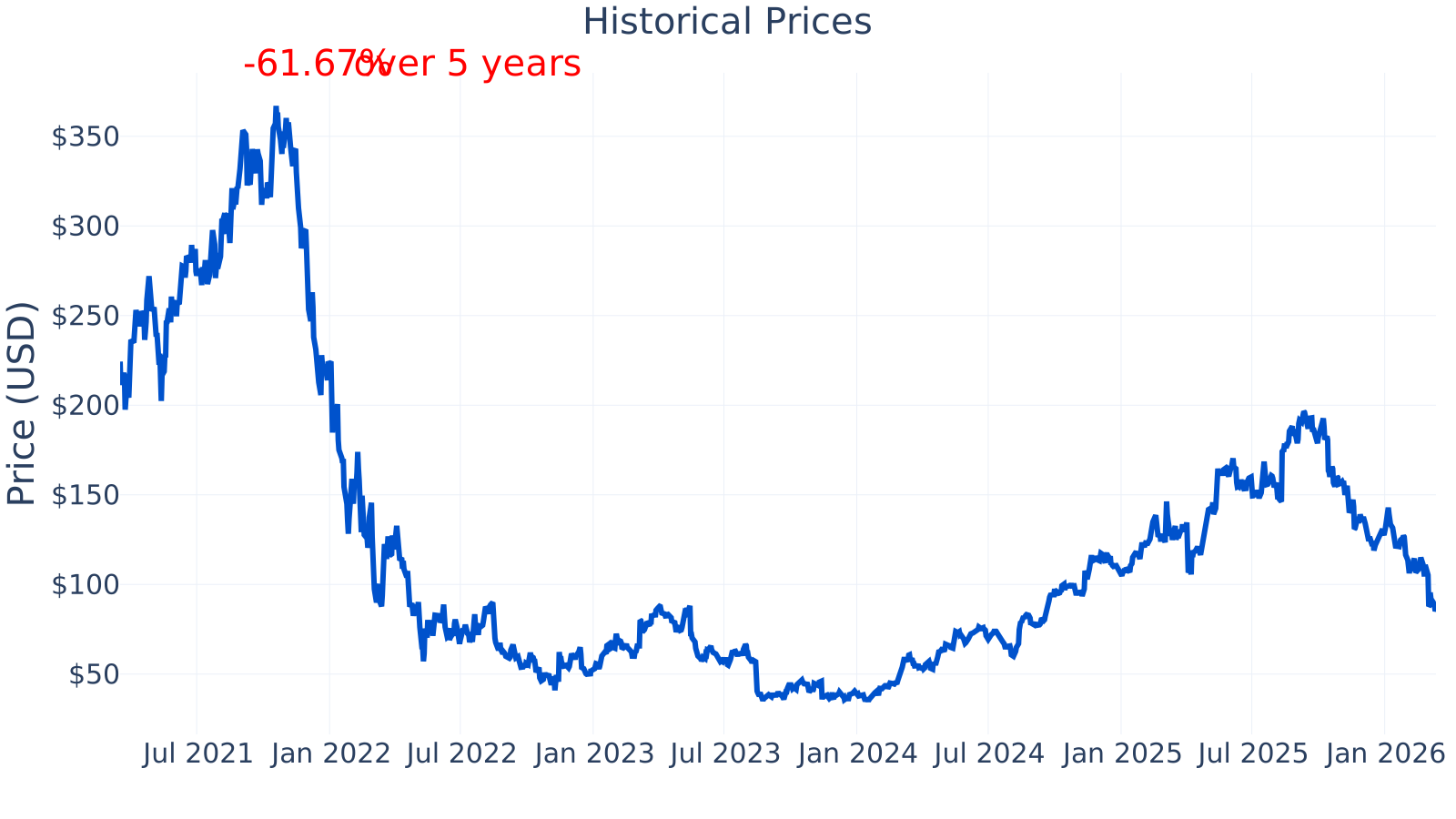
Sea Limited’s market capitalization is about $50.9B, and the stock’s beta of 1.63 indicates it has historically been more volatile than the broader market. The latest P/E ratio is ~34.1, close to the industry median (~33.2). Profit margin is about 6.88%, slightly above the industry median (~6.54%). Year-over-year revenue growth is about 38.4%, notably higher than the industry median (~11.6%). Debt-to-equity is about 26.6%, roughly in line with the industry median (~26.9%). Trailing twelve-month free cash flow is about $4.22B, indicating the business has recently been generating cash after operating costs and capital spending.
Growth (High)
Sea operates in areas that have long benefited from rising internet penetration and the ongoing shift of retail and payments to digital channels. E-commerce and digital payments can expand for many years as logistics improves, more merchants come online, and consumers become comfortable with online purchasing and cashless transactions. Digital entertainment can also be a durable demand category, but growth can be more uneven because it depends on content cycles and the popularity of specific games.
A key part of Sea’s growth strategy has been building an ecosystem: e-commerce brings frequent user activity, financial services can reduce friction at checkout and extend credit to shoppers and merchants, and entertainment supports user engagement in the broader platform footprint. When this works well, one segment can reinforce another (for example, payments adoption improving conversion for online shopping), but it also increases complexity and requires disciplined execution.
Revenue growth decelerated sharply after very high growth in 2021, then re-accelerated meaningfully from 2024 into 2025. The most recent year-over-year revenue growth shown (about 38.4%) is well above the industry median (about 11.6%), suggesting Sea has recently been expanding faster than many peers in its category.
Free cash flow shifted from negative in 2022 (about -$1.61B) to positive and growing through 2025 (about $3.59B as of 2025-03-31 in the series, and $4.22B in the latest metrics). For a platform business, sustained positive free cash flow can be an important sign that growth is being funded in a more self-sustaining way rather than relying primarily on external capital.
Risks (High)
Sea’s businesses face strong competition and can require sustained spending to defend market position. In e-commerce, competitive intensity can show up through shipping subsidies, marketing spend, seller incentives, and price competition. In digital financial services, growth can be constrained by regulation, licensing requirements, and the need to manage credit risk carefully. In digital entertainment, performance can be hit by changing player preferences, game lifecycle effects, platform policies, and the inherent unpredictability of launching and maintaining hit titles.
Debt-to-equity declined materially over time in the series, from higher levels in 2021–2023 to about 26.6% by 2025-12-31, below the industry median shown for that date (about 37.2%). Even with this improvement, leverage metrics should be interpreted alongside the company’s cash generation, investment needs, and any off-balance-sheet commitments described in filings.
Profitability has improved substantially since 2021. The profit margin moved from deeply negative levels in 2021–2022 to positive territory from 2023 onward, reaching about 6.92% by 2025-12-31 (with an industry median around 6.26% at that time). The path shows that profitability has not been perfectly smooth quarter to quarter, which is common in businesses with variable marketing intensity, gaming content cycles, and changing mix across segments.
Competitive advantages for Sea are typically discussed in terms of ecosystem scale (buyers, sellers, and engagement), localized execution across diverse markets (language, payments, logistics partners), and product integration between commerce and payments. Whether these become durable advantages depends on the company’s ability to maintain user trust, service quality, and cost efficiency while competitors pursue similar goals.
Key competitor sets vary by segment: e-commerce competition often includes large regional and global platforms; digital financial services competes with banks, local fintechs, and wallet providers; and digital entertainment competes with major global publishers and mobile-focused developers. Sea’s position relative to each group can differ by country and over time, so the most reliable way to track this is through the company’s segment disclosures and risk factor updates in SEC filings.
Valuation
The latest P/E ratio is about 34.1, close to the industry median of about 33.2 in the comparison set provided. Historically, the P/E shown for Sea has varied widely (including periods where it is not meaningful or not shown), which can happen when earnings are volatile or temporarily depressed/boosted. In general, for a company coming out of a lower-profit or loss-making phase, valuation ratios can move sharply as reported earnings change.
From a fundamentals perspective, the valuation picture combines (1) fast recent revenue growth (well above the industry median), (2) improving profitability with margins now positive and near-to-slightly above the industry median, and (3) meaningful positive free cash flow. At the same time, the company’s operating environment remains competitive and execution-dependent, which is one reason market participants may apply a wide range of valuation outcomes over time.
Conclusion
Sea Limited is a multi-business consumer internet platform with major exposure to e-commerce, digital payments/financial services, and digital entertainment. Recent years show a notable shift toward stronger profitability and cash generation alongside a re-acceleration in revenue growth, while leverage (as measured by debt-to-equity) has trended down.
The main points to balance for a long-term view are the potential durability of growth in its core digital markets and ecosystem strategy versus the company’s higher-risk features: intense competition in commerce, regulatory and credit-risk considerations in financial services, and content-cycle dependency in gaming. Over time, results can be heavily influenced by how efficiently the company sustains growth while controlling incentives and operating costs, as reflected in margins and free cash flow.
Sources:
- SEC EDGAR — Sea Limited Forms 20-F / annual reports and periodic filings (business overview, segment descriptions, risk factors, and financial statements)
- Sea Limited Investor Relations — Company filings and shareholder materials (press releases and earnings materials posted by the company)
- Wikipedia — “Sea Limited” (basic company background and history)
This article is for informational purposes only and does not constitute financial advice. Some content is AI-generated. See Disclaimer