Stock Analysis · Samsara Inc (IOT)
Overview
Samsara Inc. (IOT) builds connected-software tools that help organizations with physical operations run more safely and efficiently. In plain terms, it combines connected devices (such as vehicle gateways and cameras) with a cloud software platform so businesses can see what is happening across fleets, equipment, and worksites, then use that information to improve routing, reduce fuel use, improve driver safety, and support compliance and maintenance.
The company describes its approach as a single platform that customers can expand over time (for example, starting with vehicle tracking and later adding safety cameras or maintenance workflows). This “land and expand” style matters because the value of the platform increases as more vehicles, assets, and workflows are connected in one place.
From an accounting perspective, Samsara primarily generates revenue by selling subscriptions to its cloud software and associated services, and also from the related hardware that is typically deployed to connect vehicles and equipment to the platform. Public filings commonly describe revenue in broad categories rather than a long list of separate product lines; in general, the largest economic driver is ongoing subscriptions, with hardware usually supporting the initial rollout and expansion.
Main sources of revenue (high-level categories as described in company filings):
- Subscription revenue (recurring access to the cloud platform and features)
- Hardware and other revenue (devices and related items that enable connectivity and data capture)
Looking at the multi-year income flow, total revenue rose from about $428M (FY2022) to about $1.619B (FY2026). Over the same period, the company’s net loss narrowed dramatically (from roughly -$355M to about -$9M), suggesting the business has been moving closer to break-even while scaling.
Key Figures
| Metric | Value | Industry ⓘ |
|---|---|---|
| Date | Mar 09, 2026 | |
| Context | ||
| Sector | Technology | |
| Industry | Software - Infrastructure | |
| Market Cap ⓘ | $20.40B | |
| Beta ⓘ | 1.60 | |
| Fundamental | ||
| P/E Ratio ⓘ | N/A | 27.58 |
| Profit Margin ⓘ | -0.56% | 6.83% |
| Revenue Growth ⓘ | 28.30% | 16.30% |
| Debt to Equity ⓘ | 5.12% | 24.92% |
| PEG ⓘ | N/A | |
| Free Cash Flow ⓘ | $207.44M | |
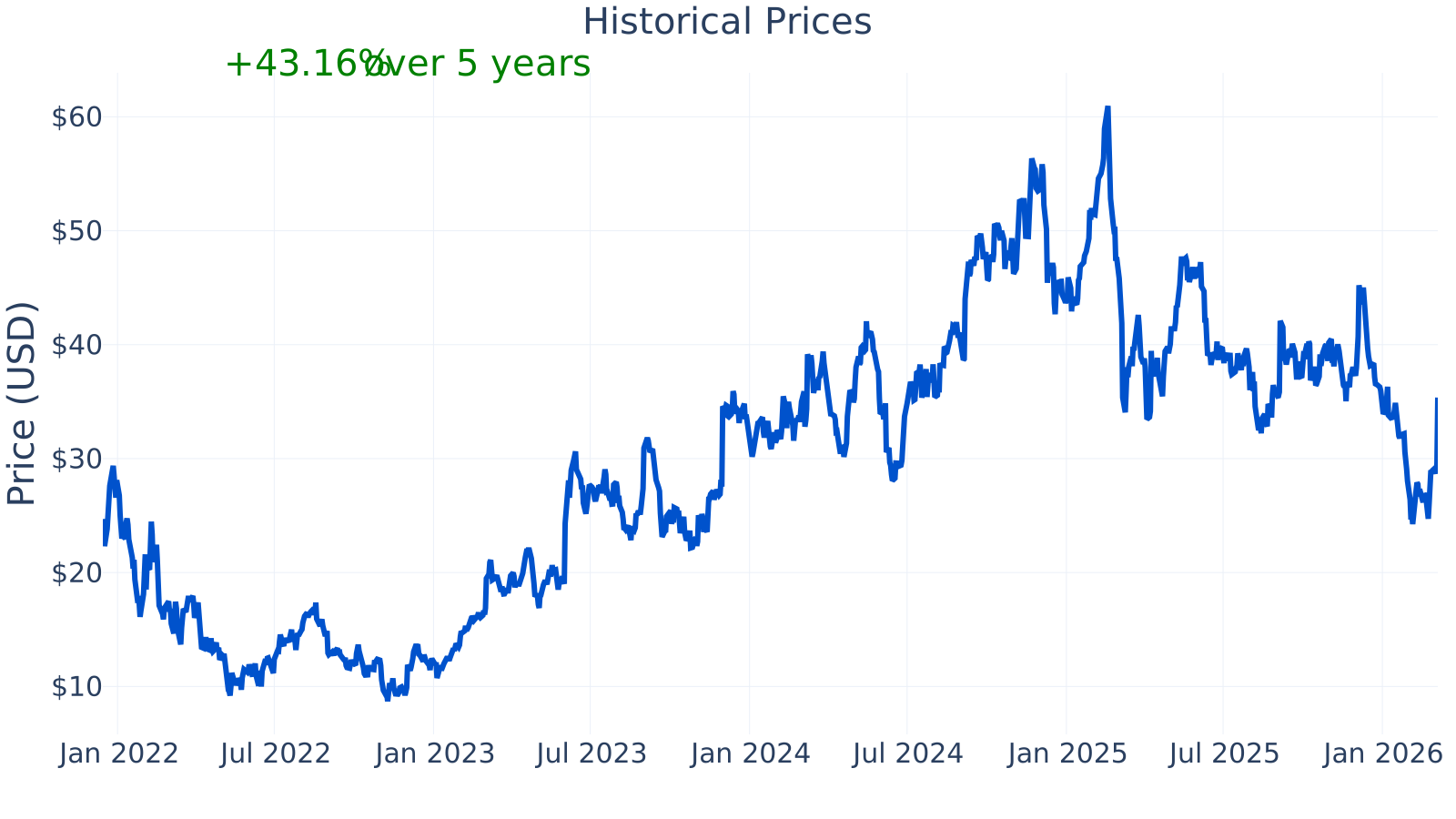
Samsara’s market capitalization is about $20.4B. The stock’s beta is about 1.60, which indicates it has tended to move more than the broader market (higher volatility is common for fast-growing software companies). On operating performance, the latest profit margin shown is about -0.6%, which is close to break-even but still below the industry median of about 6.8%. Growth remains elevated: latest year-over-year revenue growth is about 28.3%, above the industry median of about 16.3%. Leverage appears low, with debt-to-equity around 5.1% versus an industry median near 24.9%. Free cash flow over the trailing twelve months is about $207M, indicating the business has recently been generating cash after operating costs and capital spending.
Growth (Medium)
Samsara operates in a part of the technology market often described as connected operations or industrial IoT software—where companies digitize fleets, equipment, and field operations. This area tends to be supported by long-term forces such as the need to reduce operating costs, improve safety, reduce downtime through maintenance planning, and meet regulatory or insurance requirements. These drivers are not limited to one narrow industry; they can apply to transportation, construction, logistics, utilities, and other sectors that manage large numbers of vehicles or assets.
A key part of the growth strategy is expanding within existing customers by adding more connected devices and enabling additional software capabilities over time. That approach can work well if customers see measurable savings (fuel, accidents, maintenance), because it can create a practical reason to keep the system in place and broaden its use across the organization.
The company’s year-over-year revenue growth has remained strong but has generally slowed from very high levels (around the 40%–50% range earlier in the timeline) to about 28% most recently. That pattern is common as revenue becomes larger, but it also means future results depend more on continued execution (new customer wins plus expanding existing accounts) rather than relying on early-stage hypergrowth alone.
Cash generation has improved significantly over time. Trailing twelve-month free cash flow moved from negative levels (around -$205M in 2022) to positive (about $207M most recently). For long-term business durability, this shift matters because it can reduce reliance on outside funding and gives the company more flexibility to invest in product development and sales capacity.
Risks (Medium)
Even with strong top-line growth, Samsara has only recently approached break-even profitability. A core risk is execution: sustaining growth while controlling operating costs (especially sales and marketing and research and development) is essential for margins to reach levels more typical of established software businesses.
Profitability has improved markedly over the period shown, from very large losses (e.g., profit margin near -90% in 2022) toward close to break-even (around -0.6% most recently). The direction is favorable, but the company is still below the industry median profit margin (around 6%–7%), and there is no guarantee the trend continues smoothly in a more competitive or slower-demand environment.
Balance-sheet leverage appears modest. Debt-to-equity declined over time to about 5%, below the industry median (roughly 19%–25% across the period shown). Lower leverage can reduce financial risk, but it does not remove business risks such as pricing pressure, customer budget tightening, or higher costs to acquire and retain customers.
Competition is another important risk. The market for fleet telematics, safety, and connected-operations software includes a mix of specialized providers and larger technology/industrial firms. In broad terms, competitors may include:
- Fleet telematics and connected-operations platforms that offer tracking, dispatch, and analytics
- Video safety and camera-focused providers expanding into broader fleet workflows
- Large industrial/technology vendors that can bundle hardware, software, and services
Samsara’s competitive positioning, based on how it presents itself in filings, centers on a unified cloud platform, an expanding set of applications, and the ability for customers to standardize across fleets and operations. The main competitive question over time is whether these platform benefits translate into durable customer retention and expansion without requiring unsustainably high sales spending.
Additional risks that are typical for this type of company include data security and privacy expectations (because connected devices can collect sensitive operational information), hardware supply and quality management (devices must work reliably at scale), and potential regulatory changes affecting fleet operations and in-cab technologies.
Valuation
A common valuation metric, the price-to-earnings (P/E) ratio, is not meaningful here based on the values shown (the company P/E is displayed as 0, which typically happens when earnings are negative or otherwise make the metric unusable). In cases like this, valuation discussions often shift toward other yardsticks (for example, revenue-based multiples or cash-flow-based measures), but those are not included in the figures shown.
From a fundamentals-only perspective using the available metrics, the valuation context is shaped by three competing facts:
- Growth is above the industry median (about 28% YoY vs. ~16% median), which can support higher valuation levels in many market environments.
- Profitability is still slightly negative (about -0.6% profit margin), meaning the business has not yet reached sustained GAAP profitability comparable to mature software firms.
- Cash generation has turned positive (about $207M trailing free cash flow), which can improve resilience and reduce financing dependence.
As a result, whether the stock price looks “expensive” or “cheap” cannot be concluded from a P/E comparison, and it depends heavily on how durable future growth and margin improvement prove to be.
Conclusion
Samsara is a software platform company focused on digitizing physical operations, with revenue primarily tied to subscriptions supported by connected devices. Over the last several years, it has delivered large revenue expansion (reaching about $1.62B in FY2026) while narrowing losses substantially (to about -$9M) and moving to positive free cash flow (about $207M trailing).
The long-term picture depends on the company’s ability to keep expanding its customer base and deepen adoption within existing accounts, while continuing the profitability trajectory toward levels more consistent with the broader software industry. Key uncertainties include competitive intensity, the pace at which margins can improve, and how demand holds up across economic cycles for customers with large fleets and field operations.
Sources:
- U.S. SEC EDGAR — Samsara Inc. Forms 10-K, 10-Q, and 8-K
- Samsara Investor Relations — SEC Filings
- Samsara Investor Relations — Quarterly and Annual Shareholder Materials (press releases and presentations, as published by the company)
- Wikipedia — “Samsara (company)”
This article is for informational purposes only and does not constitute financial advice. Some content is AI-generated. See Disclaimer