Stock Analysis · Salesforce.com Inc (CRM)
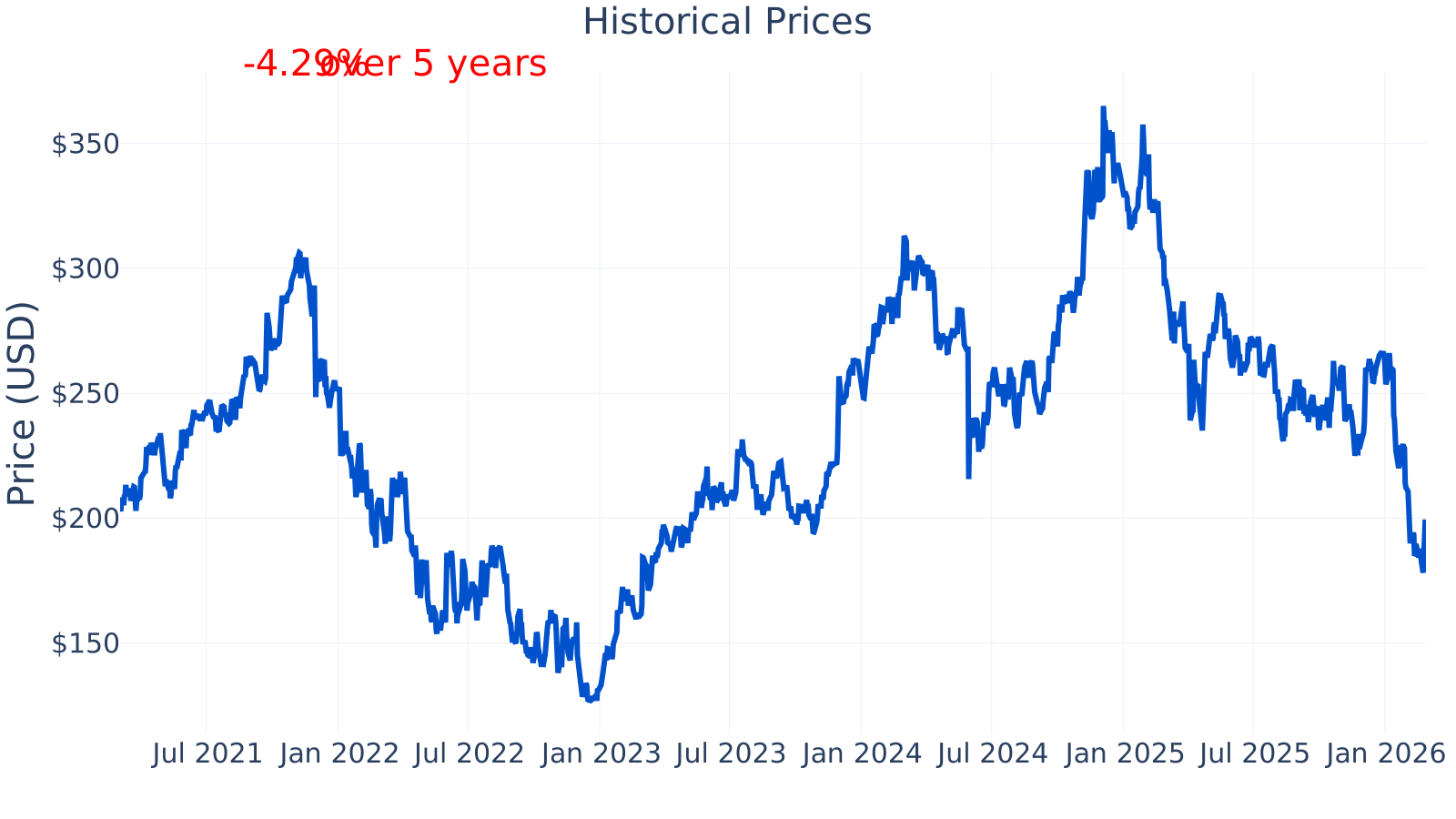
Overview
Salesforce.com Inc. (CRM) is a software company best known for helping organizations manage customer relationships in the cloud. In simple terms, it provides tools that sales teams, customer support teams, marketers, and commerce teams use to track customer interactions, automate workflows, analyze activity, and improve service. Because the software is delivered online (software-as-a-service), customers typically pay recurring subscription fees rather than buying one-time licenses.
Salesforce has broadened beyond its original sales automation product into a larger suite that includes customer service, marketing, e-commerce, analytics, integration, and application development tools. It also owns Slack, which is used for workplace messaging and collaboration, and it has been integrating Slack into its broader customer platform.
In its financial reporting, Salesforce groups revenue into two main categories:
- Subscription and support (the large majority of revenue): recurring fees for access to its cloud software and related support services.
- Professional services and other (a smaller portion): consulting and implementation work to help customers deploy and use Salesforce products.
Salesforce’s recent financial profile shows revenue growth alongside a clear shift toward higher operating profitability over the last few fiscal years.
From fiscal year 2022 to fiscal year 2026 (years ending around late January), total revenue increased from about $26.5B to about $41.5B. Over the same period, operating income improved significantly (from a loss in fiscal 2022 to a profit of roughly $9.5B in fiscal 2026), which indicates the company has been generating more profit from each dollar of revenue while continuing to invest in areas like research and development.
Key Figures
| Metric | Value | Industry ⓘ |
|---|---|---|
| Date | Mar 02, 2026 | |
| Context | ||
| Sector | Technology | |
| Industry | Software - Application | |
| Market Cap ⓘ | $185.44B | |
| Beta ⓘ | 1.28 | |
| Fundamental | ||
| P/E Ratio ⓘ | 25.97 | 25.64 |
| Profit Margin ⓘ | 17.96% | 7.25% |
| Revenue Growth ⓘ | 12.10% | 16.65% |
| Debt to Equity ⓘ | 11.39% | 24.64% |
| PEG ⓘ | 0.92 | |
| Free Cash Flow ⓘ | $14.40B | |
Salesforce’s market capitalization is about $185B, reflecting its position as a large, established software company. The beta of ~1.28 suggests the stock has historically moved more than the broader market (higher-than-market volatility). Profit margin is about 18.0%, notably above the application software industry median (~7.2%), which aligns with the profitability improvement visible in recent fiscal years. Revenue growth (about 12.1% year-over-year) is below the industry median (~16.7%), suggesting Salesforce is growing, but not as fast as the median company in its peer group. Debt-to-equity is about 11.4%, below the industry median (~24.6%), indicating relatively conservative leverage compared with peers. Free cash flow over the trailing twelve months is about $14.4B, highlighting substantial cash generation.
Growth (medium)
Salesforce operates in the enterprise cloud software market, which is supported by long-running trends: businesses continuing to move workflows to cloud services, increasing use of data and analytics to manage customer relationships, and a preference for subscription-based software that can be updated frequently. These trends tend to favor established platforms that can offer multiple connected products to large organizations.
A key part of Salesforce’s growth strategy has been to sell a broader “platform” rather than a single tool—meaning a customer might start with sales automation and later add customer service, marketing, data tools, integration products, and collaboration. In practice, this can increase the value of each customer relationship over time, especially for large enterprises that prefer fewer vendors and more integrated systems.
The revenue growth pattern shows a slowdown from the mid-20% range earlier in the period to high-single-digits in parts of fiscal 2025, followed by a rebound to roughly 12% most recently. This type of trajectory can reflect both tougher comparisons after strong growth years and the influence of broader enterprise spending cycles.
Free cash flow has risen steadily from about $5.3B (fiscal 2022) to about $14.4B (fiscal 2026). For long-term business fundamentals, this matters because free cash flow represents cash generated after running the business and funding necessary investments, which can be used for debt reduction, acquisitions, or returning capital to shareholders (depending on management decisions and board authorization).
Risks (medium)
Salesforce faces the typical risks of large enterprise software companies. Demand can be sensitive to corporate budget cycles: when customers slow hiring or reduce discretionary projects, new software purchases and expansions can slow as well. In addition, Salesforce’s strategy relies on maintaining strong customer relationships and continuing to demonstrate measurable value, because switching costs can be high but not impossible for large organizations.
Salesforce’s debt-to-equity has trended downward over time and most recently sits around 11%, which is lower than the industry median. Lower leverage can reduce financial risk, but it does not eliminate business risks such as weaker demand, pricing pressure, or execution challenges.
Profitability has improved meaningfully over the past several years, with profit margin rising from low single digits in fiscal 2023 to roughly 18% recently, well above the industry median. While stronger margins can provide a buffer during slower growth periods, a key risk is that margins can compress if the company increases spending to accelerate growth, faces price competition, or experiences changes in product mix.
Competition is a central factor. Salesforce is widely recognized for its strength in customer relationship management software and adjacent customer-facing applications, but it competes with several large and well-resourced technology companies and specialist vendors. Key competitors often include:
- Microsoft (business applications and customer engagement tools, plus deep integration with Microsoft’s productivity suite)
- Oracle (enterprise applications and customer experience tools, especially in large organizations)
- SAP (enterprise software with customer experience offerings, often strong in global enterprises)
- Adobe (not a direct CRM substitute, but a major competitor in marketing and customer experience tooling)
Salesforce’s competitive advantages typically relate to its breadth of products, large installed customer base, ecosystem of partners and developers, and the ability to bundle multiple customer-facing functions into one platform. The main competitive challenge is that large enterprise customers frequently prefer vendors that integrate deeply with their existing infrastructure, and rivals can use pricing, bundling, or platform advantages to win deals.
Valuation
Salesforce’s latest P/E ratio is about 26.0, close to the application software industry median (about 25.6). Over the period shown, the P/E ratio has moved substantially, and more recently it has trended lower than earlier peaks, reflecting a combination of stock price movement and improving earnings. In general terms, a P/E near the peer median suggests the market is valuing Salesforce similarly to comparable companies on an earnings basis.
That said, valuation cannot be separated from growth and profitability expectations. Salesforce’s recent profit margin is above the industry median, while its recent revenue growth is below the industry median. A market-level interpretation of those two facts is that Salesforce is currently being judged as a comparatively more profitable, somewhat slower-growing large software company. Whether that balance persists depends on competitive dynamics, customer spending trends, and management’s choices around investment versus margin.
Conclusion
Salesforce is a large cloud software company centered on customer relationship management, with most revenue coming from recurring subscriptions and support. Over the last several fiscal years, it has expanded revenue meaningfully and, importantly, increased operating profitability and free cash flow.
The long-term backdrop for cloud-based customer software remains supportive, and Salesforce’s platform approach can deepen customer relationships over time. At the same time, growth has moderated compared with earlier years and compared with the median peer in its industry, and competition from other large enterprise software vendors remains a constant pressure.
From a valuation perspective, the current earnings multiple is close to the industry median, which indicates the market is not assigning an unusually high or unusually low valuation relative to peers based on earnings. The main fundamentals to track going forward are the pace of revenue growth, the durability of the improved margins, and whether product integration and innovation translate into sustained customer expansion.
Sources:
- SEC EDGAR — Salesforce, Inc. Form 10-K (Annual Report)
- Salesforce Investor Relations — Annual Report materials and shareholder communications
- Salesforce Investor Relations — Earnings call materials (company-hosted transcripts and/or prepared remarks)
- Wikipedia — “Salesforce” (general company background)
This article is for informational purposes only and does not constitute financial advice. Some content is AI-generated. See Disclaimer


