Stock Analysis · Salesforce.com Inc (CRM)
Overview
Salesforce.com Inc. is a software company best known for helping businesses manage customer relationships in the cloud (often called “CRM” software). In practice, its tools are used by sales teams, customer support organizations, marketers, and commerce teams to track customer interactions, automate workflows, analyze data, and run customer-facing processes in a more consistent way across departments.
The company primarily sells software subscriptions (typically contracted for a term and billed periodically). It also earns revenue from professional services, such as implementation support and training, though this is smaller than subscriptions. Salesforce reports revenue by “Subscription and support” and “Professional services and other,” and it also provides a breakdown by product clouds (for example Sales, Service, Platform & Other, and Marketing & Commerce) in its annual filings. The exact mix can shift year to year due to product adoption and acquisitions, so the most reliable way to confirm the latest percentages is the most recent annual report (Form 10-K).
At a high level, Salesforce’s revenue sources typically look like this (largest to smallest):
- Subscription and support (the vast majority of revenue)
- Professional services and other (a much smaller portion)
Over the last few fiscal years, Salesforce has also shown a notable shift toward higher operating profitability, suggesting a stronger focus on efficiency while continuing to invest in product development.
Across fiscal years ending 2022 to 2025, total revenue increased from about $26.5B to about $37.9B. Over the same period, operating income moved from negative (FY2022) to about $7.7B (FY2025), and net income rose to about $6.2B (FY2025). This pattern points to operating leverage: revenue grew steadily while operating expenses grew more slowly, with continued large spending on research and development.
Key Figures
| Metric | Value | Industry ⓘ |
|---|---|---|
| Date | Feb 07, 2026 | |
| Context | ||
| Sector | Technology | |
| Industry | Software - Application | |
| Market Cap ⓘ | $182.17B | |
| Beta ⓘ | 1.28 | |
| Fundamental | ||
| P/E Ratio ⓘ | 25.58 | 27.79 |
| Profit Margin ⓘ | 17.91% | 6.02% |
| Revenue Growth ⓘ | 8.60% | 15.80% |
| Debt to Equity ⓘ | 18.56% | 25.15% |
| PEG ⓘ | 0.88 | |
| Free Cash Flow ⓘ | $12.89B | |
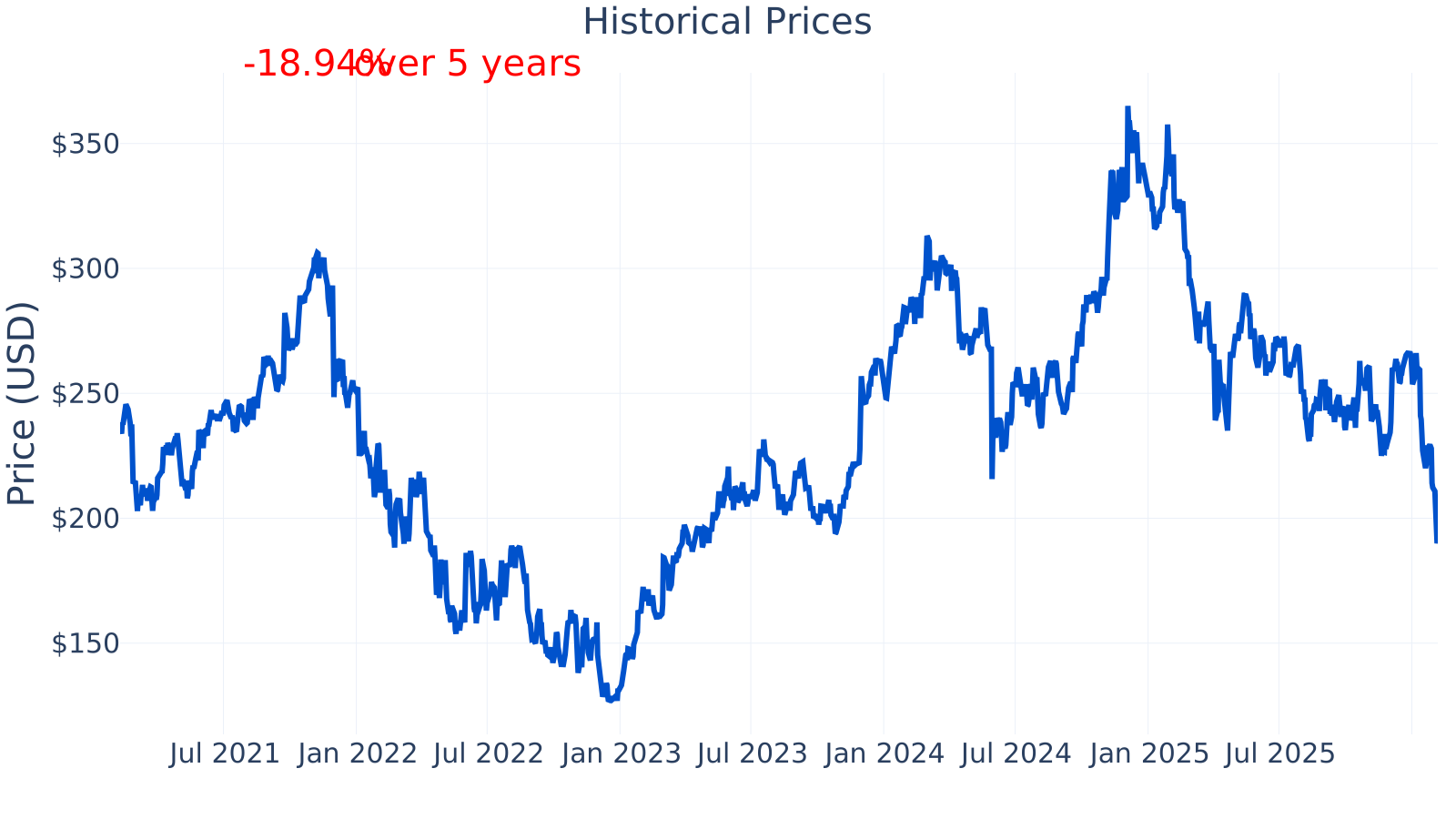
Salesforce’s market capitalization is about $182B, and the stock’s beta (~1.28) indicates it has tended to move more than the overall market. Profitability stands out versus the industry median: a ~17.9% profit margin versus an industry median of about ~6.0%. Growth is more moderate: ~8.6% year-over-year revenue growth versus an industry median around ~15.8%. Leverage appears relatively restrained with ~18.6% debt-to-equity (industry median ~25.2%). The trailing twelve-month free cash flow is about $12.9B.
Growth (Medium)
Salesforce operates in enterprise software, where organizations continue shifting core business processes to cloud-based platforms. This is a long-running trend supported by recurring subscription models and the ongoing need to integrate data across sales, service, marketing, and commerce.
Strategically, Salesforce’s approach is to provide a broad “suite” of connected applications on a shared platform, which can increase customer retention when multiple products are adopted together. For long-term growth, the company’s ability to cross-sell additional products into existing customers and expand platform usage (including analytics and automation tools) is central.
Revenue growth has been positive but has slowed versus earlier years. The year-over-year revenue growth rate declined from the mid-20% range (2021–2022) to around the high single digits more recently (about 8.6% in the latest period shown). That profile suggests a more mature scale, where growth depends more on share gains, new products, and expansions in existing accounts than on rapid market expansion alone.
Free cash flow has increased substantially over time, rising from about $5.3B (FY2022) to about $12.4B (FY2025). For a subscription software company, growing free cash flow can improve financial flexibility—such as funding product investment, absorbing economic slowdowns, and returning capital—without relying heavily on external financing.
Potential catalysts for future growth typically include broader adoption of automation and AI features within business workflows, continued platform consolidation (customers preferring fewer, more integrated vendors), and expansion of higher-value products across Salesforce’s installed base. The key question is whether new offerings increase customer value enough to accelerate net new adoption and expansions despite a slower overall growth rate.
Risks (Medium)
This article is for informational purposes only and does not constitute financial advice. Some content is AI-generated. See Disclaimer


